Caregivers SPEAK OUT! Sheria Westhoff-Eubanks
(caregiver for son, Jason Westhoff)
presented by
Donna O’Donnell Figurski

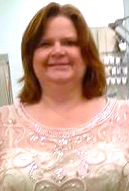
Sheria Westhoff Eubanks – Caregiver for son, Jason Westhoff
1. What is your name? (last name optional)
Sheria Westhoff-Eubanks
2. Where do you live? (city and/or state and/or country) Email? (optional)
Hendersonville, Tennessee, USA
3. What is the brain-injury survivor’s relationship to you? How old was the survivor when he/she had the brain injury? What caused your survivor’s brain injury?
The brain-injury survivor is my oldest son, Jason. He was 30 years old. He was attacked from behind.
4. On what date did you begin care for your brain-injury survivor? Were you the main caregiver? Are you now? How old were you when you began care?
On Sunday, March 11, 2012, I began to care for my son in a new way. Yes, with my husband and my ex-husband. Now we are his support. I was 51years old when my son was injured.
5. Were you caring for anyone else at that time (e.g., children, parents, etc.)?
No, we were not. Jason’s youngest sibling was in his first year of college.
6. Were you employed at the time of your survivor’s brain injury? If so, were you able to continue working?
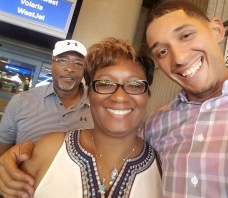
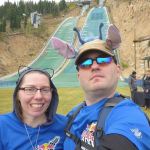
Sheria Westhoff Eubanks – Caregiver for son, Jason Westhoff with Darryl Eubanks
My husband and I were both employed at the time. We both took a leave-of-absence and temporarily relocated to Illinois.
7. Did you have any help? If so, what kind and for how long?
We were so incredibly blessed with help and support from family, friends, church members, strangers, and the wonderful doctors and staff of St. Francis Hospital. There was housing for the families of patients and transportation to and from the hospital. I think we used it for almost three months. When it was time for my son’s discharge from rehab, a good friend of my son provided us with a home to stay in – rent free. We resided there for five months. Friends and family donated money, food, gift cards, and groceries. Some spent nights with Jason, so that my husband and I could both sleep. Youth Build provided my son with money for clothing. He had lost so much weight.
8. When did your support of the survivor begin (e.g., immediately – in the hospital; when the survivor returned home; etc.)?

Jason Westhoff – Survivor of Brain Injury
Our support of Jason started immediately. He’s our child. We needed to be with him, and he needed us with him. He lived in Illinois, and my husband and I live in Tennessee.
9. Was your survivor in a coma? If so, what did you do during that time?
Jason was not in a coma when we arrived in Illinois, but in a few hours, he was. (A coma was induced for medical reasons.) While Jason was in the coma, we talked to him, touched him, loved on him, and played music. My husband read the Bible to him, and we prayed, cried, and believed God would heal him.
10. Did your survivor have rehab? If so, what kind of rehab (i.e., inpatient and/or outpatient and occupational, physical, speech, and/or other)? How long was the rehab? Where were you when your survivor was getting therapy?
Yes, Jason had inpatient and outpatient therapies. He had speech, physical, and occupational therapies. I think he had four weeks of inpatient therapies and about twelve weeks of outpatient therapies. We remained with him every step of the way – mainly my husband or I and his youngest sister.
11. What problems or disabilities of your brain-injury survivor required your care, if any?
Jason needed our care for everything but feeding himself and bathing. However, my husband had to be near the bathroom due to Jason’s issues with mobility and stability.
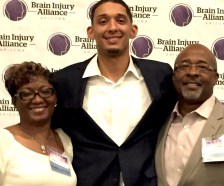
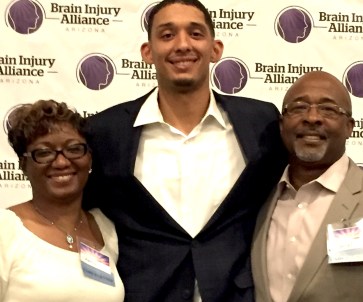
Jason Westhoff – Brain Injury Survivor with Parents, Sheria & Darryl Eubanks
12. How has your life changed since you became a caregiver? Is it better? Is it worse?
Since I’ve been a caregiver, I treasure life more. I’ve experienced a lot of anxiety. I’ve had to learn my new Jason. I really can’t characterize life as “better” or “worse.” It’s just our new normal.
13. What do you miss the most from pre-brain-injury life?
It’s not what I miss for me. It’s what I miss for my son. I miss his stamina – both physically and mentally.
14. What do you enjoy most in post-brain-injury life?
I enjoy Jason’s heart for people, his heart to help.
15. What do you like least about brain injury?
I don’t like the constant restarts.
16. Has anything helped you to accept your survivor’s brain injury?
Yes. The Fathers and Sisters at St. Francis helped me remain focused on one moment at a time. This is what it is!
17. Has your survivor’s injury affected your home life and relationships and, if so, how?
Yes, it has. We talk to Jason a lot more. We’ve had good times and bad times. I believe that our family is stronger post injury. I don’t take tomorrow for granted.
18. Has your social life been altered or changed and, if so, how?
Initially my social life was altered, but not now.
19. What are your plans? What do you expect/hope to be doing ten years from now?
Ten years from now, I will be retired and hiking in Arizona.
20. What advice would you offer other caregivers of brain-injury survivors? Do you have any other comments that you would like to add?
I would strongly advise other caregivers of brain-injury survivors to get connected with a support-group. You must take care of yourself to be able to support and care for your loved one. Take people up on their offers of help.
(Disclaimer: The views or opinions in this post are solely that of the interviewee.)
If you would like to be a part of the SPEAK OUT! project, please go to TBI SPEAK OUT! Caregiver Interview Questionnaire for a copy of the questions and the release form.
(Clip Art compliments of Bing.)
As I say after each post: Please leave a comment by clicking the blue words “Leave a Comment” below this post.
Feel free to follow my blog. Click on “Follow” on the upper right sidebar.
If you like my blog, share it with your friends. It’s easy! Click the “Share” buttons below.
If you don’t like my blog, “Share” it with your enemies. I don’t care!
Feel free to “Like” my post.

 I was knocked unconscious from the assault, and I was transported by ambulance to the hospital. The medical staff noticed the swelling, and, as a result, I was taken into emergency surgery. I had a craniotomy to relieve the swelling.


 It’s okay to lose hope sometimes. We will never be the same as before. You’ll get used to the “new you,” and you’ll be a tough, beautiful, brave individual who knows what it’s like to feel hopeless. And, that is what makes it all worth it – because you can give hope to others.
 Tell other survivors that it’s okay to be the “new you” and to not necessarily meet the status quo or the goals they were striving for before their brain injury. Tell them to just make a new game-plan and to be exceedingly thankful for the little things they previously took for granted.
 It can happen to anyone, anytime, . . . and anywhere.
 Apparently, the neurosurgeon hadn’t put things back together in an appropriate manner. So, I needed another brain surgery. It would have been hard to do if I were working full time. My wife and my friends saw me through it.

 Costas said “The reality is that this game destroys people’s brains.” Concern is growing. Some players have retired early. Participation in youth tackle football leagues is declining, as parents struggle with the rapidly emerging and compelling evidence. Costas also said “… if I had an athletically gifted 12- or 13-year-old son, I would not let him play football.” Costas’ comments were supported
  by those of ESPN’s Tony Kornheiser, who said that football is going the way of boxing. (


 A high school football team from Moncton, New Brunswick, Canada, forfeited its game after nine players left the game with possible head injuries. The coach took the precaution of having all players checked at the hospital. Before going to hospital, four players had already displayed symptoms of having a serious concussion (nausea, vomiting), and they still showed symptoms two days later when the article was written.
 It is now known that players of US and Canadian football have a




 He is back to being 100% healthy. But during the time he was sick, on the advice of the vet, I would spend several days a week visiting him. He improved so much more when I was there with him.





 Raising Awareness of Traumatic Brain Injury - one view at a time. Thanks for visiting my blog
 Surviving Traumatic Brain Injury
Recent Comments