SPEAK OUT! News Bit . . . . . Football, Brain Injury & Kids
Football, Brain Injury & Kids
presented
by
Donna O’Donnell Figurski
 Is American football a dying sport? With football’s prominence in American culture, it seems safe to assume no one would predict that its days are numbered. But, there is a growing undercurrent that may eventually lead to the demise of football as we know it. There is more and more evidence that the constant subconcussive hits experienced by football players lead to a high risk of the brain disease CTE (chronic traumatic encephalopathy). CTE can lead to early dementia,
  depression, suicidal thoughts, or problems with cognition, memory, or impulsive behavior.
Recently published by the Journal of the American Medical Association is more evidence of the enormous risk of developing CTE by playing American football. (CTE can at present only be confirmed upon studying brain tissue at autopsy, although research is being directed to finding a test that can detect CTE in the brains of living players.) A study of 202 brains of former football players was done by researchers at the VA Boston Healthcare System and Boston University. They found CTE in 87% of all the brains studied. Of the 110 brains of former professional players in the NFL (National Football League, the premier professional football league in the US), 109 (99%) showed CTE. Playing only college football did not significantly reduce the risk of having CTE, which was found in 91% of the brains of former college players. Playing less football did seem to lower the risk. Only 27% of the brains of former players who played through high school, but no further, showed evidence of CTE. Also, the severity of CTE was probably less with less playing time.
 The results have important implications for players. Many players feel they’ve been left ignorant of the risks of brain injury by the NFL, or worse, assured by the league that there is minimal risk. [Some players have quit or retired early (1, 2). Recently, a class-action lawsuit about concussions brought by former players against the NFL was settled for $1 billion.] The NFL has argued, and most players and fans who know about CTE believe, that the brains being studied are biased toward CTE because the autopsied brains in large part are from players already suspected of having a brain injury. Dr. Ann McKee, a Boston University researcher who has examined many of the brains, has stated that the results are staggering even for a biased sample (go to 1:35:58 in the video). She has stated, “It is no longer debatable whether or not there is a problem in football; there is a problem.”
Evidence of any CTE in high school football players is particularly disturbing (go to 1:29:08 in the video). Parents have taken note. Even though the NFL is actively promoting football directly to children, enrollment in youth football leagues is significantly down. Dr. Bennet Omalu, who discovered CTE by studying the brain of Mike Webster, the  famous Pittsburgh Steeler Center, wrote an Op-Ed in the New York Times titled “Don’t Let Kids Play Football.” During my radio interview of George Visger, a former lineman for the NFL’s San Francisco 49ers who had to quit the game because of a brain injury, he speculated that the preeminence of football in American society will disappear because the NFL’s talent pool will dry up. He speculates that the cost of liability insurance will be too high for youth football leagues to pay (go to 30 minutes into my interview of him).
There is no doubt that American football is exciting to watch, and there are many benefits to playing such a demanding team sport. But, difficult as it is to believe, it seems likely that the high risk of brain injury will eventually end the game.
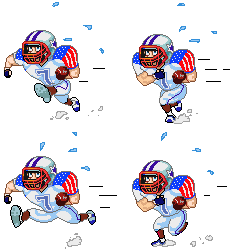
(Clip Art compliments of Bing.)
As I say after each post: Please leave a comment by clicking the blue words “Leave a Comment” below this post.
Feel free to follow my blog. Click on “Follow” on the upper right sidebar.
If you like my blog, share it (intact) with your friends. It’s easy! Click the “Share” buttons below.
If you don’t like my blog, “Share” it (intact) with your enemies. I don’t care!
Feel free to “Like” my post.


 19. What are your plans? What do you expect/hope to be doing ten years from now?
 Maria asked me a few days ago where the Kitchen Aid mixer was. I told her it was in the pantry. The next day – there it was on the counter. Maria asked daughter Samantha to pick up the ingredients to make fruit salad. I told her we would make fruit salad over the weekend, but there never was time to do it.


 SPEAK OUT! Itty-Bitty Giant Steps will provide a venue for brain-injury survivors and caregivers to shout out their accomplishments of the week.


 Originally, she was going to drive us back when it became dark. However, when we left the venue, I said I could drive – and I did! All the huzzahs!

 Yes! I lost my home, my job, and my independence. I live with family now. I do have my own room with space, but I’m not used to cooking for others or depending on others to provide for me when I did everything before. I feel like my family tiptoes around me and treats me like a fragile bird. I’m not! I can still do most things. Let me prove myself. If I don’t succeed, then maybe you can help me the next time.
 It will take time to accept the new you. Find something you like, and keep doing it. Or, try something you’ve never done before, like work out regularly. I was not a fan of the gym, but I made myself go three days a week. After a month, it became routine, and now I look forward to it. My personal trainer pushes me, and I find myself looking for ways to improve to show her the next time. I have more energy, and I am happy when I accomplish things I couldn’t do six weeks ago. That’s a great feeling! Even if it takes me longer to do it, the satisfaction is still there.
 It can happen to anyone, anytime, . . . and anywhere.
 Valentine’s Day 2010 would turn into a complete game-changer – a day we will never forget. It’s a day I’ve documented so, if the day comes when my memory is gone, I can always reflect back on God’s goodness and mercy. Following is my account of the night we were poisoned. God provided the most beautiful second chance.


 My memory is horrible at times, and I’ve lost so many precious memories. Taylor and I have a routine when it comes to trying to remember things. We just look at each other and ask, “Did we have fun?” The one who remembers says to the other, “Yes, we had fun!” That’s all that matters.
 NOTE 1:

 12. What do you enjoy most in your post-brain-injury life?
 18. What are your plans? What do you expect/hope to be doing ten years from now?

 I went to the Emergency Room after a week, because of shortness of breath and cognitive issues. They found an enlarged lymph node in my lung. This finding was followed up by other specialists. I had MRIs (magnetic resonance imaging), an EEG (electroencephalogram), a SPECT (single-photon emission computed tomography) scan (a test that uses a radioactive substance and a special camera to determine how an organ is functioning), and other tests, to name a few.

 to learn, but which you wished you had known earlier? If so, please state what it is to potentially help other survivors with your specific kind of brain injury.







 Raising Awareness of Traumatic Brain Injury - one view at a time. Thanks for visiting my blog
 Surviving Traumatic Brain Injury
Recent Comments