So, Whaddya Think? . . . . . . . . . Do Motorcycle Helmets Protect the Brain?
So, Whaddya Think?
Do Motorcycle Helmets Protect the Brain?
by
David H. Figurski, Ph.D
presented by
Donna O’Donnell Figurski
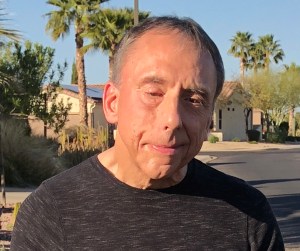
David H. Figurski, Ph.D. survivor of brain injury
Whether or not motorcycle helmets reduce head injuries is a topic that is highly controversial. Witness the fact that some states have motorcycle helmet laws while others don’t.
Clearly, helmets do not prevent all brain injuries. Former National Football League lineman George Visger (San Francisco 49ers), who’s a survivor of a football-induced brain injury, worries about the false sense of security that helmets can engender. (Listen to minutes 12:00-14:00 of Donna’s August 16, 2015, interview of him.)
On the positive side, many people believe motorcycle helmets can reduce minor head injuries and thereby mitigate or even prevent some brain injuries. I am staunchly pro-helmet in my viewpoint, but I am also realistic about how protective a helmet actually is. Recently, I encountered someone who is an adamant proponent of the anti-helmet viewpoint. Here’s what happened.
Donna and I recently attended a lecture by Carrie Collins-Fadell, Executive Director of the Brain Injury Alliance of Arizona (BIAAZ), on the basics of brain injury and the work of the organization. At one point, I asked Carrie if BIAAZ had an official position on motorcycle helmet laws. (Arizona currently has no such law.) Given the current debate, her unsurprising answer was that it does not.
I’m a firm believer in helmets because one saved my face and possibly prevented a serious brain injury. I loved my bike, and, like most riders feel about their riding ability, I considered myself to be competent, alert, and safety-conscious. But, my bike was totaled in an accident that was not my fault.
As I rounded a bend in the Catskill Mountains of southern New York one Sunday morning, I encountered a massive oil spill that was left on the road by an emergency car repair. My tires lost their grip, my bike and I went down, and my bike ended up underneath on oncoming car. Fortunately, I was thrown from my bike and ended up down the road. (The hysterical driver thought I was still with my bike underneath her car.)
The point of this story is that I was wearing the best full-face helmet I could buy. I hit face-first. I know that because the chin-bar on my helmet was ground down from the road. Because of that helmet, I was able to walk away – although with some road-rash. I hate to think what would have happened to me if I had not been wearing that helmet.
 I told Carrie that I was in favor of helmet laws. But, another member of the audience took issue with me and presented the opposing view. “The only reason I would wear a helmet is if a law required me to.” We had a short discussion about our opposing beliefs. There are valid arguments for both opinions, and I know much more could have been said. But, I was mindful of the time, and I suspected Carrie was eager to get back to her talk. (I know Donna was happy I ended quickly!)
Both of us made valid points. I’d like to address comments that were stated and what could have been said.
The audience-member argued that a helmet adds possibly dangerous weight to a rider’s head. This is a valid point.
Helmets can add up to 5 pounds to the head, and that extra weight can endanger the neck, with consequences for the brain and/or spine. (Professional race-drivers are well aware of this danger. I raced cars at the amateur level, and, again, I considered myself to be safety-conscious, although Donna thought that racing cars at all was a strange way to show it! Nevertheless, I was the first driver in the group to use a HANS device – a carbon-fiber collar that’s held tight by the safety harness. The point is that the weight of the head and helmet is somewhat counteracted by tethering the helmet to the device. There is evidence showing that the reduction in the number and/or force of head impacts by a HANS device is protective.)
The audience-member also argued that a full-face helmet cuts down on peripheral vision. I completely agree that good peripheral vision is really important for safe riding. I adamantly disagreed with the statement, however, that a full-face helmet interferes with peripheral vision, but I didn’t take the time to give my reasons for believing that way.
It’s true that old full-face helmets have small eye-ports and restrict peripheral vision. But, many modern full-face helmets have wide eye-ports so peripheral vision is not restricted. That was a consideration when I purchased my helmets for motorcycling and car racing.
Another point the audience-member made was that a helmet does nothing to protect the brain in a serious accident and, as was noted above, may make neck injury more likely. I agree that helmets are not protective in a major accident. I know of a rider who was killed while wearing a good helmet.
A helmet will not protect the brain in a catastrophic accident, but a helmet might reduce the severity of a brain injury in a minor accident. A slight impact of the head in a highly-cushioned helmet may lead to no brain injury at all or to a less severe brain injury. But, a slight impact of a helmetless head could lead to a serious brain injury or even be fatal.
The audience-member also mentioned that he’s been riding 40 years without a helmet. I congratulate him for the accomplishment of never having had a serious accident. I too thought I would ride my bike for many years. But, unexpected things happen. One such incident happened to me. It’s why some of us wear safety gear.
The audience-member and I ended by agreeing on a point. We both understand that, during a serious impact, no helmet can protect the jelly-like brain, which exists inside a hard skull.
I understand there is considerable joy in riding totally free and unencumbered. Motorcycles are about freedom, and the principle of individual freedom is paramo unt for some people. Those of us who wear safety gear are concerned with the significant risk of riding with the lack of precautions. We still experience the feeling of the impressive freedom that comes from riding a motorcycle – just a bit less.
As I say after each post:
Feel free to leave a comment by clicking the blue words “Leave a Comment” below this post.
Please follow my blog. Click on “Follow Me Via eMail” on the right sidebar of your screen.
If you like my blog, click the “Like” button under this post.
If you REALLY like my blog, share it intact with your friends. It’s easy! Click the “Share” buttons below.
If you don’t like my blog, “Share” it intact with your enemies. That works for me too!
(Clip Art compliments of Bing.)
(Photos compliments of contributor)


 The main issues I struggled with right away were visual issues. I had a problem with depth perception, and, because of that, I couldn’t walk for several days – I could only walk a few steps at a time. For the next several months, I also had to work on reading and anything else that required visual comprehension.
 headstands (it sounds obvious now but caught me completely off guard at the time), it was the first time I really, truly wept. Like, I’ve been through so much, and now I can’t even do this ONE THING that brings me so much joy and makes me feel like a beast!



 16. Has anything helped you to accept your survivor’s brain injury?
 YAY! I am one of ten finalists for the 2019 Caregiving Visionary
  Award, so I’m still in the running. A great big THANK YOU to all who voted for me. Your votes helped immensely. YOU made this happen and I am so honored to be a finalist. Winners will be announced March 1st.


 caregivers who stand out in their caregiver world. Now frankly, I think all caregivers deserve this award, but, alas, only five will be chosen, and I hope I am one of them. David thinks I should be too. He nominated me.


 of ice and flew up into the air, landed on my back, and then hit the back of my head on the concrete. I still remember that awful “Crunch” sound.

 My wife is my main caregiver. She is amazing, and I would be lost without her love and support. She is my rock. I know the things to do as a caregiver, but I also know how hard it can be.


 8. When did your support of the survivor begin (e.g., immediately – in the hospital; when the survivor returned home; etc.)?
 Take care of yourself.

 No! With a huge grin, I answered, “Yes!”
 The Ivy League colleges have done an experiment that dramatically reduced the number of concussions during a kickoff, considered to be the most dangerous play in American football. The results were reported in the Journal of the American Medical Association. The results were so dramatic that the NCAA (National Collegiate Athletic Association) changed kickoff rules for its college games in 2018 after considering the Ivy League data. It is likely to be considering adopting the Ivy League rule change for all NCAA college football.
 and the defensive teams often have the time and space to build up speed before a tackle is made. Kickoffs account for about 6% of the plays in a football season, but they are responsible for 21% of the concussions. The NFL (National Football league), which sanctions the most prominent professional football, considered doing away with the kickoff altogether. In 2016, the coaches of the Ivy League college teams agreed to an experiment that minimized the runback by moving up the kickoff line 5 yards from the 35-yard line to the 40-yard line. This change led to more touchbacks, where the ball is kicked into or beyond the end zone. As a result, there were fewer runbacks.


 Raising Awareness of Traumatic Brain Injury - one view at a time. Thanks for visiting my blog
 Surviving Traumatic Brain Injury
Recent Comments