TBI – Survivors, Caregivers, Family, and Friends

Posts tagged ‘Traumatic Brain Injury Survivor’

SPEAK OUT! . . . . . . . . . . . . . . . . . Faces of Brain Injury . . . Alexis Turcotte

SPEAK OUT! Faces of Brain Injury – Alexis Turcotte

presented by

Donna O’Donnell Figurski

 Brain Injury is NOT Discriminating!

bigstock-cartoon-face-vector-people-25671746-e1348136261718

It can happen to anyone, anytime, . . . and anywhere.

The Brain Trauma Foundation states that there are 5.3 million people in the United States living with some form of brain injury.

On “Faces of Brain Injury,” you will meet survivors living with brain injury. I hope that their stories will help you to understand the serious implications and complications of brain injury.

The stories on SPEAK OUT! Faces of Brain Injury are published with the permission of the survivor or designated caregiver.

If you would like your story to be published, please send a short account and two photos to me at neelyf@aol.com. I’d love to publish your story and raise awareness for Brain Injury.

0092415 Alexis Turcotte Survivor 1Alexis Turcotte (survivor)

So many people ask me how I can be so positive after all that I’ve been through. Well, the answer is that I’m not going to dwell on the crash. I don’t say, “I almost died, so I’m going to sit here and be worthless.” Instead, I’m going to show that I’m better than all the labels I’ve been given. So many people have said, “Oh well, since your hospital papers say … then you can’t do ….” My response has always been, “Can I please prove you wrong before you say I can’t do it?” I make an effort to change the negative to a positive. Why? Because there’s so much to be positive about – so much to be grateful for.

092415 Alexis Turcotte Survivor 2
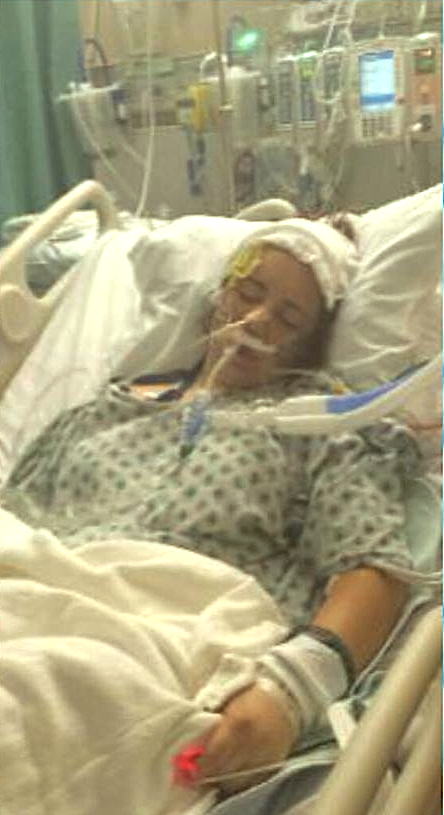
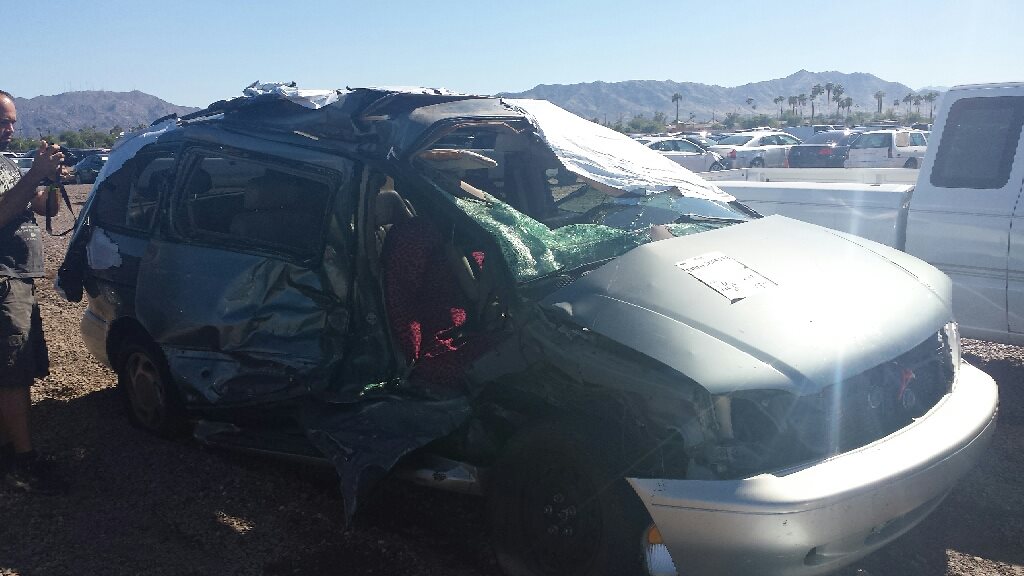
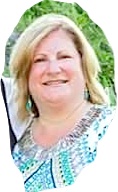
For crying out loud, I was given a second chance to live! The crash happened two days after my birthday. (One photo is from my birthday. I’m uninjured. The other is of me in the hospital in a coma.) I was in the passenger seat of the vehicle. The firefighters had to cut the door off to get to me, since I was unconscious at the scene. My skull was fractured in two places; my left foot was shattered; my left leg was broken in half (the bone was sticking out); and my nose, jaw, left shoulder, and pelvis were broken. The firefighters were told that I wouldn’t make it. The crash happened September 20, 2014. I awakened from the coma in late October, and I left the hospital on December 4.
I was told by doctors not to return to school, but I wanted to go back. I did return on January 5. I continued my courses, including my college-prep course and my two AP (advanced placement) courses. I earned As in all but one of my courses. I was also told that I wouldn’t graduate on time, but I pushed myself to do so with hours of online schooling to make up for the semester of school I missed. I wanted to show that, just because I have a label, I’m not a nothing.
I am good now. I’m still in pain due to the screws restricting my foot, but soon my doctor will remove them. Then I should be able to work out and run again. I also want to return to my team in girls’ flag football. (My coach will only allow me to play if I get written consent from my doctor and a parent. My doctor said I should be OK to play in six months.)

11734112_1057605137584263_505801146_oMy story shows that miracles do happen.

(Clip Art compliments of Bing.)

(Photos compliments of contributor.)

As I say after each post: Please leave a comment by clicking the blue words “Leave a Commentanim0014-1_e0-1 below this post.

Feel free to follow my blog. Click on “Follow” on the upper right sidebar.

If you like my blog, share it with your friends. It’s easy! Click the “Share” buttons below.

If you don’t like my blog, “Share” it with your enemies. I don’t care!

Feel free to “Like” my post.

Survivors SPEAK OUT! . . . . . Debra Cody

Survivors SPEAK OUT! Debra Cody

presented

by

Donna O’Donnell Figurski

Deb Cody Post accident1. What is your name? (last name optional)

Debra Cody

2. Where do you live? (city and/or state and/or country) Email (optional)

Ailsa Craig, Ontario, Canada     debcody63@gmail.com

3. On what date did you have your brain injury? At what age?

I was 47 when I was diagnosed, but I was 42 when I had my first concussion.

4. How did your brain injury occur?

I suffered four concussions over a five-year span.

5. When did you (or someone) first realize you had a problem?

It was clear I had a problem about four months after my last concussion in 2010, but my mother and my husband say they noticed a difference in me about two years before that.

6. What kind of emergency treatment, if any, did you have?

I was assessed in the Emergency Room after the first, second, and fourth concussions. I was always told to go home and rest for a couple weeks for the concussion. I opted not to go to the hospital after the third one because I knew I would just be told to go home and rest. For the fourth one (after the car accident), I was taken to the hospital by ambulance, as the concussion (according to the doctor) was “the least of my worries.” I had other injuries that needed surgery, a tracheotomy, and a G-PEG (gastric tube that leads directly to the stomach for feeding).

7. Were you in a coma? If so, how long?

No

8. Did you do rehab? What kind of rehab (i.e., inpatient or outpatient and occupational and/or physical and/or speech and/or other)?

Yes. I was in an outpatient treatment program.

How long were you in rehab?

I have been in the program for three years now.

9. What problems or disabilities, if any, resulted from your brain injury
(e.g., balance, perception, personality, etc.)?

I have headaches. I tire easily. My personality was affected. I have issues with perception, hearing, anxiety, depression, confusion, and vertigo.

10. How has your life changed? Is it better? Is it worse?

I like to say that “life is my oyster and my brain injury is the pearl.” My life started out as worse, but it has slowly gotten better. My life is quieter now. I am less socially active than I was before, but I am finding (TBI). I am careful about how I choose to spend my time, as I have so little “functioning” time to spend.

11. What do you miss the most from your pre-brain-injury life?

“Me”

12. What do you enjoy most in your post-brain-injury life?

I enjoy having the awareness of how valuable time truly is.

13. What do you like least about your brain injury?

My limitations

14. Has anything helped you to accept your brain injury?

Counseling and the love and support of my husband and children have helped me to accept my TBI.

15. Has your injury affected your home life and relationships and, if so, how?

My home is quieter, and we have gotten rid of a lot of things. I get over-stimulated easily, so we streamlined our home. My relationships have changed greatly. There are fewer people in my life – I found that family and friends stopped coming around and calling. Slowly, over that past eight months, I am seeing some of “The Lost” coming back. Over all, people found the changes in me hard to understand and accept.

16. Has your social life been altered or changed and, if so, how?

I go out less, and I am careful about the events I attend. It takes a lot of planning and preparation for me to go somewhere. The spontaneity is gone from my life.

17. Who is your main caregiver? Do you understand what it takes to be a caregiver?

My husband is my main caregiver. I don’t go far without him. I truly do understand what it takes to be a caregiver. (It helps the understanding that I am the mother of four children.)

18. What are your plans? What do you expect/hope to be doing ten years from now?

My plans are to keep moving forward. I look back to where I was four years ago, and I know that I never want to go back there. The only way to prevent that is to keep “getting better.” As for ten years from now, I don’t know. I have become a “one-day-at-a-time” person. What I can say is that I hope to see that I have been able to reclaim some of my independence.

19. Are you able to provide a helpful hint that may have taken you a long time to learn, but which you wished you had known earlier? If so, please state what it is to potentially help other survivors with your specific kind of brain injury.

My advice is to be gentle with yourself. I lost a lot of time trying to “force” myself to be who I once was.

20. What advice would you offer to other brain-injury survivors? Do you have any other comments that you would like to add?Deb Cody Pre accident

Planning, preparation, and pacing are huge in my life now. On days when I think I am “Superman” and can “fly” by the seat of my pants, the “kryptonite” (my brain injury) “defeats” me every time! The three things above will make your life so much easier. Look for something good in every day. Remember to celebrate your accomplishments, no matter how small they may seem to others. And, be gentle with yourself. It takes time to create something as amazing as you are going to be!


(Disclaimer: The views or opinions in this post are solely that of the interviewee.)

If you would like to be a part of the SPEAK OUT! project, please go to TBI Survivor Interview Questionnaire for a copy of the questions and the release form.

(Clip Art compliments of Bing.)

(Photos compliments of contributor.)

As I say after each post: Please leave a comment by clicking the blue words “Leave a Commentanim0014-1_e0-1 below this post.

Feel free to follow my blog. Click on “Follow” on the upper right sidebar.

If you like my blog, share it with your friends. It’s easy! Click the “Share” buttons below.

If you don’t like my blog, “Share” it with your enemies. I don’t care!

Feel free to “Like” my post.

About Me and My Blog!

SPEAK OUT! for Brain Injury 

Donna O’Donnell Figurski

Writer, Blogger, Radio Host, Speaker
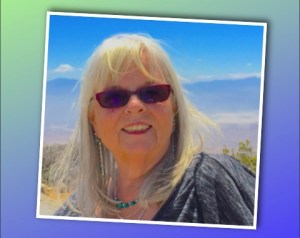
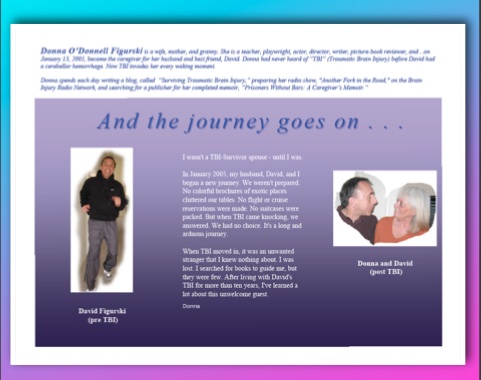
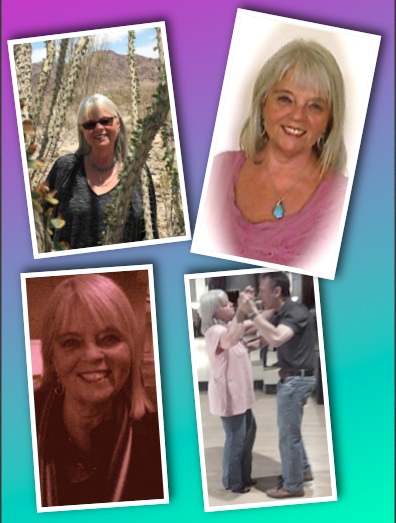
1 Donna Featured PhotoWRITER

My completed memoir, “Prisoners Without Bars: A Caregiver’s Story,” starts the minute my husband, David, had his brain injury. He was exercising. He did one more chin-up than his normal twelve. That dreaded thirteenth changed our lives forever. The story carries the reader through three unwanted brain surgeries – none of which David was expected to survive and which reduced him to an infantile state. “Prisoners Without Bars: A Caregiver’s Story” portrays David’s first eighteen months of struggles through recovery, therapy, and rehabilitation, while heralding his strength and persistence. I have included an epilogue to bring the reader up to date on David’s recovery and David added his flair to the story and his personal touch by writing the afterword. “Prisoners Without Bars: A Caregiver’s Story,” documents my dedication to helping David recover and details how we picked up the pieces and glued our lives back together. The story will make you laugh. No – brain injury is not funny, but life without humor during recovery from brain injury would be unbearable. It will also make you cry. No doubt! But, mostly it will offer hope to brain-injured survivors, their caregivers, and their family and friends. “Prisoners Without Bars: A Caregiver’s Story” is my completed memoir currently searching for an agent

I have four stories published for children in three books with Scholastic in their Education Department. Also, three biographies about notable Native Americans are scheduled for publication in two anthologies in early 2016.

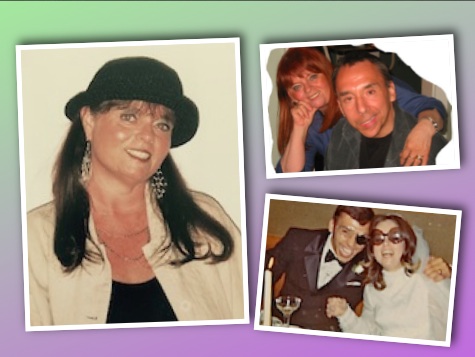
BLOGGER2 Donna Collage

My blog, Surviving Traumatic Brain Injury, was the brainchild born from my realizing how many people are living with brain injury. At least 5.3 million people, just in the United States alone, are affected by brain injury. That is an astounding number! After being a part of this huge community for almost ten years, I knew I had to raise my voice, and I realized I could use my writing skills to reach a large audience.  Social media was not yet a part of folks’ lives when David had his brain injury, so we invented our own wheel. But now, with so many social media sites where brain-injury survivors, their caregivers, and their family and friends can search for information, I felt it was senseless for them to invent their own wheels. I wanted to help. The blog began with the Survivors SPEAK OUT! interviews, which gave survivors a voice, using my blog as their stage. That venue became hugely successful, and soon the Caregivers SPEAK OUT! interviews evolved. Soon after, many more categories followed as I saw a demand for them. The categories are listed below with a brief description.

BLOG CATEGORY DESCRIPTIONS3 Donna Collage

Brain Injury Resources

The Brain Injury Resources category houses various informational topics, including books, movies, documentaries, facts, and research about brain injury.

Caregivers SPEAK OUT! Interviews

Read interviews from caregivers of brain-injured survivors. If you are a caregiver, this is where you can tell your side of the story. Look for the Caregivers SPEAK OUT! Questionnaire below.

 Caregivers SPEAK OUT! Questionnaire

This is the Caregiver Questionnaire. It’s easy – just fill out the 20-question template. (All the directions are on the page.)4 Donna Collage
SPEAK OUT! Faces of Brain Injury

Meet brain-injured survivors and their caregivers on “Faces of Brain Injury.” Their candid and heart-wrenching stories will help readers understand the serious implications and complications of living with brain injury.

 If you’d like to share your story on “Faces of Brain Injury,” please send it to me at neelyf@aol.com. I’d be happy to consider it. (Please put “Faces of Brain Injury” in the subject line.)

 SPEAK OUT! Guest Bloggers

Everyone has a story. In this section, Guest Bloggers can SPEAK OUT! about topics relevant to brain injury and special to them.

 If you have a Guest Blog you’d like to share, please contact me at neelyf@aol.com. I’d be happy to consider it. (Please put Guest Blogger in the subject line.)

SPEAK OUT! Itty-Bitty GIANT Steps

When you are living with a brain injury, no accomplishment is too small. ibGs provides a platform for brain-injury survivors and their caregivers to shout out their BIGGEST (or smallest) recent accomplishment. Share yours now!

Send it to me at neelyf@aol.com. I’d be happy to consider it. (Please put Itty-Bitty GIANT Step in the subject line.)

My Book: “Prisoners Without Bars: A Caregiver’s Story”

You can read about my book under “Writer” above.

SPEAK OUT! NewsBits

NewsBits is the place to go to find out the latest in the news about brain injury. 5 Donna Collage(Well, it was the “latest” when I published it. I’m sure it’s still interesting, though.)
On The Air: Brain Injury Radio “Another Fork in the Road” 

My radio show, “Another Fork in the Road,” airs the first and third Sundays of each month at 5:30pm Pacific Time. The show features brain-injury survivors and/or their caregivers. It also delves into the problems and issues that survivors and caregivers live with each day. Professionals, including therapists, are also interviewed on the show. If you can’t tune in to the live show, don’t fret. You can listen to the show anytime. It’s archived. Just find the show you want to hear and click the link. (“On The Air Show Menu” in the sidebar of my blog has a list of all my shows and provides their links.)

On the Air! Show Menu

This is the place to go if you are looking for a great show about brain injury. All of my shows are listed here with a link that will carry you directly to the station to listen. So, sit back, relax, and learn.6 Donna Collage
So, Whaddya Think?

Is there something you are passionate about in this brain-injury world? Do you want to be heard? Your opinion matters! You can SPEAK OUT! on “So, Whaddya Think?

Send your opinion piece to me at neelyf@aol.com. I’d be happy to consider it. (Please put So, Whaddya Think? in the subject line.)

Survivors SPEAK OUT! Interviews

Read interviews from brain-injured survivors from all walks of life. Brain injury is NOT discriminating. If you are a brain-injured survivor, this is where you can tell your side of the story. I’d be happy to consider it. Look for the Questionnaire Template below.

Survivors SPEAK OUT! Questionnaire

This is the Survivor Questionnaire. It’s easy! Just fill out the 20-question template. (All the directions are on the page.)

TBI Tales7 Donna Collage

The stories that are shared here by a variety of survivors and caregivers will make you laugh and cry – sometimes at the same time. They may delight you or they may shock you, but I can guarantee that the stories will offer you courage and hope.

If you have a TBI Tale you’d like to share, please contact me at neelyf@aol.com. I’d be happy to consider it. (Please put TBI Tale in the subject line.)

and Explore More …
You’re just going to have to click to find out. Go ahead! You know you want to.

RADIO HOST

Becoming a radio host had never entered my mind and may be just about the biggest surprise in my life. When I was approached to join the Brain Injury Radio Network on blogtalk radio, I was hesitant. Probably more like…are you kidding me? It took some convincing and a lot of soul-searching before I said, “Yes.”

I wondered what skills I had for this job, and I began to think – always dangerous. I had been a teacher for more than three decades, entertaining my audience of more than four hundred six- to eight-year-olds – teasing them into learning to “read, ‘rite, and do ‘rithmetic.” Believe me, teachers nearly stand on their heads to keep their little “twerpsters” entertained – a must, if you are going to keep their attention.8 Donna Collage

I am also in the theater and periodically climb onto the stage to cavort with other actors in front of hundreds of play-goers, so I thought maybe this radio-host thing might work. After all, if I can speak in front of hundreds of people who are directly in front of me, speaking to thousands of invisible listeners should be a cinch. So, yes, I decided to join the network.

Well, it’s not a cinch, and I still get the butterflies before each show, but as soon as my intro music plays, I am in the zone. My 80-minute show flies by, and when I invite my audience to tune in again in two weeks and the mics shut down, I savor the satisfaction of a job well done.

Since I’ve lived in the brain-injury world for more than ten years as the caregiver for my husband, David, I’ve learned a lot and was eager to share my knowledge with others. I’ve been with the network for more than a year now, and I have hosted more than twenty-seven shows.

You can listen to my radio show, “Another Fork in the Road,” on the Brain Injury Radio Network. My show airs the first and third Sundays of each month at 5:30pm Pacific Time. On my 80-minute show, I interview guests in the brain-injury world, including survivors and/or their caregivers, delving into their lives to better understand how they cope with daily living after brain injury. I invite folks from the medical professions, such as therapists, who are willing to offer suggestions and hope to survivors. I talk with folks in brain-injury communities, such as troops from the combat zones of recent wars and athletes from the battlegrounds of the playing fields. I address many topics pertinent to brain injury with my panel of brain-injury survivors and caregivers.

Tune in! Click on Brain Injury Radio and look for “Upcoming Broadcasts.” (My show will be advertised about two days before the first or third Sunday of each month.)

You can listen to the shows anytime. They’re archived. Just click on On the Air! Show Menu on my blog. See you “On the Air!”

SPEAKER9 Donna Collage

If you’ve read the section above about my being a radio host, you will already understand why I have chosen to become a spokesperson for brain injury. Though brain injury has been around for forever, it seems that it is finally coming to the forefront as our troops arrive home with traumatic brain injury – what the world is calling the “signature” wound of the Iraq and Afghanistan wars. Recently too, there is a lot of attention to the head traumas that many football players have received, resulting in serious repercussions for them, such as memory loss, unrestrained anger, and even early dementia. Sadly, many players have completely lost hope and have resorted to suicide. Of course, with the baby boomers reaching their “golden” years (and some not so golden), they are finding that many of them and their loved ones are requiring caregivers in their lives simply to manage day-to-day living. And that’s where I come in. With my knowledge and experience of being a caregiver for my husband, David, for more than ten years, I have learned a fair bit and would like to share my knowledge to help others.

Need a speaker? My 90-minute PowerPoint Presentation, “What Caregivers Need to Know,” is for anyone with a brain injury, anyone who is caring for a brain-injured person, or anyone with any interest in learning more about brain injury. For details or to schedule me for your event, please contact me at neelyf@aol.com.

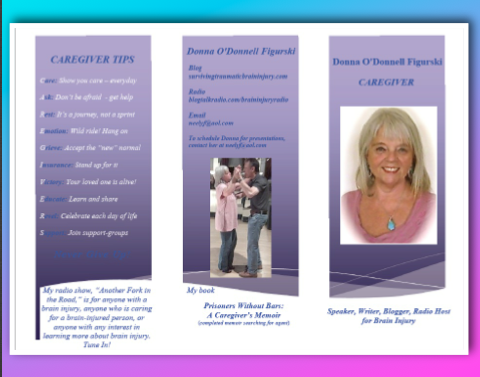
Below is my brochure.

Click on photos to enlarge.

10 Brochure 111 Brochure 2

SPEAK OUT! . . . . . . . . . . . . . . . . . Faces of Brain Injury . . . Marc Tima

SPEAK OUT! Faces of Brain Injury – Marc Tima

presented by

Donna O’Donnell Figurski

 Brain Injury is NOT Discriminating!

bigstock-cartoon-face-vector-people-25671746-e1348136261718

It can happen to anyone, anytime, . . . and anywhere.

The Brain Trauma Foundation states that there are 5.3 million people in the United States living with some form of brain injury.

On “Faces of Brain Injury,” you will meet survivors living with brain injury. I hope that their stories will help you to understand the serious implications and complications of brain injury.

The stories on SPEAK OUT! Faces of Brain Injury are published with the permission of the survivor or designated caregiver.

If you would like your story to be published, please send a short account and two photos to me at neelyf@aol.com. I’d love to publish your story and raise awareness for Brain Injury.

Marc Tima (survivor)

Marc Tima 1 Survivor 090715Traumatic brain injury (TBI) is a crazy, life-changing event. When I was fourteen years old, I was in a pretty bad car accident, in which I suffered a TBI. I was life-flighted to Allegheny General Hospital in Pittsburgh. I was in a coma for about three weeks. My doctors prepared my parents for my remaining in a vegetative state. God, my family, and I had other plans. At one point, the doctor told my parents that if she were a betting woman, she would not bet on my chances. My mother was in tears and began to weep. My father, on the other hand, said, “I’ll take that bet, and my son will prove you wrong.”

I spent three months in the Rehabilitation Institute of Pittsburgh. After my rehab, I was barely able to start my tenth-grade year of high school. Instead of getting As and Bs like I used to, I scraped by with Cs and Ds. During my coma, my entire body atrophied. Instead of being a top football and basketball player, I was made a team manager for football and basketball. I spent much of high school crying because of my shortcomings. But, I cried to myself in my room. I also spent every free second I had working out and getting stronger. By my junior year, I was able to get back on the football team. My coaches were worried about my getting injured again, so they would not let me play in the varsity games. I spent my eleventh-grade football career on the scrub team. During practice, I would outplay all the seniors who were able to play varsity. My grades were still very poor, but my short-term memory was improving little by little. By the time I was a senior, I was a starter for football and a top defensive player in western Pennsylvania. My grades were still poor, but they were improving. I got recruited to play football for Duquesne University. Though my high school grades were poor, they let me into Duquesne Marc Tima 2 Survivor 090715because of my football and some heavy pleading from my mother.

Anyway, the hits in college football were too hard for my head. So, I had to give up football. I stayed at Duquesne, though, and earned my degree. I worked extremely hard in high school to earn Cs and Ds. At Duquesne, I worked just as hard, but now I was getting As and Bs. In fact, when I graduated from Duquesne on the Dean’s List, my parents contacted that doctor who bet against my father on my recovery. He showed her my academic record at Duquesne. And, she took my parents out to dinner as payment for losing the bet she made with my dad.

I now have a Master’s degree in Exercise Science, own an “Anytime Fitness” in Ohio, and am a personal trainer. Several of my clients are TBI survivors, whom I help with their recoveries.

(Clip Art compliments of Bing.)

(Photos compliments of contributor.)

As I say after each post: Please leave a comment by clicking the blue words “Leave a Commentanim0014-1_e0-1 below this post.

Feel free to follow my blog. Click on “Follow” on the upper right sidebar.

If you like my blog, share it with your friends. It’s easy! Click the “Share” buttons below.

If you don’t like my blog, “Share” it with your enemies. I don’t care!

Feel free to “Like” my post.

SPEAK OUT! . . . . . . . . . . . . . . . . . Faces of Brain Injury . . . . . . . . . Shanna Wolf Heart Powell

SPEAK OUT! Faces of Brain Injury – Shanna Wolf Heart Powell

presented by

Donna O’Donnell Figurski

 Brain Injury is NOT Discriminating!

bigstock-cartoon-face-vector-people-25671746-e1348136261718

It can happen to anyone, anytime, . . . and anywhere.

The Brain Trauma Foundation states that there are 5.3 million people in the United States living with some form of brain injury.

On “Faces of Brain Injury,” you will meet survivors living with brain injury. I hope that their stories will help you to understand the serious implications and complications of brain injury.

The stories on SPEAK OUT! Faces of Brain Injury are published with the permission of the survivor or designated caregiver.

If you would like your story to be published, please send a short account and two photos to me at neelyf@aol.com. I’d love to publish your story and raise awareness for Brain Injury.

Shanna Wolf Heart Powell (survivor)

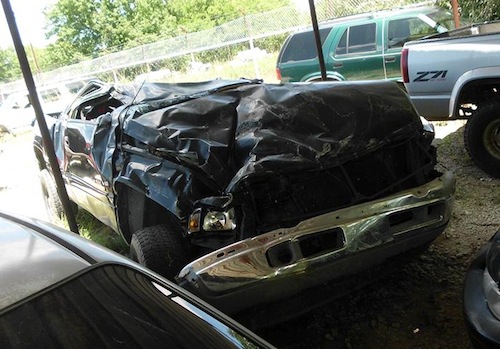
Powell, Shanna Wolf Heart Survivor 062715 3This was me three years ago. I was in this truck when it flipped and rolled at 60 mph. I had a shattered face and a shattered shoulder. And, I spent some time in a coma. This was the final nail – the one that pushed my PTSD (post-traumatic stress disorder) into full mode and gave me a TBI (traumatic brain injury). I am not the same me. I am the “new” me. God chose me to still be here. I see it too many times – people are in wrecks and they don’t make it. Powell, Shanna Wolf Heart Survivor 062715 2My survival just makes me even more thankful. (I now make a horrible passenger, as every time the driver swerves, a car looks like it’s going to hit us, or it appears that it is not going to stop, I freak out.) I forget things a lot. I loose what I am saying in the middle of a conversation. I get flustered easily. I have many depressed days and cannot do all the things I used to. I panic for people when I see them getting flown by Care Flight (as I was a “passenger” once). All I can do is say, “God, please help them.”

One day, I had taken my boys to a hospital’s Emergency Room for something, and they wheeled a trauma patient past us. Covered in blood, she was badly hurt from an automobile accident. She was screaming, confused, and scared. They were taking her out to put her on Care Flight. I cried for her and panicked. That was one of the first-known PTSD triggers for me. I have no recollection of the wreck that almost killed me. But, I relived a horrible moment in my life through her. I could only imagine what it was like for me.

Those who care enough to read through my story will read this and then go on with life. But, I live this every day. My TBI (though not as bad as some, and for that I say, “Thank you, God”), my PTSD, and my bipolar disorder will never go away. So, I just have to live with them every day. I cannot do a simple task without issues. For example, I may not understand things when I go to places, like the cell phone store. I don’t understand how to put the airtime cards in my new phone. Instead of telling the clerk, “I have a TBI and don’t understand,” I just say, “Oh, OK.” 😦

Almost every day, something triggers my PTSD, and I fight to stay afloat. People say, “Get over it.” 😦 There is no getting over it! It’s not an easy battle, so please do not tell me to “get over it.” I have lost the memory of a lot of things in my life. I may forget things you just told me. I get confused to the point that I just say, “Forget it. If you try to explain any further, I will just get mad because I don’t get it.” And, I have no filter. I tend to say what I think. So, if I say something and it offends you, move along or unfriend me. It’s not personal.

Powell, Shanna Wolf Heart Survivor 062715 1So “Happy Three-Year Survival” to me! This is why I’m getting the “;” tattoo. And, my story is not over.

To those who think I am stupid and annoying, “Please don’t let the door hit ya where the good Lord split ya.” And, to those who stayed by my side, stayed my friends, or have become my new friends – “Thank you! Love to all!”

(Clip Art compliments of Bing.)

(Photos compliments of contributor.)

As I say after each post: Please leave a comment by clicking the blue words “Leave a Commentanim0014-1_e0-1 below this post.

Feel free to follow my blog. Click on “Follow” on the upper right sidebar.

If you like my blog, share it with your friends. It’s easy! Click the “Share” buttons below.

If you don’t like my blog, “Share” it with your enemies. I don’t care!

Feel free to “Like” my post

SPEAK OUT! . . . . . . . . . . . . . . . . . Guest Blogger: Sue Hannah “Different Path”

A Different Path

by

Sue Hannah

presented by

Donna O’Donnell Figurski

Girl Blogger cartoon_picture_of_girl_writingMy traumatic-brain-injury story is different from some. I didn’t have a wonderful life that suddenly was transformed by tragedy. I had violence in my early life that forever changed me. Because no one spoke of my damage or the violence that caused it, decades passed until I was finally able to understand what had happened. In the meantime, I spent years painfully searching for an answer. I wanted to know why my handwriting was not only not neat, but how it seemed regressed to an age much earlier than my actual age. I sought to understand why spatial concepts were so difficult for me to comprehend. I yearned to know why colors and patterns made me sick to my stomach and why motion sickness affected me in vehicles, rides, and even something as gentle as a swing. After years of doctor visits, neuropsychological testing, therapists, alternative practitioners, and even nutritionists, I finally found an answer.

My first experience with vision therapy was helpful and did improve my handwriting, but it did not eliminate my issues. Syntonics (phototherapy) and prism glasses made huge differences in my life! My spatial orientation changed dramatically, my coordination improved, and even my tolerance for colors and patterns improved. I had no idea how powerful the visual system was or how Sue Hannahmuch of the brain was involved in causing my visual system to fully function. My traumatic brain injury (TBI) had done damage to areas of my visual system, which cascaded into my motor functioning as well as into my proprioception and tactile senses. Syntonics, or light therapy, gently and consistently shifted, and continues to shift, major obstacles for me. There are many optometrists in the US who do vision therapy, but I’d like to think mine is someone quite special. Her down-to-earth manner and genuine kindness radiate to her patients, as well as to her team of professionals in her office. Dr. Amy Thomas, located in Tucson, Arizona, has shown me amazing paths to my healing. She would never choose to take credit for healing anyone. She would, I believe, be willing to accept responsibility for helping patients heal themselves.

For the neuro-typical people of the world, let me say that few things are more annoying to lots of us with TBI than the following: “You don’t look like you’re brain damaged. You seem so normal. I know exactly how you feel.” Um, no you don’t! Everyone’s walk with TBI is a unique one, in my opinion. I had doctor after doctor tell me that my sensitivity was something I just needed to get over and deal with if I were to get along in life. My teeth still grate over that one! The reluctance of so much of our society to acknowledge sensitivity, neurological challenges, intensity, and deep emotions pains me. There are times for me when even sunlight can cause a round of irritability or other intense emotions. Medical professionals who discount the feelings and experiences of their patients are missing a huge amount of information that, if they allowed, could change their practices.

Hannah, Sue 2My life-path has not been easy, but it has caused me to not take little things for granted. I lost the ability to drive for a brief time, and, because of my new therapies, I am slowly getting my independence back. It’s interesting to note that as we get more reflective, we often begin to see what is most important to us. One of my strongest passions is to never give up. I was determined to find an answer to what happened to me and, even more so, to improve the quality of my day-to-day life. The second is one I continue to pursue. On days that seem filled with grief and loneliness, I remember that there are still wonderful people in the world. For me, these people have helped me to get up when I fall and to remember that tomorrow is another day.

To learn more about Sue, please visit her website/blog at Platypus Expressions.

Thank you, Sue Hannah.

Disclaimer:
Any views and opinions of the Guest Blogger are purely his/her own.

(Clip Art compliments of Bing.)

(Photos compliments of Sue Hannah)

SPEAK OUT! . . . . . . . . . . . . . . . . . Itty-Bitty GIANT Steps

SPEAK OUT! Itty-Bitty GIANT Steps

presented by

Donna O’Donnell Figurski

Itty-Bitty GIant Steps for BlogSPEAK OUT! Itty-Bitty Giant Steps will provide a venue for brain-injury survivors and caregivers to shout out their accomplishments of the week.

If you have an Itty-Bitty Giant Step and you would like to share it, just send an email to me at neelyf@aol.com.

If you are on Facebook, you can simply send a Private Message to me. It need only be a sentence or two. I’ll gather the accomplishments and post them with your name on my blog approximately once a week. (If you do not want your last name to be posted, please tell me in your email or Private Message.)

I hope we have millions of Itty-Bitty Giant Steps.

Here is this week’s Itty-Bitty GIANT Step

Debbie M. Wilson (survivor)…I want you to know that there really is a pay-off for living, and I really did get there. I was able to go by myself and navigate public transportation alone for the first time in 24 years. I did not have a seizure-alert dog or a thcaregiver. I am more thrilled than anyone can possibly imagine! I had hoped, I had prayed, and I did dare to dream. My dream became a reality. I am not just seizure-free, but I now have the cognition to be safe, alone, for the first time. Miracles really do happen in this lifetime and in this world!

YOU did it!

Congratulations to contributor!

(Clip Art compliments of Bing.)

As I say after each post:anim0014-1_e0-1

Please leave a comment by clicking the blue words “Leave a Comment” below this post.

Feel free to follow my blog. Click on “Follow” on the upper right sidebar.

If you like my blog, share it with your friends. It’s easy! Click the “Share” buttons below.

If you don’t like my blog, “Share” it with your enemies. I don’t care!

Feel free to “Like” my post.

SPEAK OUT! . . . . . . . . . . . . . . . . . . Faces of Brain Injury Chelsea Rolph

SPEAK OUT! Faces of Brain Injury

Chelsea Rolph

presented by

Donna O’Donnell Figurski

 Brain Injury is NOT Discriminating!

bigstock-cartoon-face-vector-people-25671746-e1348136261718

It can happen to anyone, anytime, . . . and anywhere.

The Brain Trauma Foundation states that there are 5.3 million people in the United States living with some form of brain injury.

On “Faces of Brain Injury,” you will meet survivors living with brain injury. I hope that their stories will help you to understand the serious implications and complications of brain injury.

The stories on SPEAK OUT! Faces of Brain Injury are published with the permission of the survivor or designated caregiver.

If you would like your story to be published, please send a short account and two photos to me at neelyf@aol.com. I’d love to publish your story and raise awareness for Brain Injury.

Chelsea Rolph (survivor)

Chelsea Rolph 3 Survivor 061415Four summers ago, I did not know what I was going to do after leaving high school. I had suffered multiple concussions, and I spent my summer in concussion rehab. I was sent for a test or results at least once a week. I had a neuropsychological exam. It was a full, exhausting day of random tests. The results of this exam really gave me some answers. Essentially the doctors were telling me that I have a lot of problem areas. If I decided to go to school, I would need:
– a note-taker
– a private room for exams
– extra time for exams
– take-home, open-book exams, if possible
– formulas for any possible math classes
– extended time for assignments
– to be given assignments right away
– exam reviews from the profs
– the use of a computer

I had a lot of problems, and I needed a lot of help. The doctor told me that, because I was trying to choose between college and university, I should choose college. I was told that college is more hands-on, but it was suggested that I take time off and not even consider going to school. I decided that I would go to McMaster University and see if I can get the accommodations. When I sat down with one of the guidance counselors, I was told that they have had people with my problems before. The counselor suggested that I take one, maybe two, classes a semester. Basically I left that meeting feeling discouraged. I didn’t think I would be going to school at all.Chelsea Rolph 1 Survivor 061415

As the school year approached and I had to make a final decision on school, I decided that I was going to go to school. I decided that I wanted to prove everybody wrong.

Four years later, I GRADUATED! I did it without the help of any doctors and without any accommodations from Mac. It wasn’t easy, but I walked across that stage and became an official “Graduate of 2015.”

Chelsea Rolph 2 Survivor 061415I would like to thank everybody that made it possible, and I want to thank everybody I have met along the way to make these past four years some of the most memorable. Among the Vanier Cup win in first year, Homecoming, meeting the love of my life, beer pong Tuesday, and even a flash mob, I have made some unforgettable memories.

Disclaimer: Any views and opinions of the Contributor are purely his/her own.

(Clip Art compliments of Bing.)

(Photos compliments of contributor.)

As I say after each post: Please leave a comment by clicking the blue words “Leave a Commentanim0014-1_e0-1 below this post.
Feel free to follow my blog. Click on “Follow” on the upper right sidebar.

If you like my blog, share it with your friends. It’s easy! Click the “Share” buttons below.

If you don’t like my blog, “Share” it with your enemies. I don’t care!

Feel free to “Like” my post

SPEAK OUT! . . . . . . . . . . . . . . . . . Faces of Brain Injury Erin Lea Beville & Evelyn Pumarejo-Justiniano

SPEAK OUT! Faces of Brain Injury

Erin Lea Beville & Evelyn Pumarejo-Justiniano

presented by

Donna O’Donnell Figurski

 Brain Injury is NOT Discriminating!

bigstock-cartoon-face-vector-people-25671746-e1348136261718

It can happen to anyone, anytime, . . . and anywhere.

The Brain Trauma Foundation states that there are 5.3 million people in the United States living with some form of brain injury.

On “Faces of Brain Injury,” you will meet survivors living with brain injury. I hope that their stories will help you to understand the serious implications and complications of brain injury.

The stories on SPEAK OUT! Faces of Brain Injury are published with the permission of the survivor or designated caregiver.

If you would like your story to be published, please send a short account and two photos to me at neelyf@aol.com. I’d love to publish your story and raise awareness for Brain Injury.

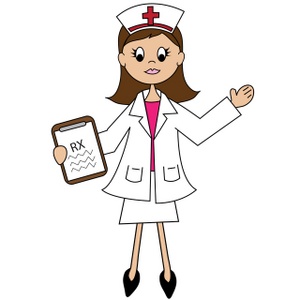
A special shout out to two special nurses.nurse_0515-0911-1420-0746_SMU

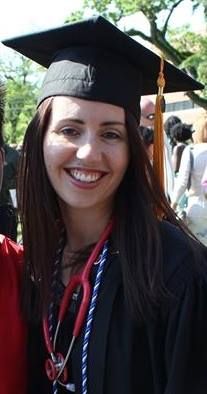
Breville, Erin LeaErin Lea Beville (survivor)

I’m a sixteen-year survivor. I got my bachelor’s degree in nursing from Florida State University in May (2014) and my RN license last October. Having a traumatic brain injury (TBI), I needed a bit of rest following the hell that is nursing school. I was fried!

I recently started a job as an Integrated Health Wellness Coach and Peer Support Specialist at Community Mental Health. It’s perfect because they want me to share my story and pay me for it. My brain injury is finally an asset rather than a liability. So, hooray for patience, Breville, Erin Lea & nieceperseverance, and determination! I’ve done it – not in spite of my TBI, but because of it. Together, we can be the difference, for each other and for others. Go out there and inspire people. Be the person only you can be – yourself. Then own it. You rock!

Evelyn Pumarejo-Justiniano 2 Survivor 082315Evelyn Pumarejo-Justiniano (survivor)

I suffered a traumatic brain injury (TBI) almost twenty years ago. I had to learn how to walk and talk and to relearn the basic things we take for granted in life. Yet, I feel I am blessed. I overcame all the obstacles and unforeseen Evelyn Pumarejo-Justiniano Survivor2 082431jpgcircumstances put in my life. I returned to school after my injury and had a GPA of 3.79 in nursing school. Today I am a nurse – going on a year now. I am planning to go for the degree of Bachelor of Science in Nursing. And, I thank God for my good husband, who has been by my side the past 29 years.

Disclaimer: Any views and opinions of the Contributor are purely his/her own.

(Clip Art compliments of Bing.)

(Photos compliments of contributor.)

As I say after each post: Please leave a comment by clicking the blue words “Leave a Commentanim0014-1_e0-1 below this post.
Feel free to follow my blog. Click on “Follow” on the upper right sidebar.

If you like my blog, share it with your friends. It’s easy! Click the “Share” buttons below.

If you don’t like my blog, “Share” it with your enemies. I don’t care!

Feel free to “Like” my post

On The Air: Brain Injury Radio “Another Fork in the Road” with Former NFL San Fran 49er, George Visger and Caregiver, Kendra Hammond Brittain

On The Air: Brain Injury Radio “Another Fork in the Road”

with

Former NFL San Fran 49er, George Visger

and 

Caregiver, Kendra Hammond Brittain

presented

by

Donna O’Donnell Figurski

Visger-275x300Former NFL San Fran 49er, George Visger talked about the dangers of football and brain injury. He also discussed hyperbaric oxygen therapy (HBOT) and Cranial-Sacral therapy, which he believes have helped him.

Kendra Brittain 2 Survivor 042315Kendra Hammond Brittain joined for the last half of the show to tell of her son’s football injury, which caused his TBI.

If you missed this show on “Another Fork in the Road” on August 16th, 2015, don’t fret. You can listen to the archived show here. Click the link below.

See you “On the Air!”

On The Air: Brain Injury Radio “Another Fork in the Road” with Former NFL San Fran 49er, George Visger and Caregiver, Kendra Hammond Brittain

Click here for a list of all “Another Fork in the Road” shows on the Brain Injury Radio Network.

diemodi jewelry

uniquely hand-crafted jewelry by donna

Welcome to Harmony Kent Online

The home of all things books

Pete Springer

Passionate Teacher and Future Children's Author

HOPE TBI

Helping Other People Excel - To Be Independent

For the Love of Books, Old and New

Katie Fischer, Writer and Reader of Stories

Charlie Bown

Children's Author

Jessica Hinrichs

“We write to taste life twice, in the moment and in retrospect.” ― Anais Nin

VIVIAN KIRKFIELD - Writer for Children

Picture Books Help Kids Soar

Mindy’s Writing Wonderland

For authors, parents, teachers & everyone who loves children’s books.

Kaitlyn Leann Sanchez

Literary Agent

Surviving Traumatic Brain Injury

TBI - Survivors, Caregivers, Family, and Friends

The Care Factor

Loving someone with a Traumatic Brain Injury

Brain Injury Support Group of Duluth-Extension

Brain Injury Information and SUPPORT

Brain Aneurysm Global Insight

Brain Aneurysm, cerebral hemorrhaging, hemorrhage stroke