TBI – Survivors, Caregivers, Family, and Friends

Posts tagged ‘Traumatic Brain Injury Caregiver’

About Me and My Blog!

SPEAK OUT! for Brain Injury 

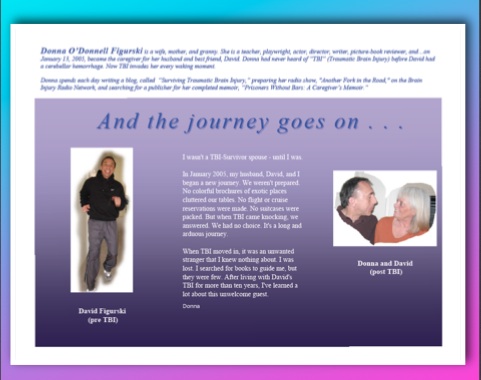
Donna O’Donnell Figurski

Writer, Blogger, Radio Host, Speaker

1 Donna Featured PhotoWRITER

My completed memoir, “Prisoners Without Bars: A Caregiver’s Story,” starts the minute my husband, David, had his brain injury. He was exercising. He did one more chin-up than his normal twelve. That dreaded thirteenth changed our lives forever. The story carries the reader through three unwanted brain surgeries – none of which David was expected to survive and which reduced him to an infantile state. “Prisoners Without Bars: A Caregiver’s Story” portrays David’s first eighteen months of struggles through recovery, therapy, and rehabilitation, while heralding his strength and persistence. I have included an epilogue to bring the reader up to date on David’s recovery and David added his flair to the story and his personal touch by writing the afterword. “Prisoners Without Bars: A Caregiver’s Story,” documents my dedication to helping David recover and details how we picked up the pieces and glued our lives back together. The story will make you laugh. No – brain injury is not funny, but life without humor during recovery from brain injury would be unbearable. It will also make you cry. No doubt! But, mostly it will offer hope to brain-injured survivors, their caregivers, and their family and friends. “Prisoners Without Bars: A Caregiver’s Story” is my completed memoir currently searching for an agent

I have four stories published for children in three books with Scholastic in their Education Department. Also, three biographies about notable Native Americans are scheduled for publication in two anthologies in early 2016.

BLOGGER2 Donna Collage
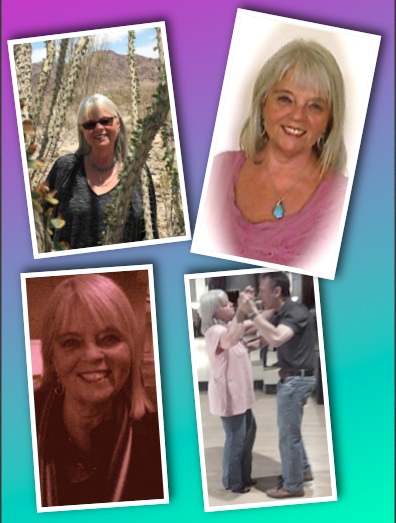
My blog, Surviving Traumatic Brain Injury, was the brainchild born from my realizing how many people are living with brain injury. At least 5.3 million people, just in the United States alone, are affected by brain injury. That is an astounding number! After being a part of this huge community for almost ten years, I knew I had to raise my voice, and I realized I could use my writing skills to reach a large audience.  Social media was not yet a part of folks’ lives when David had his brain injury, so we invented our own wheel. But now, with so many social media sites where brain-injury survivors, their caregivers, and their family and friends can search for information, I felt it was senseless for them to invent their own wheels. I wanted to help. The blog began with the Survivors SPEAK OUT! interviews, which gave survivors a voice, using my blog as their stage. That venue became hugely successful, and soon the Caregivers SPEAK OUT! interviews evolved. Soon after, many more categories followed as I saw a demand for them. The categories are listed below with a brief description.

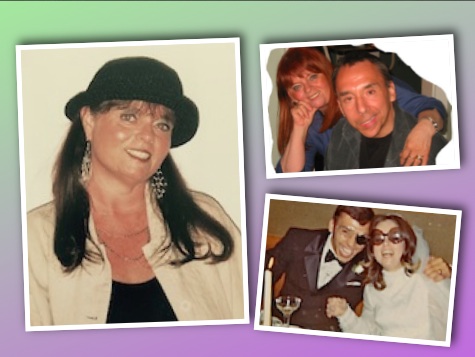
BLOG CATEGORY DESCRIPTIONS3 Donna Collage
Brain Injury Resources

The Brain Injury Resources category houses various informational topics, including books, movies, documentaries, facts, and research about brain injury.

Caregivers SPEAK OUT! Interviews

Read interviews from caregivers of brain-injured survivors. If you are a caregiver, this is where you can tell your side of the story. Look for the Caregivers SPEAK OUT! Questionnaire below.

 Caregivers SPEAK OUT! Questionnaire

This is the Caregiver Questionnaire. It’s easy – just fill out the 20-question template. (All the directions are on the page.)4 Donna Collage

SPEAK OUT! Faces of Brain Injury

Meet brain-injured survivors and their caregivers on “Faces of Brain Injury.” Their candid and heart-wrenching stories will help readers understand the serious implications and complications of living with brain injury.

 If you’d like to share your story on “Faces of Brain Injury,” please send it to me at neelyf@aol.com. I’d be happy to consider it. (Please put “Faces of Brain Injury” in the subject line.)

 SPEAK OUT! Guest Bloggers

Everyone has a story. In this section, Guest Bloggers can SPEAK OUT! about topics relevant to brain injury and special to them.

 If you have a Guest Blog you’d like to share, please contact me at neelyf@aol.com. I’d be happy to consider it. (Please put Guest Blogger in the subject line.)

SPEAK OUT! Itty-Bitty GIANT Steps

When you are living with a brain injury, no accomplishment is too small. ibGs provides a platform for brain-injury survivors and their caregivers to shout out their BIGGEST (or smallest) recent accomplishment. Share yours now!

Send it to me at neelyf@aol.com. I’d be happy to consider it. (Please put Itty-Bitty GIANT Step in the subject line.)

My Book: “Prisoners Without Bars: A Caregiver’s Story”

You can read about my book under “Writer” above.

SPEAK OUT! NewsBits

NewsBits is the place to go to find out the latest in the news about brain injury. 5 Donna Collage(Well, it was the “latest” when I published it. I’m sure it’s still interesting, though.)

On The Air: Brain Injury Radio “Another Fork in the Road” 

My radio show, “Another Fork in the Road,” airs the first and third Sundays of each month at 5:30pm Pacific Time. The show features brain-injury survivors and/or their caregivers. It also delves into the problems and issues that survivors and caregivers live with each day. Professionals, including therapists, are also interviewed on the show. If you can’t tune in to the live show, don’t fret. You can listen to the show anytime. It’s archived. Just find the show you want to hear and click the link. (“On The Air Show Menu” in the sidebar of my blog has a list of all my shows and provides their links.)

On the Air! Show Menu

This is the place to go if you are looking for a great show about brain injury. All of my shows are listed here with a link that will carry you directly to the station to listen. So, sit back, relax, and learn.6 Donna Collage

So, Whaddya Think?

Is there something you are passionate about in this brain-injury world? Do you want to be heard? Your opinion matters! You can SPEAK OUT! on “So, Whaddya Think?

Send your opinion piece to me at neelyf@aol.com. I’d be happy to consider it. (Please put So, Whaddya Think? in the subject line.)

Survivors SPEAK OUT! Interviews

Read interviews from brain-injured survivors from all walks of life. Brain injury is NOT discriminating. If you are a brain-injured survivor, this is where you can tell your side of the story. I’d be happy to consider it. Look for the Questionnaire Template below.

Survivors SPEAK OUT! Questionnaire

This is the Survivor Questionnaire. It’s easy! Just fill out the 20-question template. (All the directions are on the page.)

TBI Tales7 Donna Collage

The stories that are shared here by a variety of survivors and caregivers will make you laugh and cry – sometimes at the same time. They may delight you or they may shock you, but I can guarantee that the stories will offer you courage and hope.

If you have a TBI Tale you’d like to share, please contact me at neelyf@aol.com. I’d be happy to consider it. (Please put TBI Tale in the subject line.)

and Explore More …
You’re just going to have to click to find out. Go ahead! You know you want to.

RADIO HOST

Becoming a radio host had never entered my mind and may be just about the biggest surprise in my life. When I was approached to join the Brain Injury Radio Network on blogtalk radio, I was hesitant. Probably more like…are you kidding me? It took some convincing and a lot of soul-searching before I said, “Yes.”

I wondered what skills I had for this job, and I began to think – always dangerous. I had been a teacher for more than three decades, entertaining my audience of more than four hundred six- to eight-year-olds – teasing them into learning to “read, ‘rite, and do ‘rithmetic.” Believe me, teachers nearly stand on their heads to keep their little “twerpsters” entertained – a must, if you are going to keep their attention.8 Donna Collage

I am also in the theater and periodically climb onto the stage to cavort with other actors in front of hundreds of play-goers, so I thought maybe this radio-host thing might work. After all, if I can speak in front of hundreds of people who are directly in front of me, speaking to thousands of invisible listeners should be a cinch. So, yes, I decided to join the network.

Well, it’s not a cinch, and I still get the butterflies before each show, but as soon as my intro music plays, I am in the zone. My 80-minute show flies by, and when I invite my audience to tune in again in two weeks and the mics shut down, I savor the satisfaction of a job well done.

Since I’ve lived in the brain-injury world for more than ten years as the caregiver for my husband, David, I’ve learned a lot and was eager to share my knowledge with others. I’ve been with the network for more than a year now, and I have hosted more than twenty-seven shows.

You can listen to my radio show, “Another Fork in the Road,” on the Brain Injury Radio Network. My show airs the first and third Sundays of each month at 5:30pm Pacific Time. On my 80-minute show, I interview guests in the brain-injury world, including survivors and/or their caregivers, delving into their lives to better understand how they cope with daily living after brain injury. I invite folks from the medical professions, such as therapists, who are willing to offer suggestions and hope to survivors. I talk with folks in brain-injury communities, such as troops from the combat zones of recent wars and athletes from the battlegrounds of the playing fields. I address many topics pertinent to brain injury with my panel of brain-injury survivors and caregivers.

Tune in! Click on Brain Injury Radio and look for “Upcoming Broadcasts.” (My show will be advertised about two days before the first or third Sunday of each month.)

You can listen to the shows anytime. They’re archived. Just click on On the Air! Show Menu on my blog. See you “On the Air!”

SPEAKER9 Donna Collage

If you’ve read the section above about my being a radio host, you will already understand why I have chosen to become a spokesperson for brain injury. Though brain injury has been around for forever, it seems that it is finally coming to the forefront as our troops arrive home with traumatic brain injury – what the world is calling the “signature” wound of the Iraq and Afghanistan wars. Recently too, there is a lot of attention to the head traumas that many football players have received, resulting in serious repercussions for them, such as memory loss, unrestrained anger, and even early dementia. Sadly, many players have completely lost hope and have resorted to suicide. Of course, with the baby boomers reaching their “golden” years (and some not so golden), they are finding that many of them and their loved ones are requiring caregivers in their lives simply to manage day-to-day living. And that’s where I come in. With my knowledge and experience of being a caregiver for my husband, David, for more than ten years, I have learned a fair bit and would like to share my knowledge to help others.

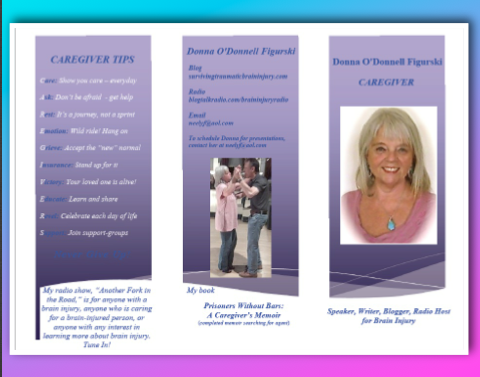
Need a speaker? My 90-minute PowerPoint Presentation, “What Caregivers Need to Know,” is for anyone with a brain injury, anyone who is caring for a brain-injured person, or anyone with any interest in learning more about brain injury. For details or to schedule me for your event, please contact me at neelyf@aol.com.

Below is my brochure.

Click on photos to enlarge.
10 Brochure 111 Brochure 2

On The Air: Brain Injury Radio “Another Fork in the Road” with Former NFL San Fran 49er, George Visger and Caregiver, Kendra Hammond Brittain

On The Air: Brain Injury Radio “Another Fork in the Road”

with

Former NFL San Fran 49er, George Visger

and 

Caregiver, Kendra Hammond Brittain

presented

by

Donna O’Donnell Figurski

Visger-275x300Former NFL San Fran 49er, George Visger talked about the dangers of football and brain injury. He also discussed hyperbaric oxygen therapy (HBOT) and Cranial-Sacral therapy, which he believes have helped him.

Kendra Brittain 2 Survivor 042315Kendra Hammond Brittain joined for the last half of the show to tell of her son’s football injury, which caused his TBI.

If you missed this show on “Another Fork in the Road” on August 16th, 2015, don’t fret. You can listen to the archived show here. Click the link below.

See you “On the Air!”

On The Air: Brain Injury Radio “Another Fork in the Road” with Former NFL San Fran 49er, George Visger and Caregiver, Kendra Hammond Brittain

Click here for a list of all “Another Fork in the Road” shows on the Brain Injury Radio Network.

SPEAK OUT! . . . . . . . . . . . . . . . . . Itty-Bitty GIANT Steps

SPEAK OUT! Itty-Bitty GIANT Steps

presented by

Donna O’Donnell Figurski

Itty-Bitty GIant Steps for BlogSPEAK OUT! Itty-Bitty Giant Steps will provide a venue for brain-injury survivors and caregivers to shout out their accomplishments of the week.

If you have an Itty-Bitty Giant Step and you would like to share it, just send an email to me at neelyf@aol.com.

If you are on Facebook, you can simply send a Private Message to me. It need only be a sentence or two. I’ll gather the accomplishments and post them with your name on my blog approximately once a week. (If you do not want your last name to be posted, please tell me in your email or Private Message.)

I hope we have millions of Itty-Bitty Giant Steps.

Here are this week’s Itty-Bitty GIANT Steps

drivers-license-621806Cory Edmondson (survivor)…Two years ago, I was told that I would never drive again. That didn’t sit too well with me. My mom told me I could accept it or I could continue to work hard and, one more time, prove somebody wrong. I am now one excited dude – I got my license back! Never give up. Always believe in yourself.

washdishesclipsahoyCory Edmondson (survivor)…I’m pretty proud of myself right now. I stood at the sink, washed and wiped the supper dishes, and put away 98% of them. I walked around the kitchen with just one hand on the cupboard. This was a BIG accomplishment for this fella. Never give up! 🙂

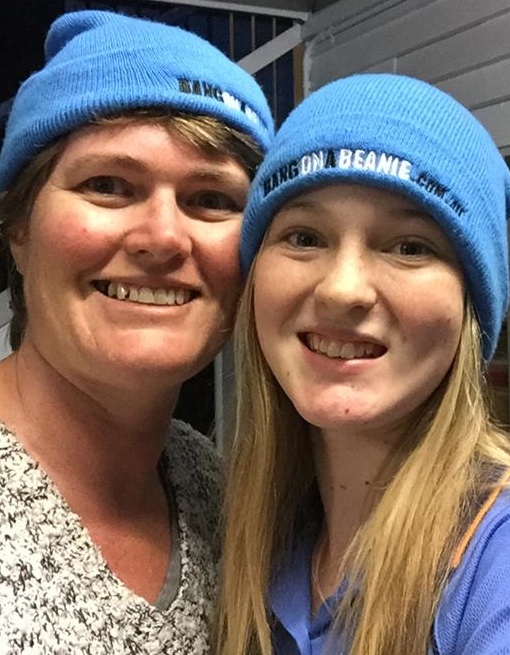
Jo Emery & DaughterJo Emery (caregiver)…This week in Australia, it is Brain Injury Awareness Week. For donations, we have BangOnABeanie and BangOnABarbie (“Barbie”=BBQ). I am so very proud of my beautiful twelve-year-old, who organised the BangOns with her local girl-guide unit. She talked about why they were doing them and a little bit about her dad. She also played a memory game with them. She raised about $30, which was really great. I’m a very proud mummy!

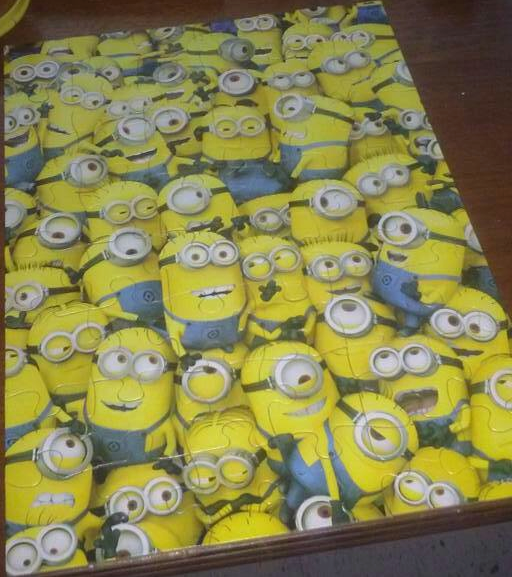
Minion Puzzle for Kyle F.Kyle F. (survivor)…This puzzle took me ALL day. It may seem rather easy, with its being only forty-eight pieces and all, but I get distracted extremely easily – a heck of a lot more easily than before my TBI. So…score one for me. Also, this puzzle is as cute as heck with all the minions.

blood_donors_1Kristina Hopkins (caregiver)…I’m about ready to donate blood again. I feel so honored to be able to do this every eight weeks. I’m a universal donor with my O-negative blood type, and it’s a blessing to be able to help so many. I challenge you all to donate if you can and are able.

YOU did it!

Congratulations to all contributors!

(Clip Art compliments of Bing.)

(Photos compliments of contributor.)

As I say after each post:anim0014-1_e0-1

Please leave a comment by clicking the blue words “Leave a Comment” below this post.

Feel free to follow my blog. Click on “Follow” on the upper right sidebar.

If you like my blog, share it with your friends. It’s easy! Click the “Share” buttons below.

If you don’t like my blog, “Share” it with your enemies. I don’t care!

Feel free to “Like” my post.

SPEAK OUT! Faces of Brain Injury Pamela Sveum & Sherri Diehl Ward

SPEAK OUT! Faces of Brain Injury  Pamela Sveum & Sherri Diehl Ward

presented by

Donna O’Donnell Figurski

 Brain Injury is NOT Discriminating!

bigstock-cartoon-face-vector-people-25671746-e1348136261718

It can happen to anyone, anytime, . . . and anywhere.

The Brain Trauma Foundation states that there are 5.3 million people in the United States living with some form of brain injury.

On “Faces of Brain Injury,” you will meet survivors living with brain injury. I hope that their stories will help you to understand the serious implications and complications of brain injury.

The stories on SPEAK OUT! Faces of Brain Injury are published with the permission of the survivor or designated caregiver.

If you would like your story to be published, please send a short account and two photos to me at neelyf@aol.com. I’d love to publish your story and raise awareness for Brain Injury.

Svenum, Pamela Caregiver to son, Robby 080315Pamela Sveum (mother and caregiver for her son, Robby)

Seventeen years ago, my son, Robby, (then age 15) suffered a traumatic brain injury from an accidental gunshot wound to the head with a .357. He was moving his boss’ gun from the seat Robby Sveum 1of the truck to the dashboard when the gun went off. He was given a 0% chance of survival. Medically speaking, Robby should not have survived. Medically speaking, everything pointed to zero at the very best. Robby’s survival and recovery are nothing less than a miracle! Robby Sveum 4The picture on left is Robby dancing at his best friend’s wedding a few years ago. He was the best man. The one on the right is Robby getting his dog, Holly, about five years ago. May 27, 2015, is the date on which I acknowledge feeling very blessed – very thankful for Robby’s presence in our lives and his continuing progress. I feel a bit of sadness for the things we lost along the way – there were casualties. My message: Keep the faith, never give up hope, and always be willing to continue to be surprised with what life has in store for you. With Robby, life is always full of surprises.

Sherri Diehl Ward (caregiver)

Ward, Sheri Diehl Caregiver 080315Our story in a nutshell: My husband, Bill, was in a near-fatal motorcycle accident on July 11, 2009. He was thrown from his bike and lay in a ravine in the woods – about twenty feet from the road. When Bill wrecked and was thrown, the bike stayed upright and continued down the road about 300 feet. The police got to the scene and saw the bike with minimal damage. They assumed that the rider dumped it and left. Bill lay in the woods until a police officer found him. The police were actually ready to leave the scene, when Officer Hurd from the Winslow Township Police Department saw something in the road and went to see if it was part of the accident scene. When he approached, he heard Bill’s moans coming from the woods. At that point, everyone sprung into action, so to speak, as Bill’s time was quickly running out. The helicopter was called in. En route to the hospital, Bill actually coded. He was gone for four minutes. Ward, Sheri Diehl CAregiver 080315 2When Bill arrived at the hospital, I was not far behind him, as I had been notified by my brother-in-law, a police officer from our town. (Once the police ran the plates on the bike and realized who the victim was, they contacted my brother-in-law first, as they knew him.) He picked me up, and we quickly made our way to the hospital, not knowing if Bill was dead or alive at that point.

When I first saw Bill, he was completely unrecognizable. He had broken every bone in his face, broken his jaw in three places, fractured his neck, broken eight ribs, and, worst of all (the reason I am writing this), received a traumatic brain injury. It was very touch and go for weeks. Bill spent three of them in a coma. He had to have complete facial reconstructive surgery, and he had his jaw wired for twelve weeks. Bill came home about a month and a half after the accident, complete with a peg tube (a tube inserted through the abdomen that delivers nutrition directly to the stomach) and a trach (tracheotomy – an opening surgically created through the neck into the trachea to allow direct access to a breathing tube).

Ward, Sherri Diehl Husband with BI 080315Although Bill healed physically, I don’t think he will ever be fixable emotionally and mentally. We now struggle daily with bouts of amnesia, sporadic memory loss, cognitive impairment, confusion, disorientation, paranoid delusions, hallucinations, nightmares, flashbacks, and early signs of dementia, among many other things. Bill’s severe and drastic mood swings and rage are a part of daily living as well. We try to make the best of the situation at hand, and I am forever grateful to still have him here, but living with a TBI survivor is not a life I would have chosen – for obvious reasons. I can only hope that one day we will all have peace.

Disclaimer: Any views and opinions of the Contributor are purely his/her own.

(Clip Art compliments of Bing.)

(Photos compliments of contributor.)

As I say after each post: Please leave a comment by clicking the blue words “Leave a Commentanim0014-1_e0-1 below this post.

Feel free to follow my blog. Click on “Follow” on the upper right sidebar.

If you like my blog, share it with your friends. It’s easy! Click the “Share” buttons below.

If you don’t like my blog, “Share” it with your enemies. I don’t care!

Feel free to “Like” my post.

SPEAK OUT! . . . . . . . . . . . . . . . . . Itty-Bitty GIANT Steps

SPEAK OUT! Itty-Bitty GIANT Steps

presented by

Donna O’Donnell Figurski

Itty-Bitty GIant Steps for BlogSPEAK OUT! Itty-Bitty Giant Steps will provide a venue for brain-injury survivors and caregivers to shout out their accomplishments of the week.

If you have an Itty-Bitty Giant Step and you would like to share it, just send an email to me at neelyf@aol.com.

If you are on Facebook, you can simply send a Private Message to me. It need only be a sentence or two. I’ll gather the accomplishments and post them with your name on my blog approximately once a week. (If you do not want your last name to be posted, please tell me in your email or Private Message.)

I hope we have millions of Itty-Bitty Giant Steps.

Here are this week’s Itty-Bitty GIANT Steps

Gina Morin (caregiver for her ex-husband)

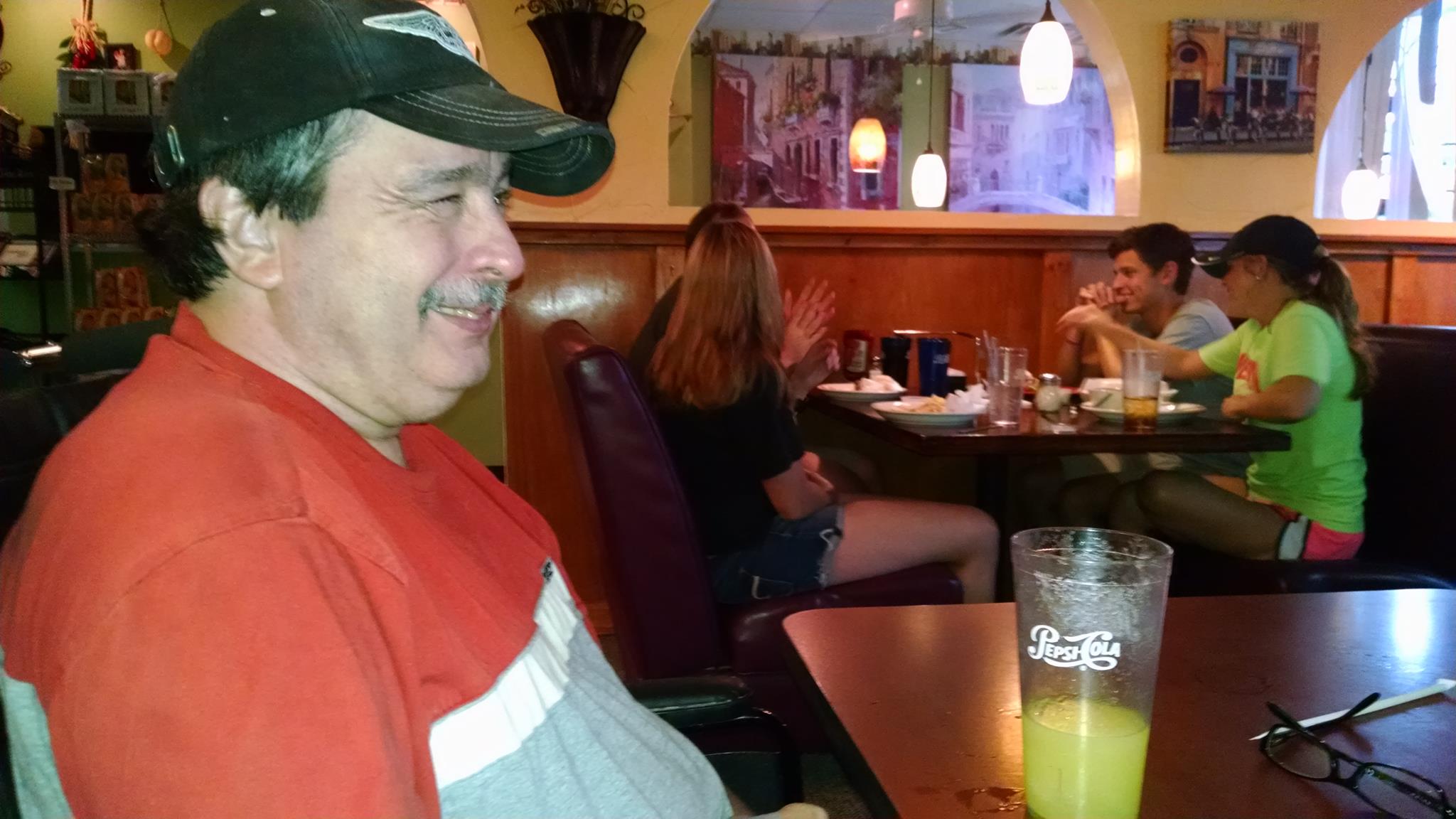
11698961_10200691336041375_5502012322701595071_oMy ex-husband’s accident was August 8, 2014. I am celebrating his first time to go out to eat at a restaurant. My prayer was answered that he could put the silverware to his mouth. Even picking up his food with his fork was amazing! He has come so far. 11141217_10200691335281356_1974107260734323069_nThe goal now is for us to get comfortable when transferring him from car to wheelchair and vice versa, so that his time in the nursing home is limited. It’s a taste of freedom for him. At some point, I want to bring him to my house for a weekend visit. But, he is two hours away, and he gets carsick. I’m going to talk to the doctor about that. For now, it has to be short rides in the car.

YOU did it!

Congratulations to all contributors!

(Clip Art compliments of Bing.)

(Photos compliments of contributor.)

As I say after each post:anim0014-1_e0-1

Please leave a comment by clicking the blue words “Leave a Comment” below this post.

Feel free to follow my blog. Click on “Follow” on the upper right sidebar.

If you like my blog, share it with your friends. It’s easy! Click the “Share” buttons below.

If you don’t like my blog, “Share” it with your enemies. I don’t care!

Feel free to “Like” my post.

Caregivers SPEAK OUT! . . . . . Kendra Brittain

Caregivers SPEAK OUT! – Kendra Brittain

presented

by

Donna O’Donnell Figurski

Kendra Brittain 2 Survivor 0423151. What is your name? (last name optional)

Kendra Brittain

2. Where do you live? (city and/or state and/or country) Email? (optional)

Sapulpa, Oklahoma, USA     brittainhome@yahoo.com

3. What is the brain-injury survivor’s relationship to you? How old was the survivor when he/she had the brain injury? What caused your survivor’s brain injury?

My TBI (traumatic brain injury) survivor is my son. He was about 13 when his injury happened. He was playing football and got hit on both sides of his helmet. This caused a severe concussion. No one knew what was going on at that time. Of course, both the coach and we let him keep playing any sport out of not knowing what happened to him. As a result, his injury did not have time to heal.

4. On what date did you begin care for your brain-injury survivor? Were you the main caregiver? Are you now? How old were you when you began care?

I immediately took him to a seizure-doctor because I suspected his juvenile epilepsy had come back. But, it was very different. Nothing showed up on what was wrong with him until six months later. My son’s concussion was around 2008. I was 37 when his injury occurred. My son is now 18, and he is mostly unable to take care of himself.

5. Were you caring for anyone else at that time (e.g., children, parents, etc.)?

My husband and I were taking care of our daughter in addition to our son.

6. Were you employed at the time of your survivor’s brain injury? If so, were you able to continue working?

No, I wasn’t working. I had been injured at work, which left me disabled. So, I wouldn’t have been able to work anyway. But, I was able to care for my son better.

7. Did you have any help? If so, what kind and for how long?

My husband helped me a lot when he could. Other than that, I didn’t have any help.

8. When did your support of the survivor begin (e.g., immediately – in the hospital; when the survivor returned home; etc.)?Brittain, Tyler Survivor 2 042315

My husband and I helped our son immediately by taking him to the doctor.

9. Was your survivor in a coma? If so, what did you do during that time?

No, my son wasn’t in a coma, but he lost all memory of before the accident and the week of the injury. He can’t remember his childhood at all.

10. Did your survivor have rehab? If so, what kind of rehab (i.e., inpatient and/or outpatient and occupational, physical, speech, and/or other)? How long was the rehab? Where were you when your survivor was getting therapy?

My son did have to do a lot of physical therapy for his back because he developed a syrinx due to the injury. (A syrinx results when cerebrospinal fluid, which normally flows around the spinal cord and brain and transports nutrients and waste products, collects in a small area of the spinal cord and forms a pseudocyst.)

11. What problems or disabilities of your brain-injury survivor required your care, if any?

My son needs constant reminders to do stuff because his memory isn’t very long. He requires reminders to take his medicine. Because his depression was so great, we had to give it to him.

12. How has your life changed since you became a caregiver? Is it better? Is it worse?

My son’s brain injury has made life better because we are closer as a family, and it made us realize what is important in life.

13. What do you miss the most from pre-brain-injury life?

My son loved sports, and we loved to watch him play. But, because of his memory, no one will give him a chance – not even to play basketball, which he is good at and enjoys. He really misses playing too, so he has had to find enjoyment someplace else.

14. What do you enjoy most in post-brain-injury life?

I enjoy our family life and the closeness we have as a family. I would not change it for the world.

15. What do you like least about brain injury?

I dislike all the struggles my son has to go through and the limitations he has that no one can see by looking at him. I also dislike when he has a seizure and I can’t do anything about it.

16. Has anything helped you to accept your survivor’s brain injury?

I’ve been helped by my faith in God’s wisdom and knowing He can heal anyone.

17.  Has your survivor’s injury affected your home life and relationships and, if so, how?

We are a closer family than ever before.

18. Has your social life been altered or changed and, if so, how?

No, not really.

Brittain, Tyler Survivor 04231519. What are your plans? What do you expect/hope to be doing ten years from now?

My son got his driver’s license. He’s graduating high school and then heading to college to learn about computers. He will have a job that he went to school for – doing what he wants to do.

20. What advice would you offer other caregivers of brain-injury survivors? Do you have any other comments that you would like to add? 

Don’t give up – even though your circumstances may look dim. There is hope in life and in God. There is a better plan for your life in the future. God will make something good out of something bad. Also, if you know your child or your survivor and you know that something is not right and you feel that what the doctors say doesn’t make sense, get a second opinion and pursue it. We did that, and my son is ten times better.


Disclaimer: Any views and opinions of the Contributor are purely his/her own.

(Clip Art compliments of Bing.)

(Photos compliments of contributor.)

As I say after each post: Please leave a comment by clicking the blue words “Leave a Commentanim0014-1_e0-1 below this post.

Feel free to follow my blog. Click on “Follow” on the upper right sidebar.

If you like my blog, share it with your friends. It’s easy! Click the “Share” buttons below.

If you don’t like my blog, “Share” it with your enemies. I don’t care!

Feel free to “Like” my post.

SPEAK OUT! Faces of Brain Injury Alicia Theroux Williams

SPEAK OUT! Faces of Brain Injury – Alicia Theroux Williams  (caregiver)

presented by

Donna O’Donnell Figurski

 Brain Injury is NOT Discriminating!


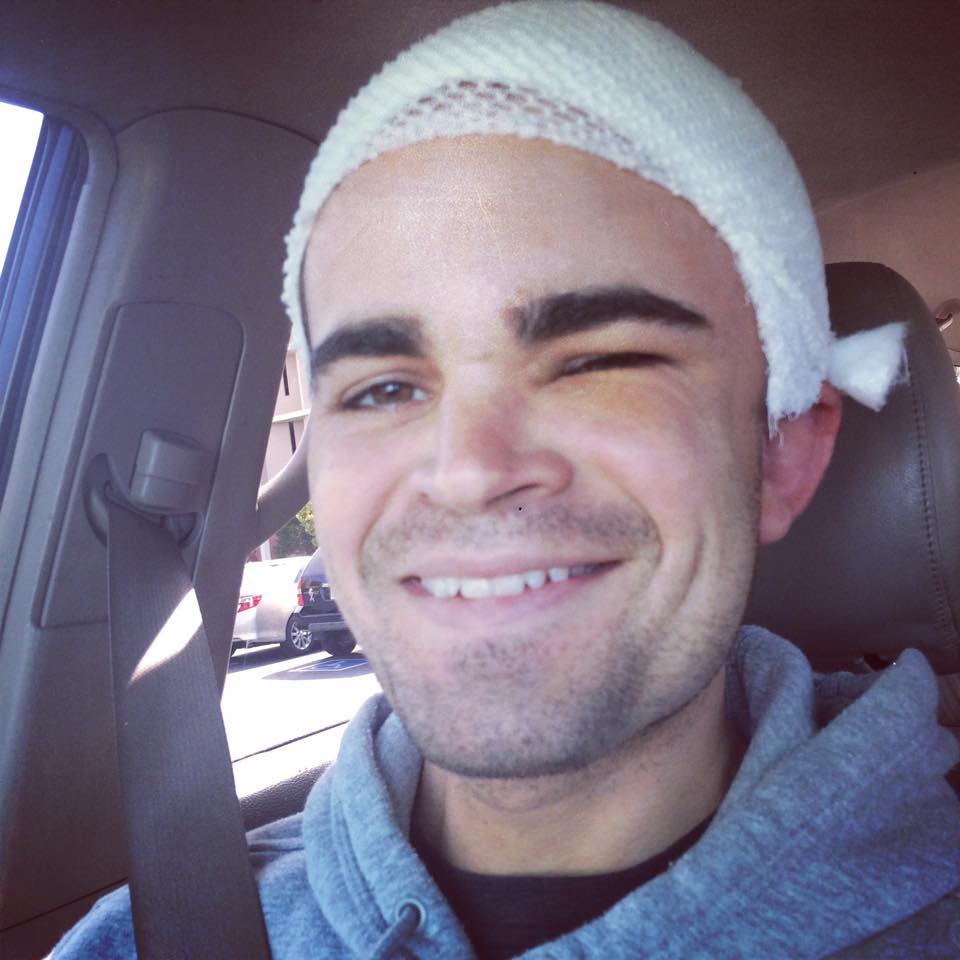
bigstock-cartoon-face-vector-people-25671746-e1348136261718I want to introduce myself with a short story about my experience with traumatic brain injury (TBI). Last Christmas was the first Christmas in six years that my husband and I spent together. (He is a firefighter/paramedic. Therefore, he is on duty most holidays.) It was the best Christmas yet. I felt complete and whole. I never imagined that in just a couple of weeks my husband would be in a coma and sadly would not remember this glorious holiday. Williams, Eric Survivor 2 061215On the morning of January 6th, my husband was out running, and he was struck from behind by a cyclist. My husband’s first responders were his friends, since we live in the city that he works in. Williams, Alica Theroux Caregiver 061215They (I believe) were the reason that my husband survived. My husband spent fourteen days in a coma, seven days on the medical-surgical floor, and twenty-six days in an acute rehab facility. In a little more than three moWilliams, Eric Survivor 061215nths, he had three surgeries on his brain, plus many moreWilliams, Alicia Theroux Caregiver for & Husband Eric 061215 procedures for other issues. Even though we have just started on this journey, I am thankful to have a support-group to vent to and to get tips from. I feel like I am not in this alone.

Disclaimer: Any views and opinions of the Contributor are purely his/her own.

(Clip Art compliments of Bing.)

(Photos compliments of contributor.)

As I say after each post: Please leave a comment by clicking the blue words “Leave a Commentanim0014-1_e0-1 below this post.

Feel free to follow my blog. Click on “Follow” on the upper right sidebar.

If you like my blog, share it with your friends. It’s easy! Click the “Share” buttons below.

If you don’t like my blog, “Share” it with your enemies. I don’t care!

Feel free to “Like” my post.

Caregivers SPEAK OUT! . . . . . Lisabeth Mackall

Caregivers SPEAK OUT! – Lisabeth Mackall

presented

by

Donna O’Donnell Figurski

Lisabeth Mackall Caregiver 06112151. What is your name? (last name optional)

Lisabeth Mackall

2. Where do you live? (city and/or state and/or country) Email? (optional)

Cottage Grove, Minnesota, USA  info@lisabethmackall.com

3. What is the brain-injury survivor’s relationship to you? How old was the survivor when he/she had the brain injury? What caused your survivor’s brain injury?

My husband, Frank, was 39 when he had his car crash and suffered his TBI. He was a police officer responding to a call for assistance for another officer, and he lost control of his car on black ice and crashed.

4. On what date did you begin care for your brain-injury survivor? Were you the main caregiver? Are you now? How old were you when you began care?

Frank’s accident was on January 2, 2012. I brought him home on March 27, 84 days after he went to the hospital. He required Lisabeth Mackall Caregiver 06121524-hour supervision due to his cognition and safety needs. They suggested to take him to a rehab center, but I decided that it was time for him to come home.

5. Were you caring for anyone else at that time (e.g., children, parents, etc.)?

At that time, we had three children – ages 6, 9, and 15. We now have a fourth child – my husband’s half-brother’s child whom we took custody of one and a half years ago.

6. Were you employed at the time of your survivor’s brain injury? If so, were you able to continue working?

I was employed full-time. I was working as Rehab Director for nine buildings here in Minnesota. I worked the shift opposite to Frank’s, so we had very little time together. When he was allowed to come home from the hospital, I quit my job. I attempted to go back about a year after he was injured and had to quit. I just recently (November) went back to work full-time, but we had to hire a nanny for the morning to help get the kids to school after I leave for work.

7. Did you have any help? If so, what kind and for how long?

I had no help with Frank, although my mom did move in with us immediately after the crash and stayed for four months. We did not allow caregivers into the house since Frank was a police officer – we had family and friend support.

8. When did your support of the survivor begin (e.g., immediately – in the hospital; when the survivor returned home; etc.)?

Our support started the minute Frank was injured and continued for about two years. If we needed help now, we could call on law enforcement, but it is not in my nature to ask for help.

9. Was your survivor in a coma? If so, what did you do during that time?

Frank was in a true coma (minimally responsive) for about two weeks. He started to respond with a thumbs-up sign and by fighting against his restraint. He continued to improve from there. I spent that time talking with Frank, and talking with the cops and visitors as well. We were usually swamped with visitors, so I did not get a lot of time without people there. But, when I did speak with Frank, I told him over and over what had happened and that he was safe.

10. Did your survivor have rehab? If so, what kind of rehab (i.e., inpatient and/or outpatient and occupational, physical, speech, and/or other)? How long was the rehab? Where were you when your survivor was getting therapy?

Frank was in the hospital for 84 days. Once he left the medical unit and went to rehab, he was in for the full time until he was discharged. He then started outpatient rehab three times a week. That continued for a month. Frank had all three disciplines, although he was eventually weaned off occupational therapy. He continued to have physical therapy and speech therapy on and off for a long time. Right now, Frank can still go back to speech therapy if he wants, but he is taking a break. I would attend some of his sessions, but I tried to stay out of the speech therapy sessions. (They were too hard for me to watch, since I am a speech therapist, and I knew Frank thought the sessions were irritating.)

Lisabeth and Frank

Lisabeth and Frank

11. What problems or disabilities of your brain-injury survivor required your care, if any?

Frank has a hard time learning new things about technology. He has a problem with short-term memory. He also has a very short fuse, so kids arguing or chaos in the house is very difficult for him. We do finances together. Otherwise, he manages his own schedule about 75% of the time. I manage most of the other aspects of the house and the kids, with help from Frank if I leave lists and tasks.

12. How has your life changed since you became a caregiver? Is it better? Is it worse?

Life is different. I have to work very hard to be a wife and not a caregiver. Caregiving is easier and not sad. When I step into the wife role on some days, it is heartbreaking to know what we have lost.

13. What do you miss the most from pre-brain-injury life?

I miss having a highly intelligent partner in life who would debate with me and who is solid in his understanding of the world around him.

14. What do you enjoy most in post-brain-injury life?

Frank and I have more time together. Our family is more important now that we know how precious life is and how fast it can change.

15. What do you like least about brain injury?

I dislike Frank’s irritability and his lack of trust in the decisions that are made.

16. Has anything helped you to accept your survivor’s brain injury?

Being a speech therapist has given me a huge advantage with this recovery, although sometimes I wish I didn’t know so much.

17. Has your survivor’s injury affected your home life and relationships and, if so, how?

Frank’s brain injury has changed many things. In fact, we are moving. Our wood floors bother him when the dog walks across it. Frank also needs to have more space for himself, so we are trying to find a bigger house for all of us.

18. Has your social life been altered or changed and, if so, how?Lisabeth Mackall Book 061215

We have very little social life at this point. Most of our friends from before the accident have drifted away. The people we are closest with are those we met after the crash. We have busy kid schedules, and with Frank’s fatigue, it is often just easier to hang out at home.

19. What are your plans? What do you expect/hope to be doing ten years from now?

We have a child with behavior struggles. That doesn’t mix well with a TBI. Puberty and life-changes are going to be challenging. My goal is to hold our family together by thinking ahead, finding the right space for all of us, and consciously talking about the problems that we have together as a family.

20. What advice would you offer other caregivers of brain-injury survivors? Do you have any other comments that you would like to add?

We are all in the same ocean, but in separate sinking ships. We can help one another stay afloat if we ask for help. I truly feel that trying to navigate this world without help is too hard. Even knowing what I know about brain injuries as a professional, I was in no way prepared to deal with things that I live through each day. No one is. We all just have to find a way to make the best decisions we can for ourselves and for our loved ones. That doesn’t mean that we all stay together as a family – sometimes families break apart. That is the devastating part of this journey. A brain injury can destroy a family. Sometimes there is no choice but to separate a survivor from the family due to the injury. Being a therapist, my goal is to help people navigate the world as best as they can and to hopefully keep the family together.

Learn more about Lisabeth Mackall:

On the Air: Brain Injury Radio “Another Fork in the Road” with Lisabeth Mackall, Caregiver, Therapist, Author

Lisabeth Mackall Website

27 Miles: The Tank’s Journey Home

Disclaimer: Any views and opinions of the Contributor are purely his/her own.

(Clip Art compliments of Bing.)

(Photos compliments of contributor.)

As I say after each post: Please leave a comment by clicking the blue words “Leave a Commentanim0014-1_e0-1 below this post.

Feel free to follow my blog. Click on “Follow” on the upper right sidebar.

If you like my blog, share it with your friends. It’s easy! Click the “Share” buttons below.

If you don’t like my blog, “Share” it with your enemies. I don’t care!

Feel free to “Like” my post

Caregivers SPEAK OUT! . . . . . Jeannette Davidson-Mayer

Caregivers SPEAK OUT! – Jeannette Davidson-Mayer

presented

by

Donna O’Donnell Figurski

jeannette davidson-Mayer 0417151. What is your name? (last name optional)

Jeannette Davidson-Mayer

2. Where do you live? (city and/or state and/or country) Email? (optional)

New Plymouth, Idaho, USA     2004djmjdm@gmail.com

3. What is the brain-injury survivor’s relationship to you? How old was the survivor when he/she had the brain injury? What caused your survivor’s brain injury?

My husband, DeWayne, has a traumatic brain injury (TBI). He was 38 when it happened. While serving in Iraq, DeWayne survived one Humvee rollover, two close-range IEDs (improvised explosive devices), one helicopter explosion (They were guarding a downed helicopter when the remains were blown-up for disposal), and lastly an IED that went off right under the command seat, where DeWayne was sitting. All this happened in 2005 between May 23rd and October 3rd.

4. On what date did you begin care for your brain-injury survivor?

At the end of October 2004, DeWayne was flown to Madigan Air Force Base in Washington State on the advance plane from Iraq. I made a few trips there to see him. He was allowed occasional trips home. By February 2006, DeWayne was home for good. We didn’t know DeWayne had a TBI until mid-2007. We just knew something wasn’t connecting right in his daily mental functions.

Were you the main caregiver?

Yes. Our daughter as well has learned to be a caregiver over the years.486770_10200560183360321_1086965832_n

Are you now?

Yes

How old were you when you began care?

33

5. Were you caring for anyone else at that time (e.g., children, parents, etc.)?

No

6. Were you employed at the time of your survivor’s brain injury? If so, were you able to continue working?

Yes, I was employed. My employer helped above the call of duty. In mid-October 2014, I did have to quit working because DeWayne’s medical needs had increased. Also, I had gone to one of our smaller companies, which is a 10-minute drive vs. a 5-minute walk. DeWayne couldn’t comprehend this change, which created hardships for our daughter and for DeWayne and me as a couple.

7. Did you have any help? If so, what kind and for how long?

I couldn’t make it without the love and support of our family, friends, and church family. Help is from driving DeWayne to assisting with happenings at home. Most of all, help is providing an ear to listen.

8. When did your support of the survivor begin (e.g., immediately – in the hospital; when the survivor returned home; etc.)?

My quality of care has grown over the years. It took a while because I didn’t know how to ask for help. I was embarrassed to ask, and I didn’t understand how to ask either. I felt that if I couldn’t do it myself, I was failing my family.

9. Was your survivor in a coma? If so, what did you do during that time?

No, but DeWayne was knocked out several times.

10. Did your survivor have rehab?

Yes

If so, what kind of rehab (i.e., inpatient and/or outpatient and occupational, physical, speech, and/or other)?

DeWayne had occupational, physical, speech, and recreational therapies as an outpatient. He also had behavioral health therapy.

How long was the rehab?

Rehab started out three days a week, eight hours a day, for three months at Idaho Elks Rehab. DeWayne was then moved to the Boise VA (Veterans Administration) facility, where he went several days a week. DeWayne still has recreational therapy, physical therapy, and occasionally occupational therapy. And, monthly behavioral health therapy.

Where were you when your survivor was getting therapy?

Idaho Elk’s Rehab, Boise VA Medical Center, Tri-Cities Physical Therapy, St. Luke’s Spinal Care

11. What problems or disabilities of your brain-injury survivor required your care, if any?

DeWayne has many difficulties. He has fixations. He’s easily lost, confused, and disoriented. He tires easily. His short-term memory is a problem. DeWayne doesn’t always understand what is happening around him or what is being said to him. Also we don’t always understand what he is trying to say to us. He suffers from migraines/headaches. He has silent seizures, bi-lateral hearing loss, tremors, and sensitivity to light.

12. How has your life changed since you became a caregiver? Is it better? Is it worse?

I can’t really say if life is better or worse because of the TBI. We are both different from the deployment alone. I am the lucky wife because he came home alive, which is a celebration in itself.

13. What do you miss the most from pre-brain-injury life?

There is a lot I miss (for example, long hiking trips and long conversations). But, the trade-off is worth it.

14. What do you enjoy most in post-brain-injury life?Jeannette Davidson-Mayer & DeWayne

We have learned to depend on each other completely – as spouses and as a family. We tend to stand up for what we believe in. We hold on tighter. We often show each other how important we are. We travel off-season, which is nice because the crowds are less. Nicer indeed!

15. What do you like least about brain injury?

We never know what to expect from day to day, yet it is also a positive, for we never have a dull moment.

16. Has anything helped you to accept your survivor’s brain injury?

Through many trials and errors, we have finally discovered our saving grace. Our kitchen has become our “Central Command Post.” Our lives center around our kitchen. We were able to set up an atmosphere that can adapt to DeWayne’s ever-changing daily new normal. Post-it Notes and whiteboard markers saved our family.

17. Has your survivor’s injury affected your home life and relationships and, if so, how?

Of course, DeWayne’s TBI has affected home life, relationships, and so on. We have lost.

18. Has your social life been altered or changed and, if so, how?

Our social life has been cut. We don’t go out as much. We avoid crowds, noisy situations, and places that make DeWayne uncomfortable. I also have become uneasy about the same things that make DeWayne uneasy.

19. What are your plans? What do you expect/hope to be doing ten years from now?

Our plans for the future are to continue to live in joy and love together, to share our lives with our children as they continue to grow, to travel the world in an RV, and to reach out to others to show them that they have the inner strength needed to move forward. (How they move forward is unique to each family.)

20. What advice would you offer other caregivers of brain-injury survivors?

Never give up. Give in from time to time. Let it out – cry or scream. Then look back on what is happening to find ways to make adjustments or to find solutions to the challenges. Know that you are not alone. You yourself, along with your family, have so much to offer.

Do you have any other comments that you would like to add?

Military families are not alone in living with TBIs and/or PTSD (post-traumatic stress disorder) and in being caregivers. We didn’t sign up for this life, but we have it. Now let’s figure out how to keep moving forward, so we can reach higher, dream bigger, and hold on tighter.

To learn more about Jeannette Davidson-Mayer, you can listen to her interview with me on “Another Fork in the Road” on blogtalkradio.com or at R4 Alliance.


Jeannette Davidson-MayerThank you, Jeannette, for taking part in this interview. I hope that your experience will offer some hope, comfort, and inspiration to my readers.

If you would like to be a part of this project, please go to TBI Caregiver Interview Questionnaire for a copy of the questions and the release form.

(Photo compliments of Jeannette.)

Disclaimer: The views or opinions in this post are solely that of the interviewee.

As I say after each post: Please leave a comment by clicking the blue words “Leave a Comment” below this post.

Feel free to follow my blog. Click on “Follow” on the upper right sidebar.

If you like my blog, share it with your friends. It’s easy! Click the “Share” buttons below.

If you don’t like my blog, “Share” it with your enemies. I don’t care! Feel free to “Like” my post.

SPEAK OUT! Faces of Brain Injury Tanner Thomas

SPEAK OUT! Faces of Brain Injury Tanner Thomas

presented by

Donna O’Donnell Figurski

Brain Injury is NOT Discriminating!

bigstock-cartoon-face-vector-people-25671746-e1348136261718It can happen to anyone, anytime, . . . and anywhere. The Brain Trauma Foundation states that there are 5.3 million people in the United States living with some form of brain injury. On “Faces of Brain Injury,” you will meet survivors living with brain injury. I hope that their stories will help you to understand the serious implications and complications of brain injury. The stories on SPEAK OUT! Faces of Brain Injury are published with the permission of the survivor or designated caregiver. If you would like your story to be published, please send a short account and two photos to me at neelyf@aol.com. I’d love to publish your story and raise awareness for Brain Injury – one view at a time.

Tanner Thomas (survivor) contributed by Molly Strieter Thomas‎ (mom and caregiver)

Thomas, Tanner Survivor 051015 Mom Molly Streiter ThomasMy six-year-old son, Tanner, had emergency brain surgery to deal with a ruptured cerebral AVM (arteriovenous malformation) on March 8th, spent two weeks in the PICU (pediatric intensive care unit) for his coma, was in Pediatric Care another one and a half weeks, Thomas, Tanner Survivor 051015 Molley Strieter Thomas Mom 11138613_10206751047637517_944490406653736580_nand had another two and a half weeks of inpatient rehab. It was a delight to go home! We are continuing with outpatient therapy. The doctors are amazed with his rehab. They are calling him a miracle. He has come so far – nothing is slowing this kid down. He remains so positive. He never says “no” or “I can’t.” Tanner really is an inspiration! He is AWESOME! ❤

Disclaimer: Any views and opinions of the Contributor are purely his/her own.

(Clip Art compliments of Bing.)

(Photos compliments of contributor.)

As I say after each post: Please leave a comment by clicking the blue words “Leave a Comment” below this post.

Feel free to follow my blog. Click on “Follow” on the upper right sidebar.

If you like my blog, share it with your friends. It’s easy! Click the “Share” buttons below.

If you don’t like my blog, “Share” it with your enemies. I don’t care! Feel free to “Like” my post

diemodi jewelry

uniquely hand-crafted jewelry by donna

Welcome to Harmony Kent Online

The home of all things books

Pete Springer

Passionate Teacher and Future Children's Author

HOPE TBI

Helping Other People Excel - To Be Independent

For the Love of Books, Old and New

Katie Fischer, Writer and Reader of Stories

Charlie Bown

Children's Author

Jessica Hinrichs

“We write to taste life twice, in the moment and in retrospect.” ― Anais Nin

VIVIAN KIRKFIELD - Writer for Children

Picture Books Help Kids Soar

Mindy’s Writing Wonderland

For authors, parents, teachers & everyone who loves children’s books.

Kaitlyn Leann Sanchez

Literary Agent

Surviving Traumatic Brain Injury

TBI - Survivors, Caregivers, Family, and Friends

The Care Factor

Loving someone with a Traumatic Brain Injury

Brain Injury Support Group of Duluth-Extension

Brain Injury Information and SUPPORT

Brain Aneurysm Global Insight

Brain Aneurysm, cerebral hemorrhaging, hemorrhage stroke