TBI – Survivors, Caregivers, Family, and Friends

Posts tagged ‘Donna O’Donnell Figurski’

Survivors SPEAK OUT! Kristin Russo

Survivors  SPEAK OUT!  Kristin Russo

by

Donna O’Donnell Figurski

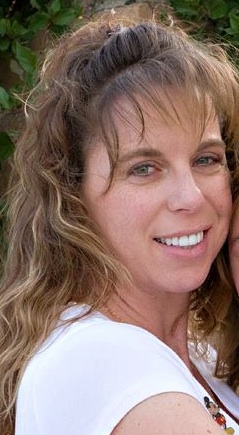
Russo, Kristin December 2014 After

Kristin Russo – Post-TBI Dec. 2014

1. What is your name? (last name optional)

Kristin Russo

2. Where do you live? (city and/or state and/or country) Email (optional)

Annandale, Virginia, USA

3. When did you have your TBI? At what age?

July 22, 2013 – I was 28.

4. How did your TBI occur?

My TBI was caused by a collision with a tractor-trailer. Read about it. “Kristin Russo accident.”

5. When did you (or someone) first realize you had a problem?

It was realized about 2-3 days into my stay in the ICU (Intensive Care Unit).

6. What kind of emergency treatment, if any, did you have?

I have no memory of the accident, the month in the hospital, and even the first 5-6 months at home under 24-hour care.

7. Were you in a coma? If so, how long?

Yes. My coma was induced.

8. Did you do rehab? What kind of rehab (i.e., inpatient or outpatient and occupational and/or physical and/or speech and/or other)? How long were you in rehab?

I had occupational, physical, speech, and recreational therapies for a month as an inpatient. I had therapy as an outpatient until May 2014 when all but physical therapy ended. I’m still in physical therapy for physical injuries.

9. What problems or disabilities, if any, resulted from your TBI
(e.g., balance, perception, personality, etc.)?

I have moderate to severe diminished visual memory, mild to moderate decreased attention span, diminished executive function, and mildly diminished speech and language function. Those are the significant findings as per my neurological addendum. It was also noted that I am likely to have significant permanent neurocognitive dysfunction due to the TBI. This problem with the physical brain injury is further complicated due the fact that I have significant PTSD (post-traumatic stress disorder). I have a college degree, yet I had to learn how to do things as simple as double-digit subtraction. My entire education has been wiped away. Since I graduated with honors, it was easy to get accepted to Liberty University. But, I can’t retain information anymore, so I’m not sure if I’m going to go back to try and learn everything all over again. My neurologist has diagnosed me with ADD (attention deficit disorder) due to the TBI. I’m not allowed to use anything hot without supervision, etc.

10. How has your life changed? Is it better? Is it worse?

Some things are better because I now have an excuse for being directionally challenged or for when I mess up (haha). 😉 Things are worse because I am dependent and I HATE IT! (I am an independent girl.) I was such an intelligent woman. I was still paying off my degree when the accident happened. Not being able to use ANY of the knowledge really made me unhappy. Not being able to work has been horrible because that is all I have ever known. I have been working since the day I turned 14. (My first day of work was on my 14th birthday). I worked at the same place until I graduated high school and went to college. I hate that I can no longer drive. I miss being able to do what I want to do when I want to do it. 😦 I live about eighty miles from where I grew up, so it’s not often that someone comes to visit me. The accident caused me to lose my family because my own father was stealing my pain pills for his sick addiction. I’ve lost some of my friends because I’m a totally different person personality-wise. I’m 100% honest, and I have dedicated my life to Jesus Christ. The girl in the accident died. She wasn’t the best wife. (I’d give more details, but those things are better kept between husband and wife. 😉 ) But, that’s why my accident happened, and I know it. God was showing me what was in front of me, and the same, for my husband. God was bringing us closer together, and that’s exactly what my accident did. So, that’s what I do like about the TBI. Another thing that I like about the TBI is that I don’t remember the accident or being in the hospital or even the 5-6 months after it. I also don’t remember my surgeries up to July. I remember the ones on Black Friday and December 1st. But, yeah, the girl I was before was a girl who drank a lot and went to clubs and acted like she was a single 21-year-old female. Since I’m not her anymore, I’ve lost a couple friends who were just like that girl. I don’t need those girls anyway!

11. What do you miss the most from your pre-TBI life?

I miss being able to drink alcohol sometimes – at least to drink socially. I miss being able to drive. I miss being able to do what I want when I want. I miss working. What I do now is to constantly go to appointments – it’s nuts! I am still in physical therapy – several months post accident. I just got yet another MRI scan (magnetic resonance imaging). I had surgery number eight on January 27th. I began speech therapy in January since insurance started paying again. I miss sleeping like a normal person. I miss being skinny. (I was a size 2 when I was married on July 7th, 2011, and I’m not that size anymore.) I hate being on so many damn medications. I loathe people’s not understanding invisible disabilities. I also have CRPS (complex regional pain syndrome) that was caused by the accident. It’s a chronic pain disease that has no cure.

12. What do you enjoy most in your post-TBI life?

I enjoy the fact that the Trauma Survivors Network Next Steps program taught me to find the positive in everything, so I do. When my legs hurt, I remind myself that I shouldn’t have any, so I thank God for letting me keep my legs! When I have my chronic headaches, I thank God for not making the swelling be so bad that I need to have surgery!

13. What do you like least about your TBI?

I don’t like that I sleep every other day sometimes. I dislike the chronic headaches and the fact that a headache is invisible. I don’t like having memory issues and being confused so often.

14. Has anything helped you to accept your TBI?

God

15. Has your injury affected your home life and relationships and, if so, how?

My husband gets rather upset when I forget that I’m not supposed to use a curling iron, and I fail to remember to turn it off. I no longer speak to my parents – my father makes fun of my TBI and acts like I’m making it up. (A*^#@~! ! I guess that’s what drugs do to ya.)

16. Has your social life been altered or changed and, if so, how?

I don’t really have a social life anymore. Things are so much louder now. People annoy me more. 😦 I have NO filter. I just want to be home with my husband or alone with my dogs. I haven’t watched TV since the accident.

17. Who is your main caregiver? Do you understand what it takes to be a caregiver?

My husband is my main caregiver.

18. What are your future plans? What do you expect/hope to be doing ten years from now?

I’ll be running a photography business. 🙂 And, I better be a mommy to more than just my fur babies!

Russo, Kristin Before Accident

Kristin Russo Pre-TBI

19. Are you able to provide a helpful hint that may have taken you a long time to learn, but which you wished you had known earlier? If so, please state what it is to potentially help other TBI survivors with your specific kind of TBI.

I urge people to try to make a positive out of everything. Depression is so ugly. I wish that I never hit that stage. Having a positive attitude has helped me SOOO much.

20. What advice would you offer to other TBI survivors? Do you have any other comments that you would like to add?

I give back now by volunteering at the hospital where I did my outpatient therapy. I got one of my dogs certified as a therapy dog, and we visit patients. I also visit patients in the trauma unit. My visits help others, and they also help me!


Thank you, Kristin, for taking part in this interview. I hope that your experience will offer some hope, comfort, and inspiration to my readers.

(Disclaimer: The views or opinions in this post are solely that of the interviewee.)

If you would like to be a part of the SPEAK OUT! project, please go to TBI Survivor Interview Questionnaire for a copy of the questions and the release form.

(Photos compliments of Kristin.)

As I say after each post:

Please leave a comment by clicking the blue words “Leave a Comment” below this post.

Feel free to follow my blog. Click on “Follow” on the lower right corner of your screen.

If you like my blog, share it with your friends. It’s easy! Click the “Share” buttons below.

If you don’t like my blog, “Share” it with your enemies. I don’t care!

Feel free to “Like” my post.


Trike Treks

April 9, 2015 to June 6, 2015

040915 David 1st Ride Catrike 700

David

Cumulative mileage for David                          616.2 mi

Donna

Donna

Cumulative mileage for Donna                         79.9 mi

Combined miles for Donna and David           696.1 mi

Miles to reach 5390* miles                             4693.9 mi

*done by both Catherine Brubaker and Dan Zimmerman in their cross-country rides

Cat TrikeZimmerman, Dan

As I say after each post: Please leave a comment by clicking the blue words “Leave a Commentanim0014-1_e0-1 below this post.

Feel free to follow my blog. Click on “Follow” on the upper right sidebar.

If you like my blog, share it with your friends. It’s easy! Click the “Share” buttons below.

If you don’t like my blog, “Share” it with your enemies. I don’t care!

Feel free to “Like” my post

SPEAK OUT! Faces of Brain Injury Davien Lopez

Brain Injury is Not Discriminating

bigstock-cartoon-face-vector-people-25671746-e1348136261718It can happen to anyone, anytime, . . . and anywhere.

The Brain Trauma Foundation states that there are 5.3 million people in the United States living with some form of brain injury.

On Faces of Brain Injury,” you will meet survivors living with brain injury. I hope that their stories will help you to understand the serious implications and complications of brain injury.

The stories on SPEAK OUT! Faces of Brain Injury are published with the permission of the survivor or designated caregiver.

If you would like your story to be published, please send a short account and two photos to me at neelyf@aol.com. I’d love to publish your story and raise awareness for Brain Injury – one view at a time.

Davien Lopez (survivor) contributed by Diana Lopez (mom and caregiver)

10501889_768245286553199_2546552260294944140_nI am the mother of a now six-year-old boy who has a TBI (traumatic brain injury). My son, Davien, was four and a half years old when people in a car were shooting at people in Davien Lopez with brotheranother car in front of our house. While Davien was napping in my arms, a stray bullet came through our bedroom window and the headboard and struck my son in his left frontal lobe. The bullet traveled diagonally across Davien’s face and lodged in the right side of his cheek. Davien suffers from bilateral frontal lobe brain damage. He had a fractured jaw, which is healed now. He is completely blind in his right eye. He has PTSD (post-traumatic stress disorder), ADHD (attention deficit hyperactivity disorder), a mood disorder, Davien Lopez 033015and an impulse disorder. A year and a half later, Davien runs around like nothing happened. He still has a ton of psychiatric issues, but that is nothing compared to what could have occurred. A smile emoticon here is a picture of Davien and Bruno (Davien’s service dog in training).

Disclaimer:
Any views and opinions of the Contributor are purely his/her own.

(Clip Art compliments of Bing.)

(Photos compliments of contributor.)

As I say after each post:

Please leave a comment by clicking the blue words “Leave a Comment” below this post.

Feel free to follow my blog. Click on “Follow” on the upper right sidebar.

If you like my blog, share it with your friends. It’s easy! Click the “Share” buttons below.

If you don’t like my blog, “Share” it with your enemies. I don’t care!

Feel free to “Like” my post

Caregivers SPEAK OUT! . . . . . Christina WIlliams

Caregivers SPEAK OUT! – Christina Williams

by

Donna O’Donnell Figurski

Christina WIlliams1. What is your name? (last name optional)

Christina Williams

2. Where do you live? (city and/or state and/or country) Email? (optional)

Pine, Colorado, USA

3. What is the TBI survivor’s relationship to you? How old was the survivor when he/she had the TBI? What caused your survivor’s TBI?

The TBI survivor was my fiancé. His TBI was caused by a motor vehicle accident. He was 37. I want to add that it was in 2008, so it happened more than six years ago.

4. On what date did you begin care for your TBI survivor? Were you the main caregiver? Are you now? How old were you when you began care?

I was at the scene of the accident. I was his main caregiver; I still am now. I began care as soon as I could. I was 47 when the accident happened.

5. Were you caring for anyone else at that time (e.g., children, parents, etc.)?

No

6. Were you employed at the time of your survivor’s TBI? If so, were you able to continue working?

I worked with my fiancé in our own business – building custom homes, decks, basements, bars, etc. We also designed and created log furnishings on the side. When he got hurt, I was unable to continue working. I lost my job because I assisted him. We lost both businesses.

7. Did you have any help? If so, what kind and for how long?

No

8. When did your support of the survivor begin (e.g., immediately – in hospital, when the survivor returned home, etc.)?

Never.

9. Was your survivor in a coma? If so, what did you do at that time?

Yes, my fiancé was in a coma. I sat at his bedside, cried, and prayed a lot. I NEVER left the hospital for 72 days. I finally did after he was transferred to the rehab hospital.

10. Did your survivor have rehab? If so, what kind of rehab (i.e., inpatient and/or outpatient and occupational, physical, speech, and/or other)? How long was the rehab? Where were you when this was happening?

My fiancé was accepted to Craig Hospital in Denver, Colorado, (one of the top ten rehabilitation facilities in the US for spinal cord and brain injuries) for intensive physical, occupational, and speech therapies. He also had group therapy, recreational therapy, and swim therapy. I was with him every day. I had to be there before breakfast to help dress and feed him and to get him to his daily “classes.” He remained an inpatient for three and a half months. He then became an outpatient. I took him to therapy three times a week at first. Over time, it decreased to one or two times a week. After about sixteen months, we no longer went. We still continue to go back to Craig Hospital for specialized therapies for issues he has had since the accident. The last one was vestibular therapy for vertigo symptoms. But, they couldn’t treat it, so they worked on his balance issues.

11. What problems or disabilities of your TBI survivor required your care, if any?

He has epilepsy due to his TBI, so he requires supervision 24/7. He can never be left alone. Because of seizures and balance issues, he has frequent falls and injuries that require medical attention and trips to the Emergency Room. He can’t drive or work. He requires prompting for many of daily living skills, including hygiene, which is a huge issue.

12. How has your life changed since you became a caregiver? Is it better? Is it worse?

Both our lives have changed drastically. Our lives are worse, since we can’t have the “normal” life together that we expected. We now realize that we took our lives for granted. Buying a home or a new car and taking vacations are no longer possibilities in our lives.

13.  What do you miss the most from pre-TBI life?

I miss the freedom and having hope for the future.

14. What do you enjoy most in post-TBI life?

I enjoy spending time with him every day. Every day is NOT “sunshine and roses,” but we make the best that we can out of every day. He is simply amazing. I look at him and watch him in awe, as he does whatever he does. I have a saying: “Let’s just hope today is better than yesterday.” It helps us focus on the positives in every day.

15. What do you like least about TBI?

I dislike that the TBI has destroyed such a good person and his future. We also lack the money and the ability to do whatever we want.

16. Has anything helped you to accept your survivor’s TBI?

Yes. God.

17. Has your survivor’s injury affected your home life and relationships and, if so, how?

We were officially engaged two days before the accident. We were SO in love and excited to be planning our future. Since his injury, his emotions (or I should say “ his lack of emotions”) and his poor judgment have caused us many, many problems.

18. Has your social life been altered or changed and, if so, how?

We have no social life. ALL our “friends” vanished after he was hurt. Our social life is whatever we do in our day. When he has a doctor or therapy appointment, we plan a whole day in the city together.

19. What are your plans? What do you expect/hope to be doing ten years from now?

I don’t have any hopes or plans anymore. We just take it a day at a time. In ten years, I imagine that we will still be doing what we’re doing now, but perhaps in a different house.

20. What advice would you offer other TBI survivor caregivers? Do you have any other comments that you would like to add?

Turn to Facebook for support, especially the TBI pages. You may not know the people, but they have been a constant and great support not only to me, but also to so many others – survivors, caregivers, and their families and friends. It’s nice to read the stories of others and to share comments and advice. When my fiancé was hurt, I wasn’t using Facebook. It would have been so nice just to know that I wasn’t alone in my journey. Facebook is my “human” outlet for support. I have also come to find out that I can help others. That is more rewarding to me than I can say.

I think what I would want people to know that they aren’t prepared for is that it is VERY common for TBI survivors to start having seizures a year or so after the injury. It was something we weren’t prepared for, or even thought could happen. He was on anti-seizure meds while in rehab, but there was “no seizure activity.” So, they took him off the medication, and I thought it would never be a concern. Boy, was I wrong!Christina Williams 2012

Thank you, Christina, for taking part in this interview. I hope that your experience will offer some hope, comfort, and inspiration to my readers.

If you would like to be a part of this project, please go to TBI Caregiver Interview Questionnaire for a copy of the questions and the release form.

(Photo compliments of Christina.)

Disclaimer: The views or opinions in this post are solely that of the interviewee.


“Another Fork in the Road” . . . Brain Injury Radio Network . . . Interview: Jeannette Davidson-Mayer

putthis_on_calendar_clip_artYOU Are Invited!

When Jeannette Davidson-Mayer’s husband, DeWayne, had five brain injuries – the result of his active duty in Iraq – Jeannette became his caregiver. To combat this 24-hour job, Jeannette redesigned her kitchen to become the family’s ?Central Command Post.” Jeannette will discuss how she, DeWayne, and their daughter make this system work for them.

Come One! Come ALL!

What:        Interview with Jeannette Davidson-Mayer, caregiver to spouse, DeWayne Mayer

Why:        Jeannette will talk about how she and DeWayne and their daughter live on the TBI Trail.

Where:     Brain Injury Radio Network

When:       Sunday, April  19th, 2015

Time:         5:00p PT (6:00p MT, 7:00p CT, and 8:00p ET) 90 minute showjeannette davidson-Mayer 041715

How:         Click: Brain Injury Radio Network

Call In:    424-243-9540

Call In:     855-473-3711 toll free in USA

Call In:    202-559-7907 free outside USA

or SKYPE

If you miss the show, but would like to still hear the interview, you can access the archive on On Demand listening. The archived show will be available after the show both on the Brain Injury Radio Network site and on my blog in “On the Air.”

(Clip Art compliments of Bing.)

(Photo compliments of Jeannette Davidson-Mayer.)

SPEAK OUT! . . . . . . . . . . . . . . . . . Itty-Bitty GIANT Steps

11136933_10155590257065643_153293147_nLisa Marie Cohen (survivor)…I hiked a mountain! It was Mount Beacon on the Hudson River.

Bonita Gibb (caregiver)…I was reflecting on how I came to be the person I am today. One of the moments in my life canstock5980362that showed me my true colors was sitting in the ICU (intensive care unit) and praying for a miracle. It was during that dark time that I realized just how strong I am. While I would do anything to give my husband, Brian, back his independence, I also am thankful for that moment and all it had to teach me.

Sarah Klingler (survivor)Graduate broomfield-orthodontics-graduation-cartoonI learned that I can do anything as long as I put my mind to it. I got my TBI when I was eight. I started having seizures the next week, and they haven’t stopped. As a result, I’ve never driven. But, I graduated from high school with honors, and I am two semesters from getting my Bachelor’s Degree in elementary education.

Pamela Miceli (caregiver)Welcome HomeMy son came home for good last week after fifteen months of rehab! Can we say that this is a Great Big Giant Step?

Tina Thorne (caregiver)…My son, Jordan, is a two-time brain-cancer survivor and has had an ABI (acquired brain injury) since the age of twelve. He is eighteen now. He received a very nice message from a lady representing the Brain Tumour Foundation of London, Ontario, Canada. The foundation wanted Jordan to attend a special dinner for an event on the foundation’s behalf. docs-on-ice-generic“Docs on Ice” is an annual event that travels from community to community. Nine hundred doctors from across Ontario come to a city and raise money for an individual charity every year. This year the city is London and the charity is the Brain Tumour Foundation. Darryl Sittler, a retired National Hockey League player who was elected to the Hall of Fame and who played for the Toronto Maple Leafs, was the guest speaker. Jordan was an ideal choice. He is a brain-injury survivor and a hockey buff. He thanked Darryl Sittler for helping to raise funds for the Brain Tumour Foundation and for raising awareness of brain injury. Jordan also met Master of Ceremonies Joe Bowen, “The Voice of the Leafs.” The mayor of London was also in attendance. I am super proud of Jordan!

Kimberly June West (survivor)…I am a consultant for a therapeutic oils company! YAY! These oils are awesome. I was getting sad from all my pain. EssentialOilsThey have given me a love for life and a passion for living. These are products that people love – bath infusions for pain, migraines, eczema, difficulty sleeping, etc. The awesome thing is that I made the leadership team and VIP consultant two months in a row!

YOU did it!

Congratulations to all contributors!

(Clip Art compliments of Bing.)

SPEAK OUT! . . . . . . . . . . . . . . . . . . . Guest Blogger: Kristin Olliney . . . My Fight: The Reason to Advocate

My Fight: The Reason to Advocate

by

Kristin Olliney

(presented by Donna O’Donnell Figurski)

Girl Blogger cartoon_picture_of_girl_writingIsabella’s Acquired Brain Injury (ABI) is the result of sudden acute encephalitis. However, there was also medical error involved in her care. Given the many factors involved, it is difficult to prove which symptom caused what damage. Due to this, no one will ever be held accountable for what happened. As a result, there are four important reminders that everyone needs to know.

  1. It doesn’t matter where you live. Even in the best city, at the best hospital, with the best doctor, mistakes can happen. I am often told how lucky I am to live in the Boston area because we have access to so many medical facilities. While this is true, not all doctors and care are the same.
  1. Doctors are human. They are people who have studied medicine and, based on their knowledge, give you their opinion. It is not fact. It is opinion. Their opinion is their best guess. This is so important to remember, especially when given a prognosis. Isabella, like many other survivors, was not supposed to make it through the night, and yet she did.

    Kristin Olliney with Isabella 2014

    Kristin Olliney with Isabella 2014

  1. Always follow your gut instinct, especially if something doesn’t seem right. Ask questions. When Isabella first got sick, the Emergency Department wanted to discharge her with a stomach bug. I knew that there was something seriously wrong. I can’t explain how I felt – only that I just knew. I fought and advocated to get Isabella admitted into the hospital. One of Isabella’s specialists was on call, and he trusted my gut instinct. Later in the PICU (pediatric intensive care unit), as I watched my child fighting for her life, I was told by him and other doctors that my fighting and advocating saved Isabella. If Isabella had been discharged, she would have died. Always fight and advocate for what you feel is right. You know your child/loved one better than anyone.
  1. Get another opinion. When you are in crisis, there isn’t always time. When things stabilize, seek out another opinion should you and the doctor have a difference of opinion. On this journey, things can change. Opinions differ, treatment options vary, and, if there are fundamental differences, another opinion can help.

    Kristin Olliney & daughter, Isabella  2015

    Kristin Olliney & daughter, Isabella
    2015

For me, it is hard knowing that the doctors who cared for my daughter made mistakes. Coming to terms with the fact that no one will ever be held accountable for what happened to Isabella is difficult. I know Isabella is here because I fought and advocated. It is still devastating to know that mistakes could have been prevented. I am sharing this part of our journey in hopes that it will encourage others to continue to fight and advocate for their child/loved one. Against all odds, my amazing miracle is here today, and, for that, I am forever grateful.

To learn more about Kristin and Isabella, please visit Kristin’s website/blog at In An Instant Your Life Can Change Forever – Brain Injury Association of Massachusetts Blog

Thank you, Kristin Olliney.

Disclaimer:
Any views and opinions of the Guest Blogger are purely his/her own.

(Clip Art compliments of Bing.)

(Photos compliments of Kristin Olliney.)

As I say after each post:

Please leave a comment by clicking the blue words “Leave a Comment” below this post.

Feel free to follow my blog. Click on “Follow” on the lower right corner of your screen.

If you like my blog, share it with your friends. It’s easy! Click the “Share” buttons below.

If you don’t like my blog, “Share” it with your enemies. I don’t care!

Feel free to “Like” my post.

TBI Tales . . . Tracking Miles in Electric Blue and Shiny Mango

Tracking Miles in Electric Blue and Shiny Mango

by

Donna O’Donnell Figurski

Cat TrikeCatherine (Cat) Brubaker (TBI survivor) got a black Catrike 700. Dan Zimmerman (StrokeZimmerman, Dan survivor) got a black Catrike 700. They pedaled across America diagonally, 5,300 miles, and it changed each of their lives.

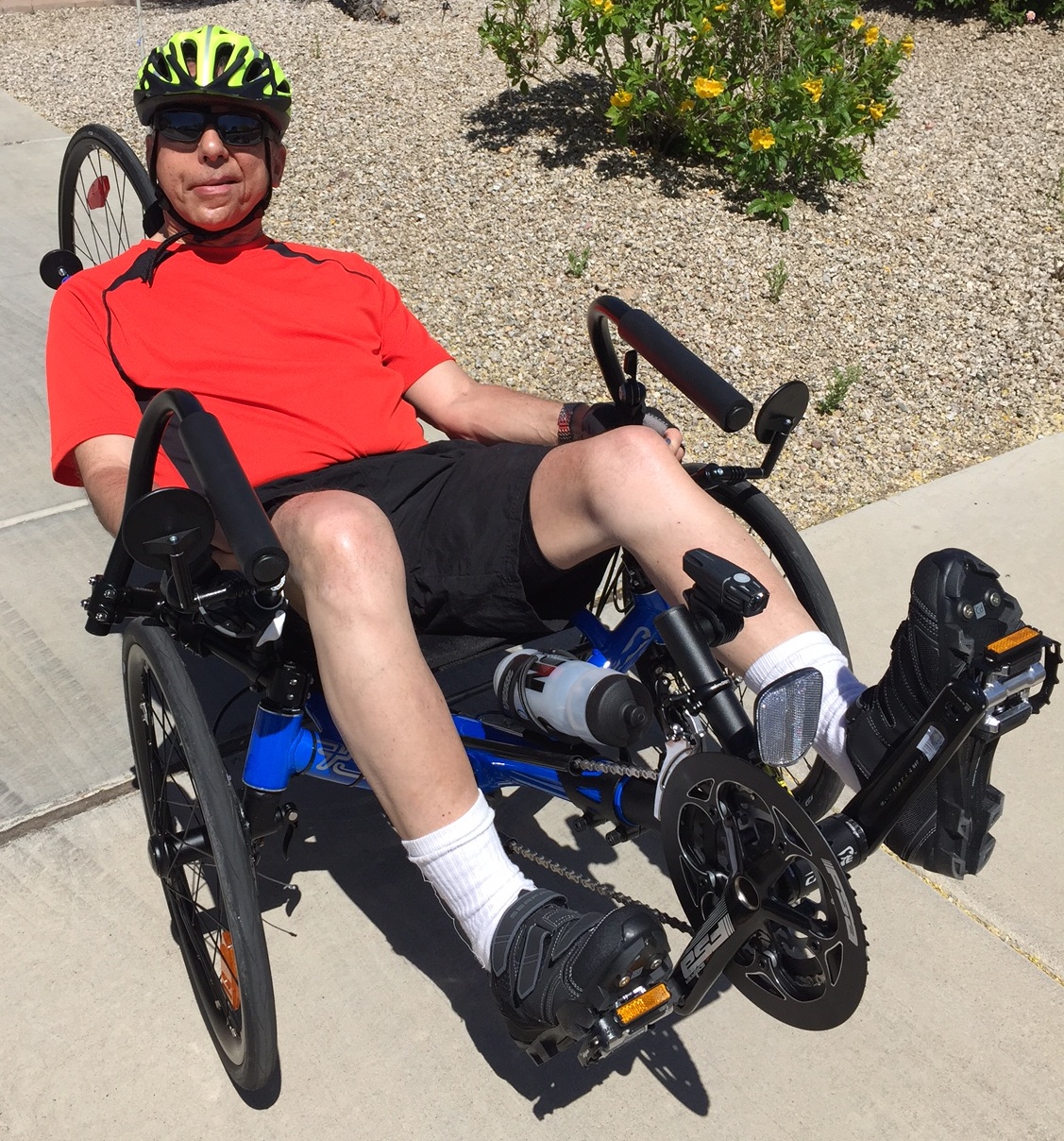
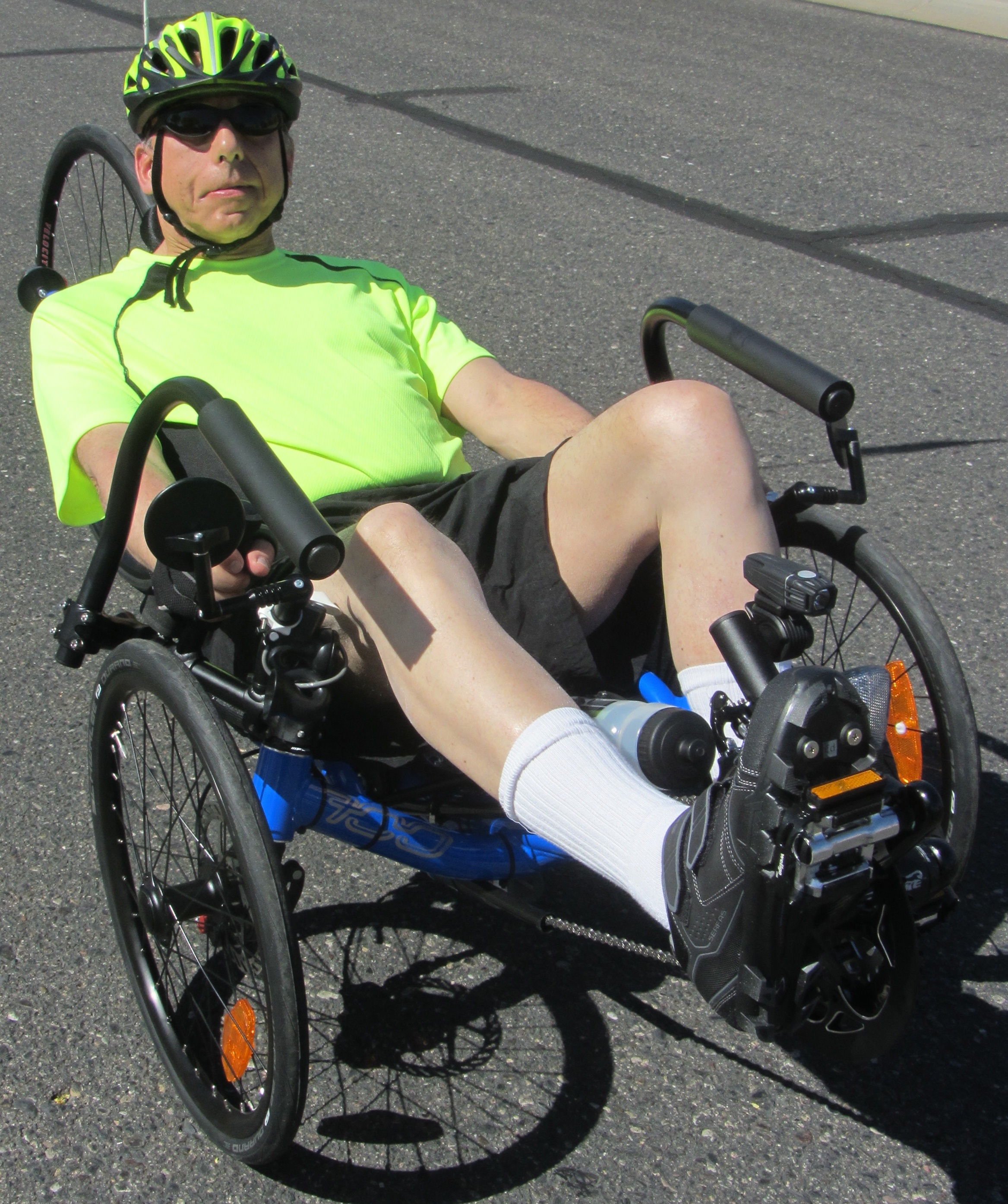
David Figurski (TBI survivor) got a trike, an electric blue Catrike 700, the same model as Cat and Dan’s, but a different color.040915 David 1st Ride Catrike 700

Donna O’Donnell Figurski (copycat) got a trike, too. Though to show her independence, she didn’t get a Catrike 700. She went for the Donna's Pocket 040915Shiny Mango Pocket Trike. It’s cute!

DonnaNow David and Donna want to match Cat and Dan’s GOAL! We want to trike 5,300 miles in the desert. I wonder how long it will take us.

LET’S GO!

NAME          DATE                     Total MILES since 4/9/15

David           1/24/16                    1,570

NAME          DATE                    Total MILES since 4/9/15

Donna          1/24/16                 79

As I say after each post:

Please leave a comment by clicking the blue words “Leave a Comment” below this post.anim0014-1_e0-1

Please follow my blog. Click on “Follow” on the top right sidebar. (It’s nice to know there are readers out there.)

If you like my blog, share it (intact) with your friends. It’s easy! Click the “Share” buttons below.

If you don’t like my blog, “Share” it (intact) with your enemies. I don’t care!

Feel free to “Like” my post.

(Clip Art compliments of Bing.)

(Photos compliments of Me.)

TBI Tales . . . . . . . . . . . . . . . . . . Freedom and a Blue, Metallic Trike

FREEDOM and a Blue-Metallic Trike

(presented by Donna O’Donnell Figurski)


040915 David 1st Ride Catrike 700April 9, 2015 marks a pretty exciting day for us. It’s the first official day of David’s independence since his brain injury in 2005. David recently bought a Catrike 700 recumbent trike. This sleek, low-to-the-ground, metallic-blue machine will be his wheels and his freedom.

Because of severe balance issues due to his brain injury and the damage to his cerebellum, David has been unable to leave our home unattended for the past ten years. With his Catrike 700, he can hop on and and pedal away for hours and hours. (Well, not really hop on, but that sounded better than crawl or climb on.) Of course, his limitation of getting off the trike because he is unableFigurski, David Trike to walk anywhere on his own remains a problem. But, that won’t deter David.

David’s first excursion was a 5-mile trip around the winding, scenic roads in our neighborhood. Pedaling down streets lined with palm trees and a variety of cacti, many of which are in bloom right now, was liberating and fun, if the grin plastered on his face when he returned was any indication.

DonnaLater the same afternoon, David guided me on my first recumbent-trike trip. I have a yellow/mango Pocket Catrike, and I love it.

Today, David is riding with friends in a neighboring community. What fun! This is only the beginning.

Donna's Pocket 040915

As I say after each post:

Please leave a comment by clicking the blue words “Leave a Comment” below this post.anim0014-1_e0-1

Please follow my blog. Click on “Follow” on the top right sidebar. (It’s nice to know there are readers out there.)

If you like my blog, share it with your friends. It’s easy! Click the “Share” buttons below.

If you don’t like my blog, “Share” it with your enemies. I don’t care!

Feel free to “Like” my post.


(Clip Art compliments of Bing.)

(Photos compliments of Me.)

SPEAK OUT! . . . . . . . . . . . . . . . . . Itty-Bitty GIANT Steps

Michelle Lee Bonnenfant (survivor)…With hubby’s help, I made it through a busy grocery store. pix0138Ken, my hubby, got me in and out in one piece! He even stood three feet behind me in the check out so that I would not get crowded by people. It was the first time in months that I went through a check out. I was plagued by a lot of sweat and chest pain, but I still did it. I hate my TBI and PTSD (post-traumatic stress disorder), but Ken gave me a big hug and told me that he was proud of me. I’m exhausted, but pleased with myself!

Cara Lauderdale Eberle (caregiver)…The one-year anniversary of my husband’s accident was April 1st. While I was at work sitting at a table of four-year-olds trying to get them to do a project with me, Eberle,  Cara Lauderdale  FlowersI saw them all stop and look up. Standing next to me was my husband holding a beautiful bouquet of flowers. I was in complete shock! He hasn’t shown any concern for the feelings of others since the accident. He told me he thought that he should do something to thank me for helping him get through the last year. This was definitely a breakthrough moment for us. 🙂

David Figurski (survivor)…I am excited! I took delivery of a Catrike 700 recumbent trike. It’s the same model that was used by Catherine Brubaker (a two-time TBI survivor) and Dan Zimmerman (a stroke Figurski, David Trikesurvivor) on their five-month, cross-country ride from Washington State to Florida. Cat and Dan espouse their new-found freedom, and their new physical capabilities are truly amazing. They both believe that riding a recumbent trike is great therapy. Also, my wife, Donna, just took delivery of the Catrike Pocket, a slightly smaller trike. Donna, Cat, Dan, and I plan to ride together.

Corina Mendoza (survivor)…I passed my teaching exam for Special Education! I passed both teaching exams I needed on the first try.

Mendoza, Corina Test Scores 033015


YOU did it!

Congratulations to all contributors!

(Clip Art compliments of Bing.)

diemodi jewelry

uniquely hand-crafted jewelry by donna

Welcome to Harmony Kent Online

The home of all things books

Pete Springer

Passionate Teacher and Future Children's Author

HOPE TBI

Helping Other People Excel - To Be Independent

For the Love of Books, Old and New

Katie Fischer, Writer and Reader of Stories

Charlie Bown

Children's Author

Jessica Hinrichs

“We write to taste life twice, in the moment and in retrospect.” ― Anais Nin

VIVIAN KIRKFIELD - Writer for Children

Picture Books Help Kids Soar

Mindy’s Writing Wonderland

For authors, parents, teachers & everyone who loves children’s books.

Kaitlyn Leann Sanchez

Literary Agent

Surviving Traumatic Brain Injury

TBI - Survivors, Caregivers, Family, and Friends

The Care Factor

Loving someone with a Traumatic Brain Injury

Brain Injury Support Group of Duluth-Extension

Brain Injury Information and SUPPORT

Brain Aneurysm Global Insight

Brain Aneurysm, cerebral hemorrhaging, hemorrhage stroke