TBI – Survivors, Caregivers, Family, and Friends

Posts tagged ‘Another Fork in the Road’

“Another Fork in the Road” . . . Brain Injury Radio Network . . . . . Dr. David Figurski – Prisoner Without Bars

YOU ARE INVITED!

putthis_on_calendar_clip_art

You’ve heard my story about David’s Traumatic Brain Injury and how we have come to be in this place that we are now. It’s David’s turn to step up to the mic to talk about his perspective of living with a TBI, as I interview him about the past 9+ years. He promises that I may even learn something. I wonder if it’s about the black mark on the wall.


Come One! Come ALL!

(NOTE: New Day, Sunday – Same Time)

What:        Interview with Dr. David Figurski – Prisoner Without Bars. (Segment 4 of “Prisoner Without Bars: Conquering Traumatic Brain Injury”)

Why:         Hear David’s perspective of living with Traumatic Brain Injury

Where:     Brain Injury Radio Network

When:       Sunday, November 2, 2014

Time:         5:00p PDT (6:00p MDT, 7:00p CDT, and 8:00p EDT) 90 minute show

How:         Click: Brain Injury Radio Network.

Call In:    424-243-9540

Call In:     855-473-3711 toll free in USA

Call In:    202-559-7907 free outside US

or SKYPE

If you miss the show, but would like to still hear the interview, you can access the archive on On Demand listening. The archived show will be available after the show both on the Brain Injury Radio Network site and on my blog in “On the Air.”

(Clip Art compliments of Bing.)

Survivors SPEAK OUT! Bart Boughner

SPEAK OUT! – Bart Boughner

by

Donna O’Donnell Figurski


Bart Boughner - TBI Survivor

Bart Boughner – TBI Survivor

1. What is your name? (last name optional)

Bart Boughner

2. Where do you live? (city and/or state and/or country) Email (optional)

St. Williams, Ontario, Canada

3. When did you have your TBI? At what age?

37

4. How did your TBI occur?

I fell about 5 feet off a step ladder at work, striking my head on the concrete foundation.  It happened ~45 minutes before the end of the day…the day before my daughter’s 8th birthday.

5. When did you (or someone) first realize you had a problem?

The seriousness of my fall was realized about a half hour later. My leg couldn’t hold me, and I had blood coming from my ear and cuts on my wrist.

6. What kind of emergency treatment, if any, did you have?

I was in the local hospital for about five hours. They didn’t ship me earlier to a trauma center because they didn’t think I would make the trip. They took a wait-and-see approach, since the bleeds didn’t change too much. I was in the ICU (Intensive Care Unit) for 1 week, and then I was in the Step Down Unit for another week. I was then moved back to my local hospital for 3 more weeks.

7. Were you in a coma? If so, how long?

No

8. Did you do rehab? What kind of rehab (i.e., inpatient or outpatient and occupational and/or physical and/or speech and/or other)?

I had outpatient rehab for 1 year for physical, occupational, and speech therapies, then again 2 years after I was hospitalized.

How long were you in rehab?

Just over 1 year

9. What problems or disabilities, if any, resulted from your TBI
(e.g., balance, perception, personality, etc.)?

Well now, I have an issue with short-term memory;  I severed my olfactory nerve, affecting my senses of smell and taste; I experience exhaustion; I have a problem with sleep; and I have no tolerance.

10. How has your life changed? Is it better? Is it worse?

For 11 1\2 years, my life was worse to the point that I gave up. I went into a hole and rarely went out. My marriage went down hill fast, since we couldn’t communicate. My marriage ended September 16, 2013. I lost so many friends and family, some from my own choice. I found it hard to trust.

11. What do you miss the most from your pre-TBI life?

My energy and my love of life

12. What do you enjoy most in your post-TBI life?

Now I have my own independence. My kids chose to live with me. I’m letting go of the past and now living now.

13. What do you like least about your TBI?

Overwhelming situations, severe headaches, lack of patience

14. Has anything helped you to accept your TBI?

The first neuro doctor told me straight out I would be different. Also my new independence is helping me accept my TBI.

15. Has your injury affected your home life and relationships and, if so, how?

My injury destroyed everything, but eventually my kids had the chance to know me for myself without people telling them things. It’s the best thing that happened.

16. Has your social life been altered or changed and, if so, how?

Yes, I became reclusive and couldn’t tolerate too many people at once. Now I’m better.

17. Who is your main caregiver? Do you understand what it takes to be a caregiver?

I am my own caregiver. Yes, I do understand about caregivers.

18. What are your future plans? What do you expect/hope to be doing ten years from now?

I’m building on my bucket list. I plan to continue enjoying life and laughing with my kids. Soon I will be 50. What I’ll be doing in 10 years is hard to say. I live life day-to-day.

19. Are you able to provide a helpful hint that may have taken you a long time to learn, but which you wished you had known earlier? If so, please state what it is to potentially help other TBI survivors with your specific kind of TBI.

Speak for yourself, instead of letting others do it for you. Realize that the past is the past. Nothing can bring it back. Learn to laugh again and not to be so frustrated when you can’t accomplish things. Find support groups (e.g., Facebook) early.

20. What advice would you offer to other TBI survivors? Do you have any other comments that you would like to add?

Be strong. Keep your voice, and let it be known. Never dwell on things – they can put you in a deep, dark place with only a small window of light. Believe in yourself. If friends treat you differently, tell them. If they cannot adjust, then let them go on your terms. LIVE, LOVE, AND LAUGH!!!!!!!!

Bart Boughner - TBI Survivor with his children

Bart Boughner – TBI Survivor with his children


Thank you, Bart, for taking part in this interview. I hope that your experience will offer some hope, comfort, and inspiration to my readers.

(Disclaimer: The views or opinions in this post are solely that of the interviewee.)

(Photos compliments of Bart.)

If you would like to be a part of the SPEAK OUT! project, please go to TBI Survivor Interview Questionnaire for a copy of the questions and the release form.

TBI Tales: One Usable Hand

Living With One Usable Hand

by

Dorothy Mah Poh Choo

(presented by Donna O’Donnell Figurski)


As a hemiplegic, I have one usable hand. It’s definitely very challenging. To carry on with life, I had to find new ways of doing things. I lost my job when I could not return to work full-time. Though I live with my children, I am home alone during the day when they go to work.

I learnt that the saying “Necessity is the mother of invention” is true. Creative thinking can find new solutions to old ways. Besides finding new ways, I also use many aids, the most useful of which is a portable trolley. With it, I can carry things around. I found a one-touch can opener, which does the job with just one press of a button.th-1

The fingers of my remaining hand can do much more than before. I can hang socks on a peg carousel with one hand. Using a peg system I invented, I hang towels and small items on an airer. (It was most frustrating trying to hang undies before that.) I still do most indoor house chores. Washing dishes is very noisy, but I do my best.

My best achievement is putting the bread clip back onto the bread bag, after an occupational therapist I asked in rehab told me it couldn’t be done with one hand. It is important to acknowledge all achievements, no matter how small.

Cutting Board with NailsI cut meat and vegetables using a special cutting board with nails in one corner to hold the item. I butter bread using a special board with raised sides that hold the bread in place. I open jars by pressing down on an anti-slip mat, which stops the jar from moving. There are mats everywhere. There is one where I eat so the plate doesn’t move around. I cook using a heavier pan so it doesn’t turn round and round from stir-frying. I use the gas burner closest to the wall so that the pan doesn’t fall off the stove onto me.

Doing things with one hand is a matter of breaking the activity down into individual steps. For example, to put a cup into the cupboard, I open the cupboard door, get the cup, then put it into the cupboard. Before I had only one good hand, I would just take the cup, open the door with one hand, and put the cup in with the other hand.207041972

Of course, some results won’t be as good as they would be using two hands. I have accepted that and learnt to laugh at myself. Folding clothes takes double the time now and results in a messy pile. Wrapping presents is a sloppy task. After I lost my left arm, I wrapped presents for the last time at the end of that year. I handed the “wrapped” presents to my friends saying, “Sorry – not my best effort. It’s a one-handed job”. LOL! Life is better when you are laughing.

Doing things with only one hand takes a lot of patience and determination. I keep trying until I do it. I’m also very safety conscious. If I can work out in my mind to do something safely, I will do it. Waiting for someone else to do something can be quite frustrating. (I don’t like sitting on leather chairs – it’s cold. I had an old doona on the electric recliner I sleep in. It kept slipping off, and it annoyed me terribly. I had the brilliant idea to sew one end so it would slip over the chair like a cover. I asked my daughter to do it, but she was very busy, and the days stretched on. I got up one morning, helpplanned everything in my head, took some measurements, threaded the needle using a needle-threader, and off I went. The work took four hours, but I did it. My daughter didn’t notice it for weeks, until I pointed out that she didn’t need to do it for me anymore. She was impressed.)

Most things are possible if you put your mind to it. If something is truly hard, ask for help. It is not worth it to get hurt.

I have learnt that success is just one more try after failure. Life is worth living. Don’t give up.


Thank you, Dorothy, for sharing your story in TBI Tales. I hope that your experience will offer inspiration to my readers.

(Disclaimer: The views or opinions in this post are solely that of the author.)


If you have a story to share and would like to be a part of the SPEAK OUT! project, please submit your TBI Tale to me at donnaodonnellfigurski@gmail.com. I will publish as many stories as I can.

(Clip Art compliments of Bing.)


As I say after each post:

Please leave a comment by clicking the blue words “Leave a Comment” below this post.anim0014-1_e0-1

Please follow my blog. Click on “Follow” on the lower right corner of your screen. (It’s nice to know there are readers out there.)

If you like my blog, share it with your friends. It’s easy! Click the “Share” buttons below.

If you don’t like my blog, “Share” it with your enemies. I don’t care!

Feel free to “Like” my post.


On the Air – Brain Injury Radio Julie Kintz Substitutes for Donna O’Donnell Figurski

On the Air – Brain Injury Radio

Julie Kintz sits in for Donna O’Donnell Figurski

Mark Ittleman, MS CCC-SLP, speech & language pathologist

 images-1

Due to a prior engagement, I was unable to host my show, Another Fork in the Road on the Brain Injury Radio Network on October 19, 2014. Fortunately for me and all my listeners, Julie Kintz of Quantum Leap stepped into her host shoes and interviewed a very interesting guest. Mark Ittleman, a speech and language pathologist, spoke of the many difficulties brain-injured survivors encounter after their injury. I will be back on November 2nd with Dr. David Figurski, (my spouse) who will give his perspective of his life as he conquers traumatic brain injury.

Mark explained his philosophy of therapy (it should be doable, interesting, and enjoyable), his methods (analysis, repetition, and modeling), and his strong desire to involve the caregiver (by his or her presence in the sessions, by learning from him, and by his writing simple-to-understand books – he’s working on one now). Mark cautioned survivors to get more than one prognosis because a prognosis is only a doctor’s opinion and because survivors are often more capable than people realize. Mark understands the power of the ability to communicate and suggested that survivors – even years after their trauma – can benefit from having a speech therapist.

If you missed the show, don’t fret. You can always listen to the archived show. I’ve included the link below.

Please SHARE!

I hope you’ll tune in to my show, Another Fork in the Road, which airs the 1st and 3rd Sunday evenings of every month. The show starts at 5:00p Pacific Time and runs for 90 minutes. On the 2nd and 4th Sundays at 5:00p Pacific Time, Julie Kintz hosts Quantum Leap. When there is a fifth Sunday in a month, Julie and I will team up to cohost a show called Another Quantum Leap in the Road.

See you “On the Air!”

(Click the link below to listen to the show.)

Julie Kintz interviews Mark Ittleman M.S. CCC/SLP. Mark will address speech difficulties after brain injury in both children and adults.  

“Another Fork in the Road” . . . Brain Injury Radio Network with Julie Kintz and Mark A. Ittleman, M.S., CCC/SLP

YOU ARE INVITED!


putthis_on_calendar_clip_artJulie Kintz of “Quantum Leap” will be substituting for Donna O’Donnell Figurski of “Another Fork in the Road” on the Brain Injury Radio Network.

Julie’s guest will be Senior Speech Language Pathologist-Author Mark A. Ittleman, M.S., CCC/SLP. Mark Ittleman will discuss speaking difficulties and tell how loved ones can help improve the speech of their survivor at home in a fun and easy way.

Come One! Come ALL!

(NOTE: New Day, Sunday – Same Time)

What:        Host, Julie Kintz of “Quantum Leap” substitutes for “Another Fork in the Road” host, Donna O’Donnell Figurski.

Why:         Hear Mark A. Ittleman, M.S., CCC/SLP discuss speaking difficulties.

Where:     Brain Injury Radio Network

When:       Sunday, October 19th, 2014

Time:         5:00p PDT (6:00p MDT, 7:00p CDT, and 8:00p EDT) 90 minute show

How:         Click: Brain Injury Radio Network.

Call In:    424-243-9540

Call In:     855-473-3711 toll free in USA

Call In:    202-559-7907 free outside US

or SKYPE

If you miss the show, but would like to still hear the interview, you can access the archive on On Demand listening. The archived show will be available after the show both on the Brain Injury Radio Network site and on my blog in “On the Air.”

(Clip Art compliments of Bing.)

Survivors SPEAK OUT! Melissa Cronin

SPEAK OUT! – Melissa Cronin

by

Donna O’Donnell Figurski


Melissa Cronin Head Shot 2

Melissa Cronin

1. What is your name? (last name optional)

Melissa Cronin

2. Where do you live? (city and/or state and/or country) Email (optional)

South Burlington, Vermont, USA

3. When did you have your TBI? At what age?

Age 36

4. How did your TBI occur?

In 2003, when visiting the Santa Monica Farmers’ Market, an elderly driver confused the gas pedal for the brake and sped through the market. I was thrown forward, and my head hit the pavement. The force of the impact resulted in a ruptured spleen and multiple fractures, including my pelvis.

5. When did you (or someone) first realize you had a problem?

Fourteen months after the accident, when I returned to part-time work as a public health nurse, I experienced increased fatigue, difficulty concentrating, and multitasking. My boss threatened to fire me, so I resigned and attempted part-time work in a pediatrician’s office (bad idea for someone with a TBI), but I struggled to keep up in a fast-paced environment. In May 2006, I finally saw a neuropsychiatrist for testing, and the results proved to be consistent with a TBI.

6. What kind of emergency treatment, if any, did you have?

I did not have emergency treatment for a TBI. The CT (computerized tomography, also known as “CAT”) scans showed no bleeding (typical for a “mild” TBI). I did have emergency surgery, though, to remove my ruptured spleen.

7. Were you in a coma? If so, how long?

No

8. Did you do rehab? What kind of rehab (i.e., inpatient or outpatient and occupational and/or physical and/or speech and/or other)? How long were you in rehab?

I had physical and occupational therapy at Cedars Sinai Hospital in Los Angeles to help regain muscle mass and strength after being hospitalized for nearly one month. I would be in a wheelchair for four months while my fractures healed, so rehab taught me ways to navigate through my day.

9. What problems or disabilities, if any, resulted from your TBI
(e.g., balance, perception, personality, etc.)?

Fatigue, difficulty multitasking and concentrating, occasional irritability, depression; and difficulty processing verbal, auditory, and visual information

10. How has your life changed? Is it better? Is it worse?

My life is both better and worse. It’s better because my TBI, and other injuries, opened up a path for me to writing. And my husband, whom I met only three weeks prior to the accident, has been my strongest support. It’s worse because I eventually had to give up my 20-year nursing career.

11. What do you miss the most from your pre-TBI life?

Running and skiing, and the babies I cared for in the neonatal intensive care unit where I worked before my injury

12. What do you enjoy most in your post-TBI life?

Writing, playing the Irish fiddle, going for walks, and, of course, my husband’s unwavering support

13. What do you like least about your TBI?

I’m much slower at getting things done. I often sleep in until 9:30 or 10:00 am, and I feel as if I’ve wasted much of the day. Also, I often fail to understand concepts others seem to grasp so easily.

14. Has anything helped you to accept your TBI?

I’ve been helped by the neuropsychiatrist who diagnosed me with a TBI and by the cognitive therapist who treated me. Also, my therapist – he continually reminds me that my brain has been rewired.

15. Has your injury affected your home life and relationships and, if so, how?

Definitely my home life has been affected. I rely on my husband to do much of the “heavy” lifting, like cooking, grocery shopping, and driving, because I am easily distracted.

16. Has your social life been altered or changed and, if so, how?

Absolutely. I do not socialize as much as I did before my injury because it doesn’t take much for me to become fatigued.
9781611592399_p0_v3_s260x420

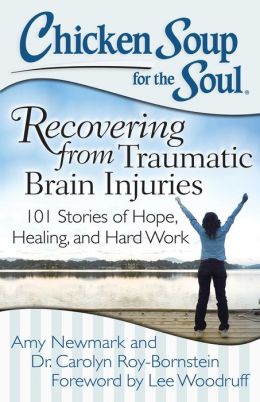
“Invisible Bruise” Chicken Soup for the Soul: Recovering from Traumatic Brain Injuries. June 2014

17. Who is your main caregiver? Do you understand what it takes to be a caregiver?

I am my own main caregiver, though my husband does much of the cooking. I do not know what it takes to be a caregiver, though my father is living with Alzheimer’s, and I help out as much as I can.

18. What are your future plans? What do you expect/hope to be doing ten years from now?

Writing and traveling

19. Are you able to provide a helpful hint that may have taken you a long time to learn, but which you wished you had known earlier? If so, please state what it is to potentially help other TBI survivors with your specific kind of TBI.

I wish I understood much earlier the truth about TBIs before I re-entered the workplace and had to face the threat of being fired. For example, I wish someone had warned me that I might have actually suffered a TBI, and that the initial presentation of milder injuries does not mean the consequences are mild.

20. What advice would you offer to other TBI survivors? Do you have any other comments that you would like to add?

Persevere. Try not to compare yourself to non-brain injured individuals – you’ll only get frustrated. Pay attention to what your body and brain are telling you, and give yourself permission to take naps. Exercise your brain, in moderation, by doing crossword puzzles or learning a new skill. Whatever you accomplish, even if it’s getting out of bed by 7:00 am, is an accomplishment.

Melissa is the author of “Invisible Bruise,” published in Chicken Soup for the Soul: Recovering from Traumatic Brain Injuries.

Melissa playing fiddle

Melissa Cronin with her fiddle

To learn more about Melissa, please visit her website/blog at Melissa Cronin.


Thank you, Melissa, for taking part in this interview. I hope that your experience will offer some hope, comfort, and inspiration to my readers.

(Disclaimer: The views or opinions in this post are solely that of the interviewee.)

(Photos compliments of Melissa.)

If you would like to be a part of the SPEAK OUT! project, please go to TBI Survivor Interview Questionnaire for a copy of the questions and the release form.


“Another Fork in the Road” . . . Brain Injury Radio Network: “Triking Across America – diagonally,” with Catherine (Cat) Brubaker

YOU ARE INVITED!


putthis_on_calendar_clip_art“Another Fork in the Road” on Brain Injury Radio Network invites you to meet Catherine (Cat) Brubaker who is “Triking Across America – diagonally.” Cat looks like your normal, everyday, young woman. But what you don’t know about Cat, by just looking at her, is that she is living with not one, but two, traumatic brain injuries. But, Cat does not let her brain injury tie her down. No, she is on a 5,200 mile trike trip across America – diagonally – to raise awareness for TBI. Come hear Cat.

Come One! Come ALL!

(NOTE: New Day, Sunday – Same Time)

What:        “Another Fork in the Road” . . . Brain Injury Radio Network presents “Triking Across America – diagonally” with Catherine (Cat) Brubaker

Why:         Hear Cat’s amazing story of how she is pedaling into her future on he recumbent trike despite two traumatic brain injuries..

Where:     Brain Injury Radio Network

When:       Sunday, October 5th, 2014

Time:         5:00p PDT (6:00p MDT, 7:00p CDT, and 8:00p EDT) 90 minute show

How:         Click: Brain Injury Radio Network.

Call In:    424-243-9540

Call In:     855-473-3711 toll free in USA

Call In:    202-559-7907 free outside US

or SKYPE

If you miss the show, but would like to still hear the interview, you can access the archive on On Demand listening. The archived show will be available after the show both on the Brain Injury Radio Network site and on my blog in “On the Air.”

(Clip Art compliments of Bing.)

Brain Injury Resources “You Disappear”

“You Disappear” by Christian Jungersen

(Insight Into the World of Brain Damage)

reviewed by

Donna O’Donnell Figurski

"You_Disappear"_Jungersen-205x300

You Disappear by Christian Jungersen

As anyone who has had a brain injury and his or her caregiver know, life is forever altered. It will never be the same. Christian Jungersen takes his readers on the twisted journey of Frederick, a headmaster at a prestigious school; Mia, his wife and a reputable schoolteacher; and their teenage son, Niklas. Unlike many brain injuries that occur by an impact, an accident, or a hemorrhage, Frederick’s brain “injury” evolved over time, changing his personality bit by bit. Mia slowly noticed inexplicable changes in her husband. Talking too loud and eating too much were just two of the little signs that were manifested as Frederick’s brain changed. While on a vacation in Majorca, Frederick drove unusually erratically and dangerously. His driving caused their rental car to scrape a stone cliff. When Frederick, in a crazed state, jumped from the car, fell down a hillside, and woke in the local hospital, he was forced to seek help, and the mystery of his strange behavior is unveiled.

Once Frederick is diagnosed with a slow-growing brain tumor, his aberrant behavior becomes more understandable, but not excusable. As is the case for many brain-injured persons, Frederick’s behavior hampered his decision–making process. Frederick illegally took large sums of money from his school, causing the school to become bankrupt and Frederick to lose the respect and friendship of many people, including his chairman and close friend, Laust. Eventually Frederick, while seeking help, loses his job and faces a possible prison sentence.

Mia fondly remembers the years before the change in Frederick. She remembers the love they shared. She does what she can to help him, but his deviant and erratic behavior makes living with him difficult. Finally, Mia seeks help and companionship with a local brain-injury support group, where she meets Bernard, who not only becomes Frederick’s attorney, but also a “special” friend to Mia.

As Christian Jungersen so aptly states, “As any family member of someone with brain damage knows, the hard part isn’t the initial shock. The hard part comes when the adrenalin recedes and you have to set out down the endless gray corridor of disheartening days, days that look like they’ll last the rest of your life.”

As the caregiver for my husband, who has a traumatic brain injury, I understand Jungersen’s words completely. The adrenalin gets you through the early surgeries and the beginning days in the hospital. It may even carry you through the weeks in the rehabilitation facility. But the adrenalin-rush ends, and “real life” sets in when the caregiver brings the survivor home. That’s when the realization occurs that life will never be the same as it was. The survivor will never be the same as before, and neither will the caregiver. Brain damage has a way of changing the normal. That’s when the survivor and caregiver realize that the journey through the brain-damage maze has just started. They eventually realize that it has no end. Once brain damage comes to stay, it can tear families apart. But, it can also make families stronger, as they pull together to overcome the trials of brain injury.

In “You Disappear,” Jungersen portrays how one family finds their world breaking up. Will they find enough glue to repair it?


Jungersen 2

Christian Jungersen

As I say after each post:

Feel free to leave a comment by clicking the blue words “Leave a Comment” below this post.

Please follow my blog. Click on “Follow Me Via eMail” on the right sidebar of your screen.anim0014-1_e0-1

If you like my blog, click the “Like” button under this post.

If you REALLY like my blog, share it with your friends. It’s easy! Click the “Share” buttons below.

If you don’t like my blog, “Share” it with your enemies. That works for me too!


(Clip Art compliments of Bing.)

On the Air – Brain Injury Radio “Prisoner Without Bars” (segment 2)

On the Air – Brain Injury Radio

“Prisoner Without Bars” (segment 2)

images-1This show takes David bouncing across the George Washington Bridge in an ambulance blaring rap music to his rehabilitation hospital where he would spend the next two months of recovery.

Listen to stories about life in the lockdown unit, of strange roommates, staff being fired, and Hasidic chanting in this second segment of “Prisoner Without Bars: Conquering Traumatic Brain Injury.” There’s never a dull moment when living with TBI.

“Your show will start in 5, 4, 3, 2, 1 second. ‘You’re On the Air.’” There was a second of dead air time before the Brain Injury Radio logo music began. Then there was no turning back…

“We lived a normal life…until we didn’t….”

I hope you’ll tune into my show the 1st and 3rd Sunday evenings of every month. The show airs at 5:00p Pacific time and runs for 90 minutes.

“See you “On the Air!”

“Another Fork in the Road” . . . Brain Injury Radio Network: “Prisoner Without Bars” (part 2)

                  Come one! Come ALL!putthis_on_calendar_clip_art

(NOTE: New Day, Sunday – Same Time)

What:        “Another Fork in the Road” on Brain Injury Radio Network:                               “Prisoner Without Bars” (part 2)

(This show was originally scheduled for August 18th, but was aborted due to technical difficulties in the studio.)

Why:         Donna continues her story of David’s Traumatic Brain Injury and their life together after TBI.

Where:     Brain Injury Radio Network

When:       Sunday, September 7th, 2014

Time:         5:00p PDT (6:00p MDT, 7:00p CDT, and 8:00p EDT) 90 minute show

How:         Click: Brain Injury Radio Network.

Call In:    424-243-9540

Call In:     855-473-3711 toll free in USA

Call In:    202-559-7907 free outside US

or SKYPE

If you miss the show, but would like to still hear the interview, you can access the archive on On Demand listening (Archived show) will be available after the show both on the Brain Injury radio Network site and on my blog in “On the Air.”

(Clip Art compliments of Bing.)

diemodi jewelry

uniquely hand-crafted jewelry by donna

Welcome to Harmony Kent Online

The home of all things books

Pete Springer

Passionate Teacher and Future Children's Author

HOPE TBI

Helping Other People Excel - To Be Independent

For the Love of Books, Old and New

Katie Fischer, Writer and Reader of Stories

Charlie Bown

Children's Author

Jessica Hinrichs

“We write to taste life twice, in the moment and in retrospect.” ― Anais Nin

VIVIAN KIRKFIELD - Writer for Children

Picture Books Help Kids Soar

Mindy’s Writing Wonderland

For authors, parents, teachers & everyone who loves children’s books.

Kaitlyn Leann Sanchez

Literary Agent

Surviving Traumatic Brain Injury

TBI - Survivors, Caregivers, Family, and Friends

The Care Factor

Loving someone with a Traumatic Brain Injury

Brain Injury Support Group of Duluth-Extension

Brain Injury Information and SUPPORT

Brain Aneurysm Global Insight

Brain Aneurysm, cerebral hemorrhaging, hemorrhage stroke