TBI – Survivors, Caregivers, Family, and Friends

Posts tagged ‘Brain Injury’

SPEAK OUT! . . . . . . . . . . . . . . . . . . Guest Blogger: Lee Staniland . . . . What I Can Remember

SPEAK OUT! Guest Blogger: Lee Staniland

What I Can Remember

Girl Blogger cartoon_picture_of_girl_writingIt was June 11, 1978, in Somis, California, so I’ve been told. Because, you see, I have no memory of what happened that day.

I know that I had just gotten back from Arizona, where I became the godparent to my young nephew. I had brought my mother back with me, and for Mother’s Day, I had taken her to Solvang for the day. I also remember taking her to the Burbank Airport for her to go home. I remember all that very clearly, but the actual day of the accident, I remember nothing.

I have been told things so many times that they now have become my memories. I was told that I had been outside washing windows when my husband left to go somewhere. I was probably upset about something or someone because that is the only time I would wash windows.

I put my dogs up in their kennel like I always did when I rode my horse. My husband came home and could not find me anywhere, until he looked out in the pasture, which was in the front of our house. He noticed my horse with her bareback blanket on and a hackamore hanging from her neck.

Our pasture has walnut trees in it, and he found me unconscious under one of the trees. He told everybody that he had always told me not to ride when I was alone.

He gathered me up and took me to Camarillo’s Emergency Room. They sent me to Ventura’s Community Hospital, where I stayed in a coma for six weeks.

I have been told stories of things that happened there, like the time they left me in front of an open window one day. I caught pneumonia as a result. Another time, they kept giving me Dilantin to control seizures, and I was allergic to it. Because of that, I was scratching myself so badly that they tied my hands to the bed so that I could not reach any part of my body.

I guess they must have done most things right, though, because I’m here today to tell you about it.

I came out of the coma six weeks later, and I was sent up to Santa Barbara Rehab, where I spent another 2 or 3 months.

That was where I got my first memory that stuck. I was in a room all by myself, and I could hear people out in the hall. I had no idea where I was or why I was there.

I have memories of little fragments of that time – like being with my family, my sister’s wheeling me around their hotel pool, another sister’s taking me for a car ride around Santa Barbara, and lunch at Micky D’s (MacDonald’s). Funny the things that you remember.

My husband took me out of the hospital to spend the day in Solvang for our first anniversary. That was a super memory. I got to be out of the hospital for a WHOLE day. Wow!

Other memories:

Trying to walk down the hall with a walker, and not doing so well.

The day my brother hid the belt that the nurses had tied around me so that I didn’t fall out of the wheelchair every time I thought that I could stand up on my own.

A great young gal who was supposed to be with me while I cooked a meal that I had chosen.  [There was no way that I could do that yet, so she and her boyfriend cooked and ate a steak dinner (or whatever it was that I had picked out to try to cook). It was so much fun just watching them enjoy it. It still puts a smile on my face whenever I think of it.]

Then there is the memory of crying and pleading with my family to take me home.  They all felt so bad and wanted to do it, but they knew I wasn’t ready, so they would leave and I would just fade out. That is the good thing about not having a good memory. You forget most things that upset you. I remember things a lot better today, but there are times, especially when I am tired, that the old memory just doesn’t work the way it used too.

Well, I finally got to go home. I was so happy.

My parents had moved down from Sacramento to help take care of me. I had to relearn to walk, talk, dress, and feed myself. My old self was a very headstrong person, but I just let everyone help me with life. It’s amazing how your mind protects you from yourself.

After awhile, it was time for my parents to leave. I love them so much, but my parents were smothering me, and I wanted MY house back.

I know my mom was so afraid to leave me to handle things on my own, but it was the best thing for me.

I want to tell all you caregivers a secret. I know that it is a lot easier if you just do everything for us, but please don’t. I believe that is how I got to be as good as I am. After my parents left, I had to do everything myself – from taking care of a big house to caring for cows, chickens, dogs, and cats and helping to run a carpet-supply warehouse. I sold my horse because I could not ride her then. Oh yeah, I just remembered that my rooster would chase me whenever I would go out to collect eggs. They always go after the weakest thing, and that was me.

I forgot to mention that we were also still in the process of finishing the house we were building and living in. Talk about crazy!

I am so thankful that the part of my brain that reasons things out was not damaged completely. Don’t get me wrong. I know that there are times when I get a little crazy about things. Maybe other people who do not have a brain injury would handle the situation a lot differently, but I do the best that I can.

I am now remarried to a man who does pretty well for someone who was not with me from the beginning. I think he has learned a lot from me. I have learned a lot from him.

When someone says to me, “Oh your head injury must not have been very serious,” I would like to shake him or her. I had to work very hard to get where I am. I had Someone looking over me, and He decided that my time was not up yet and that I have something that I’m still supposed to do. I believe my purpose in life is to be with my fellow brain injured and to give them and their families hope.

I am very satisfied with my life right now, and maybe that is because I have been given back most of my old self. And then Staniland, Lee-1maybe it is because I have some of the best people around me. So here is a big Thank You to all those wonderful people who have stuck by me through thick and thin.

I love you!


Thank you, Lee Staniland.

Disclaimer:
Any views and opinions of the Guest Blogger are purely his/her own.

(Clip Art compliments of Bing.)

Survivor’s SPEAK OUT! – Daniel Mollino

SPEAK OUT! – Daniel Mollino

by

Donna O’Donnell Figurski


Daniel Mollino - TBI Survivor & Cyclist

Daniel Mollino – TBI Survivor & Cyclist

1. What is your name? (last name optional)

Daniel Mollino

2. Where do you live? (city and/or state and/or country) Email (optional)

Ringwood, New Jersey, USA     Daniel@mollino.net

3. When did you have your TBI? At what age?

August 11, 2010     Age 27

4. How did your TBI occur?

At work, I fell from a ladder on a telephone pole.

5. When did you (or someone) first realize you had a problem?

Right away. The emergency response was fast.

6. What kind of emergency treatment, if any, did you have?

I was in a medically induced coma. I had a craniotomy, and a shunt was inserted.

7. Were you in a coma? If so, how long?

I was in the medically induced coma for about three weeks.

8. Did you do rehab? What kind of rehab (i.e., inpatient or outpatient and occupational and/or physical and/or speech and/or other)?

I had speech therapy as an inpatient. As an outpatient, I had physical therapy and therapy for executive skills.

How long were you in rehab?

Three months as an inpatient; a little over a year as an outpatient.

9. What problems or disabilities, if any, resulted from your TBI
(e.g., balance, perception, personality, etc.)?

I have deafness of and ringing in my right ear. I have issues with fatigue, memory, balance, personality, pain, and finding words. (See my website below for more details.)

Daniel Mollino - TBI Survivor in hospital

Daniel Mollino – TBI Survivor in hospital

10. How has your life changed? Is it better? Is it worse?

Things became harder. It is in some ways better and in others, worse.

11. What do you miss the most from your pre-TBI life?

My memory

12. What do you enjoy most in your post-TBI life?

That I got back to being able to ride

13. What do you like least about your TBI?

The problem with my memory; also the public’s understanding of how a TBI impacts a person

14. Has anything helped you to accept your TBI?

My family’s being there helped. My strong headed, never-give-in mentality stuck and resulted in the support and the joining in of larger groups in my 2015 cross country bike ride to get brain injury addressed and donations to research groups. I am also on a calling basis with the offices of federal politicians from my district trying to get them to fix a system I saw fail. Hopefully the ride will get more people calling their politicians.

15. Has your injury affected your home life and relationships and, if so, how?

My home life changed in some ways. My wife and I switched roles – but not in a bad way.

16. Has your social life been altered or changed and, if so, how?

My social life hasn’t really changed that much. But, my deafness is an issue, and I don’t like loud environments.

17. Who is your main caregiver? Do you understand what it takes to be a caregiver?

My wife is my main caregiver. Thankfully, I am not as bad off as some.

18. What are your future plans? What do you expect/hope to be doing ten years from now?

My future plans are in motion. I am biking coast to coast in hopes of getting attention for brain injury and donations flowing to research groups. I also hope I can get the media involved and possibly get more sponsors, so I can continue on that path for years to come. A book would be nice. However, my English is really bad, so I am looking for a ghostwriter. My hope is that I can keep going and prove that “disabled” does not mean that someone is incapable of great things. That aspect is aimed at all those who give up.

19. Are you able to provide a helpful hint that may have taken you a long time to learn, but which you wished you had known earlier? If so, please state what it is to potentially help other TBI survivors with your specific kind of TBI.

I have to say no, but I may be wrong. As I have said to others, when you accept “broken” as a status, you will always be broken. You need always to push for a want. Nothing is impossible, but life is a pathway of obstacles. You will at times just have to step back and find another way. For when you give up trying, that is the point in the life that you have willfully chosen to be in the broken state.

20. What advice would you offer to other TBI survivors?

Fight for what you want. Ask others for help, and keep your eyes on the goal. Never give in to defeat. My personal view is that I will do this or die trying. Not to sound morbid, but the idea is that if you try your entire life, you are living life – not letting life live you.

Do you have any other comments that you would like to add?

I hope that some of you see my ride as I post my routes and progress in 2015 and show up if you’re near. Nothing is better than seeing others involved and having the support. I will be personally calling media stations I can find numbers to, but getting calls from others, sharing photos on Facebook, etc. would be a great help. The more exposure and media I get, the more we can educate the public and force the politicians to move on fixing the issues.


You can learn more about Daniel at the following sites.

TBI to Victory

TBI Rider

Double Cross-Country Bicycle Ride Will Challenge New Jersey TBI Athlete

 Stroll ‘N Roll With Kessler Foundation at Verona Park

Daniel Mollino - TBI Survivor & Sky Diver

Daniel Mollino – TBI Survivor & Sky Diver


Thank you, Daniel, for taking part in this interview. I hope that your experience will offer some hope, comfort, and inspiration to my readers.

(Disclaimer: The views or opinions in this post are solely that of the interviewee.)

(Photos compliments of Daniel.)

If you would like to be a part of the SPEAK OUT! project, please go to TBI Survivor Interview Questionnaire for a copy of the questions and the release form.

SPEAK OUT! . . . . . . . . . . . . . . . Itty-Bitty GIANT Steps

SPEAK OUT! Itty-Bitty GIANT Steps

Itty-Bitty GIant Steps for Blog


SPEAK OUT! Itty-Bitty Giant Steps will provide a venue for brain-injury survivors and caregivers to shout out their accomplishments of the week.

If you have an Itty-Bitty Giant Step and you would like to share it, just send an email to me at donnaodonnellfigurski@gmail.com.

If you are on Facebook, you can simply send a Private Message to me. It need only be a sentence or two. I’ll gather the accomplishments and post them with your name on my blog approximately once a week. (If you do not want your last name to be posted, please tell me in your email or Private Message.)

I hope we have millions of Itty-Bitty Giant Steps.


Here are this week’s Itty-Bitty Giant Steps.

Jessica…Made it to about ten houses Trick or Treating with my kiddos before it became too much for me. BUT I am CELEBRATING because I only went to a few last year, and I don’t even really remember it! I post this for those mourning the loss of the “old you.” It gets better. No, I’m not able to do what I used to do, but I have learned/am learning to appreciate the little victories in life, and I am counting my blessings. I have a great husband, who took over for me, and I got 30 minutes of “alone time” before my kids returned. (Isn’t that what most moms want – “alone time”? LOL.)

Bernadette McSorley Futch…After having a hemorrhagic stroke at 11, I got a job when I was 16. Basically I lived my life as though nothing happened. Now that I have had three additional surgeries to control seizures, I decided I have to slow down and focus on keeping my terminally ill husband comfortable. When he does pass, I would like to call the Board and tell them why I let my Massage Therapist license lapse. I plan to try to get back to doing massage. Being able to laugh at yourself helps, and there is always Faith.

YOU did it!

Congratulations to all contributors!

(Clip Art compliments of Bing.)

SPEAK OUT! . . . . . . . . . . . . . . . Itty-Bitty GIANT Steps

SPEAK OUT! Itty-Bitty GIANT Steps

Itty-Bitty GIant Steps for Blog

SPEAK OUT! Itty-Bitty Giant Steps will provide a venue for brain-injury survivors and caregivers to shout out their accomplishments of the week.

If you have an Itty-Bitty Giant Step and you would like to share it, just send an email to me at donnaodonnellfigurski@gmail.com.

If you are on Facebook, you can simply send a Private Message to me. It need only be a sentence or two. I’ll gather the accomplishments and post them with your name on my blog approximately once a week. (If you do not want your last name to be posted, please tell me in your email or Private Message.)

I hope we have millions of Itty-Bitty Giant Steps.


Here are this week’s Itty-Bitty Giant Steps.

10728597_703464463078195_2052174794_n-1

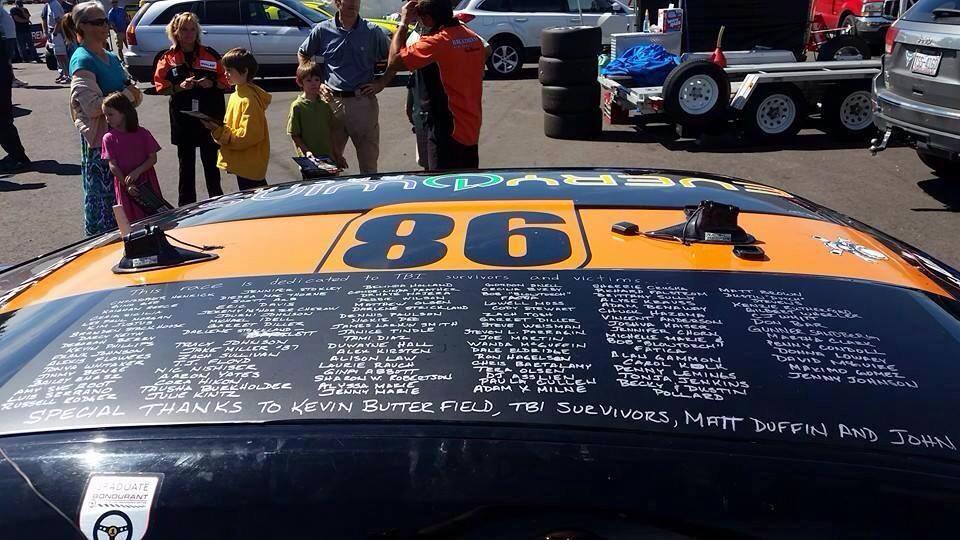
The #98 Camaro was driven by Ernie Francis, Jr. He won the TA3 race and the TA3 championship.

DuWayne HallMatt Duffin of the Brain Injury Radio Network submitted my name for painting onto a Trans-Am race car with about 100 other names of TBI survivors. My name is front and center above Kevin Butterfield. It is in the third row from the left, 8th name from the bottom.


Joshua Edward Daniel…I got my TBI while putting chains on a customer’s car. A Jeep going 45 mph hit me, breaking my neck and giving me a TBI. The doctor said I would never walk or talk again, but I’m proving him wrong. I love my recovery.

Gena Marie…I am in a place where I can finally feel safe and cared about for the first time in my life.

YOU did it!

Congratulations to all contributors!

(Clip Art compliments of Bing.)

(Photo compliments of DuWayne Hall.)

Caregivers SPEAK OUT! . . . . . Gill Evans

SPEAK OUT! – Gill Evans

by

Donna O’Donnell Figurski


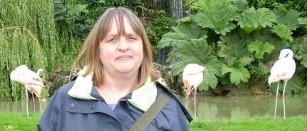
Evans, Gill Caregiver with Flamingoes

Gill Evans – Caregiver for her Husband

1. What is your name? (last name optional)

Gill Evans

2. Where do you live? (city and/or state and/or country)     Email? (optional)

Birmingham, England     gce46@hotmail.co.uk

3. What is the TBI survivor’s relationship to you? How old was the survivor when he/she had the TBI? What caused your survivor’s TBI?

The TBI survivor is my husband. He had his TBI in 1984 at age 23. The TBI was originally due to a motorcycle accident, but he has been reinjured three times since then, the last being 11 years ago. He has had one work-related injury and two motorcycle-related head injuries.

4. On what date did you begin care for your TBI survivor? Were you the main caregiver? Are you now? How old were you when you began care?

I was 22 and in full-time work. He was living with his mom. We decided to split up due to his being violent, but we continued seeing each other as friends. We got back together when I was 40 and he was 41. We married 2 years later. I have looked after him since because the last injury left him unable to work.

5. Were you caring for anyone else at that time (e.g., children, parents, etc.)?

When we got back together, I had two teenage boys.

6. Were you employed at the time of your survivor’s TBI? If so, were you able to continue working?

I work full-time, but I have 13-hour shifts, so I’m home 4 days each week. I no longer work night shifts, as he struggles with the change that causes.

7. Did you have any help? If so, what kind and for how long?

No

8. When did your support of the survivor begin (e.g., immediately – in hospital, when the survivor returned home, etc.)?

My husband finally accepted help three weeks ago. When he had his TBI 30 years ago, there was nothing in place for him. He got speech therapy, and that was it.

9. Was your survivor in a coma? If so, what did you do at that time?

No

10. Did your survivor have rehab? If so, what kind of rehab (i.e., inpatient and/or outpatient and occupational, physical, speech, and/or other)? How long was the rehab? Where were you when this was happening?

He got speech therapy at home.

11. What problems or disabilities of your TBI survivor required your care, if any?

He required constant prompting of his memory and calming down due to temper. He had a broken leg, so he was wheelchair-bound for a couple of weeks until he was able to have crutches.

12. How has your life changed since you became a caregiver? Is it better? Is it worse?

I’m not really sure that I can answer this. My response probably wouldn’t make sense, as it would be “better than what, and worse than what?”

13. What do you miss the most from pre-TBI life?

I miss my independence – not having to worry about my husband when I’m out or not having to walk on eggshells because he’s in a bad mood. But, as much as I miss my independence, I regret that over the last couple of years he has stopped going out unless he has to. So, I go everywhere on my own. Sometimes I wish I didn’t have to.

Evans, Gill Caregiver IMG_1130

Gill Evans

14. What do you enjoy most in post-TBI life?

On reflection, not a lot

15. What do you like least about TBI?

I dislike that my husband’s last injury took him away from me and that he is like a stranger sometimes. He can forget who I am, and he will talk to me like I’m his ex-wife.

16. Has anything helped you to accept your survivor’s TBI?

I’m helped by the fact that I have loved my husband since I was 17 years old. (So, I have known him with the TBI most of my life.)

17. Has your survivor’s injury affected your home life and relationships and, if so, how?

When we married, I had two teenage sons living at home, and this became really difficult. There were lots of arguments. After two years of our fighting, my sons decided it was better if they moved out. I have spent the last eight years trying to rebuild my relationship with them, and thankfully we are much closer. Also they, to an extent, get on with my husband.

18. Has your social life been altered or changed and, if so, how?

Not really. My husband doesn’t go out much, and I go out with my sons or with colleagues from work. The one rule I have when I am out is that, unless it’s an emergency, he is only allowed to phone me once and the rest has to be text messages. Also he is not to bombard me with texts if I don’t reply.

19. What are your plans? What do you expect/hope to be doing ten years from now?

I’m hoping to be retired (or at least to be coming up to retirement) and spending some quality time with my family.

20. What advice would you offer other TBI survivor caregivers? Do you have any other comments that you would like to add? 

Evans, Gill Caregiver IMG_1129

Gill Evans – Caregiver for her Husband

Have boundaries, boundaries, and boundaries – to protect your own sanity. Remember to keep time for yourself. Don’t tolerate violence. It’s okay for you to get mad occasionally, but walk away. You won’t win a fight (verbal) with him or her. Grow a thick skin – he or she doesn’t always mean what is said. If you take everything personally, you won’t survive. Remember most of all, regardless of the effects of the TBI, your partner is still in there, so don’t give up hope of ever seeing him or her again – even if it’s only for a fraction of a second that he or she shines through. That’s why at the end of the day you are still there.


Thank you, Gill, for taking part in this interview. I hope that your experience will offer some hope, comfort, and inspiration to my readers.

If you would like to be a part of this project, please go to TBI Caregiver Interview Questionnaire for a copy of the questions and the release form.

(Photo compliments of Gill.)

Disclaimer: The views or opinions in this post are solely that of the interviewee.

Survivors SPEAK OUT! Jayson Phillips

SPEAK OUT! – Jayson Phillips

by

Donna O’Donnell Figurski


Phillips, Jayson Survivor 082414

Jayson Phillips

1. What is your name? (last name optional)

Jayson Phillips

2. Where do you live? (city and/or state and/or country) Email (optional)

Houston, Texas, USA

3. When did you have your TBI? At what age?

2009   I was 17.

4. How did your TBI occur?

My head was run over by a car.

5. When did you (or someone) first realize you had a problem?

Immediately

6. What kind of emergency treatment, if any, did you have?

A bone flap was removed, and I had brain surgery.

7. Were you in a coma? If so, how long?

Yes. About a month

8. Did you do rehab? What kind of rehab (i.e., inpatient or outpatient and occupational and/or physical and/or speech and/or other)?

Yes. I had physical, occupational, and speech therapies.

How long were you in rehab?

I was in and out of therapy, but altogether I had therapy over a year.

Phillips, Jayson Survivor Hospital 082414

Jayson Phillips – Miraclekid – lucky to be alive

9. What problems or disabilities, if any, resulted from your TBI
(e.g., balance, perception, personality, etc.)?

Left-side weakness, irritation, depression, left neglect

10. How has your life changed? Is it better? Is it worse?

I have a new perspective on life, and I don’t take anything for granted anymore.

11. What do you miss the most from your pre-TBI life?

Skateboarding

12. What do you enjoy most in your post-TBI life?

My new attitude and the support of friends

13. What do you like least about your TBI?

My physical limitations

14. Has anything helped you to accept your TBI?

I’ve been helped by personal-development videos, music, poetry, and writing.

15. Has your injury affected your home life and relationships and, if so, how?

Yes. It has strengthened my relationship with my mom and dad.

16. Has your social life been altered or changed and, if so, how?

No

17. Who is your main caregiver? Do you understand what it takes to be a caregiver?

My mother and grandmother are my main caregivers. Yes, I understand what they do.

18. What are your future plans? What do you expect/hope to be doing ten years from now?

I hope to have a large business. I also hope to contribute my time towards helping TBI survivors and people in general better their lives. In ten years, I expect to be retired, to be living on my own, and to be going to different places to speak about TBI awareness.

19. Are you able to provide a helpful hint that may have taken you a long time to learn, but which you wished you had known earlier? If so, please state what it is to potentially help other TBI survivors with your specific kind of TBI.

No matter what challenges or adversities you may come across, keep a useful and positive attitude. Always find the positives in any situation.

Jayson Phillips

Jayson Phillips

20. What advice would you offer to other TBI survivors? Do you have any other comments that you would like to add?

Attitude is everything. It can be the difference between a healthy, speedy recovery and a stressful, slow recovery.


Thank you, Jayson, for taking part in this interview. I hope that your experience will offer some hope, comfort, and inspiration to my readers.

(Disclaimer: The views or opinions in this post are solely that of the interviewee.)

(Photos compliments of Jayson.)

If you would like to be a part of the SPEAK OUT! project, please go to TBI Survivor Interview Questionnaire for a copy of the questions and the release form.

On the Air – Brain Injury Radio Julie Kintz Substitutes for Donna O’Donnell Figurski

On the Air – Brain Injury Radio

Julie Kintz sits in for Donna O’Donnell Figurski

Mark Ittleman, MS CCC-SLP, speech & language pathologist

 images-1

Due to a prior engagement, I was unable to host my show, Another Fork in the Road on the Brain Injury Radio Network on October 19, 2014. Fortunately for me and all my listeners, Julie Kintz of Quantum Leap stepped into her host shoes and interviewed a very interesting guest. Mark Ittleman, a speech and language pathologist, spoke of the many difficulties brain-injured survivors encounter after their injury. I will be back on November 2nd with Dr. David Figurski, (my spouse) who will give his perspective of his life as he conquers traumatic brain injury.

Mark explained his philosophy of therapy (it should be doable, interesting, and enjoyable), his methods (analysis, repetition, and modeling), and his strong desire to involve the caregiver (by his or her presence in the sessions, by learning from him, and by his writing simple-to-understand books – he’s working on one now). Mark cautioned survivors to get more than one prognosis because a prognosis is only a doctor’s opinion and because survivors are often more capable than people realize. Mark understands the power of the ability to communicate and suggested that survivors – even years after their trauma – can benefit from having a speech therapist.

If you missed the show, don’t fret. You can always listen to the archived show. I’ve included the link below.

Please SHARE!

I hope you’ll tune in to my show, Another Fork in the Road, which airs the 1st and 3rd Sunday evenings of every month. The show starts at 5:00p Pacific Time and runs for 90 minutes. On the 2nd and 4th Sundays at 5:00p Pacific Time, Julie Kintz hosts Quantum Leap. When there is a fifth Sunday in a month, Julie and I will team up to cohost a show called Another Quantum Leap in the Road.

See you “On the Air!”

(Click the link below to listen to the show.)

Julie Kintz interviews Mark Ittleman M.S. CCC/SLP. Mark will address speech difficulties after brain injury in both children and adults.  

“Another Fork in the Road” . . . Brain Injury Radio Network with Julie Kintz and Mark A. Ittleman, M.S., CCC/SLP

YOU ARE INVITED!


putthis_on_calendar_clip_artJulie Kintz of “Quantum Leap” will be substituting for Donna O’Donnell Figurski of “Another Fork in the Road” on the Brain Injury Radio Network.

Julie’s guest will be Senior Speech Language Pathologist-Author Mark A. Ittleman, M.S., CCC/SLP. Mark Ittleman will discuss speaking difficulties and tell how loved ones can help improve the speech of their survivor at home in a fun and easy way.

Come One! Come ALL!

(NOTE: New Day, Sunday – Same Time)

What:        Host, Julie Kintz of “Quantum Leap” substitutes for “Another Fork in the Road” host, Donna O’Donnell Figurski.

Why:         Hear Mark A. Ittleman, M.S., CCC/SLP discuss speaking difficulties.

Where:     Brain Injury Radio Network

When:       Sunday, October 19th, 2014

Time:         5:00p PDT (6:00p MDT, 7:00p CDT, and 8:00p EDT) 90 minute show

How:         Click: Brain Injury Radio Network.

Call In:    424-243-9540

Call In:     855-473-3711 toll free in USA

Call In:    202-559-7907 free outside US

or SKYPE

If you miss the show, but would like to still hear the interview, you can access the archive on On Demand listening. The archived show will be available after the show both on the Brain Injury Radio Network site and on my blog in “On the Air.”

(Clip Art compliments of Bing.)

SPEAK OUT! . . . . . . . . . . . . . . . Itty-Bitty GIANT Steps

SPEAK OUT! Itty-Bitty GIANT Steps

Itty-Bitty GIant Steps for Blog

SPEAK OUT! Itty-Bitty Giant Steps will provide a venue for brain-injury survivors and caregivers to shout out their accomplishments of the week.

If you have an Itty-Bitty Giant Step and you would like to share it, just send an email to me at donnaodonnellfigurski@gmail.com.

If you are on Facebook, you can simply send a Private Message to me. It need only be a sentence or two. I’ll gather the accomplishments and post them with your name on my blog approximately once a week. (If you do not want your last name to be posted, please tell me in your email or Private Message.)

I hope we have millions of Itty-Bitty Giant Steps.


Here are this week’s Itty-Bitty Giant Steps.

David Figurski…I assembled Donna’s new office chair. It came as 12 pieces with 13 screws. The Allen screws made it possible to use my non-ataxic left hand. Because the instructions were written with two good hands in mind, I sometimes had to devise my own way of assembling the parts. It took me twice as long, but I felt good about doing it.

Jodi Mannon…I was hit and thrown down stairs in January by my ex-roommate. I don’t remember a lot in the past 8 1/2 months. Yesterday I became friends with a lot of people who also have a TBI. I spoke with one on Facebook Messenger for a couple of hours. We chatted for a moment today, and he is going to call me tonight. I was shocked! He made me truly happy for once because we were able to talk the way we did and share our lives. I haven’t done that with anyone because I’ve never even thought about it before. I just had a lot of issues in dealing with getting better. It’s the greatest feeling to have people who have been through the same thing understand me!! Not that my parents and friends haven’t been nice, but they just don’t understand the things I go through. My new friends do. I feel so blessed to have them in my life, and I look forward to keeping these new friendships for the rest of my life!!!

Carmen Gaarder Kumm…I passed the test that allows me to keep my job!!! I needed a 70, and I got 73.7 – not much, but I PASSED! Better yet, I found my car after going out a different door than the one I went in. (Also, I was parked on the street in a college city that I’ve only been to once before.) I walked around for a half an hour looking for it – but I was still within 2 hours! LOL!

YOU did it!

Congratulations to all contributors!

(Clip Art compliments of Bing.)

Survivors SPEAK OUT! David Villarreal

SPEAK OUT! – David Villarreal

by

Donna O’Donnell Figurski

David Villarreal

David Villarreal

1. What is your name? (last name optional)

David Villarreal

2. Where do you live? (city and/or state and/or country) Email (optional)

Temple, Texas, USA

3. When did you have your TBI? At what age?

1st and 2nd – 2012 (age 50), 3rd – 2013 (age 51), and 4th – 2014 (age 52)

4. How did your TBI occur?

I’m not sure…I really don’t remember.

5. When did you (or someone) first realize you had a problem?

It was realized when I hit the floor and did the best I could do to call for help.

6. What kind of emergency treatment, if any, did you have?

A coworker called 9-1-1. I was rushed to the Emergency Room and given some kind of med that broke up the clot (note: possibly tissue plasminogen activator, tPA) and saved my life.

7. Were you in a coma? If so, how long?

No

8. Did you do rehab? What kind of rehab (i.e., inpatient or outpatient and occupational and/or physical and/or speech and/or other)? How long were you in rehab?

Yes. I had physical therapy and occupational therapy for 6 months.

It wasn’t until my 3rd stroke that I finally got help. It was from the Central Texas VA (Veteran’s Administration) in Temple, Texas. They have made everything possible for me. I credit all my progress to them.

9. What problems or disabilities, if any, resulted from your TBI
(e.g., balance, perception, personality, etc.)?

Wow…I have problems with my speech, vision, balance, strength, and control of my bodily functions. I could not eat or drink. I still do not have use of my right side. I am right-handed, so that is a problem. I have to learn to do everything again with my left hand.

10. How has your life changed? Is it better? Is it worse?

Oh my goodness! My life has changed so much. I was a studio musician before all of this happened. I’ve heard many of the CDs that I am on. I went from playing several instruments to not being able to play any. That led to some very, very deep depression.

11.What do you miss the most from your pre-TBI life?

My musician life

12. What do you enjoy most in your post-TBI life?Villarreal, David Handcycle

That I now race a handcycle

13. What do you like least about your TBI?

That I get tired too fast

14. Has anything helped you to accept your TBI?

I got up one day and remembered I was a Marine. I decided to do what Marines do best, and that is save others. So now, I ride this handcycle with the one hand that works to let other stroke survivors know we can still have a good, normal life.

15. Has your injury affected your home life and relationships and, if so, how?

Well, after my first stroke, my wife of 10 months filed for divorce three days after I had it. I met my current wife a year later – after my 3rd stroke. She was my therapist. We got married about a month ago.

16. Has your social life been altered or changed and, if so, how?

For the longest time, I would not leave my home. I didn’t want anyone to see me like this. Now I go out more often, but I’m not really at ease with it.

17. Who is your main caregiver? Do you understand what it takes to be a caregiver?

I have been taking care of myself from the start. Now I am having a very hard time allowing my wife to do anything for me. She wants to help me so badly, but I have a hard time letting go.

18. What are your future plans?

I really don’t know.

    What do you expect/hope to be doing ten years from now?

I hope to be helping stroke survivors.

19. Are you able to provide a helpful hint that may have taken you a long time to learn, but which you wished you had known earlier? If so, please state what it is to potentially help other TBI survivors with your specific kind of TBI.

Ok, it happened (the stroke). Get over it…Cry…Get mad…OK, now that is out of the way…Get to work, and work harder than you have ever worked. It will be worth it if you can do it. Life is so good when you get through it all.

20. What advice would you offer to other TBI survivors? Do you have any other comments that you would like to add?

DON’T GIVE UP. YOU CAN DO WHATEVER YOU WANT TO DO. Don’t let anyone tell you different. I have been told I am supposed to be dead…I am supposed to be paralyzed from my neck down. BY THE GRACE OF GOD I AM NOT!!!!!!!!

David Villarreal - 1st of 4 strokes (Not expected to survive) He DID!

David Villarreal – 1st of 4 strokes (Not expected to survive.) He DID!


Thank you, David, for taking part in this interview. I hope that your experience will offer some hope, comfort, and inspiration to my readers.

(Disclaimer: The views or opinions in this post are solely that of the interviewee.)

(Photos compliments of David.)

If you would like to be a part of the SPEAK OUT! project, please go to TBI Survivor Interview Questionnaire for a copy of the questions and the release form.

diemodi jewelry

uniquely hand-crafted jewelry by donna

Welcome to Harmony Kent Online

The home of all things books

Pete Springer

Passionate Teacher and Future Children's Author

HOPE TBI

Helping Other People Excel - To Be Independent

For the Love of Books, Old and New

Katie Fischer, Writer and Reader of Stories

Charlie Bown

Children's Author

Jessica Hinrichs

“We write to taste life twice, in the moment and in retrospect.” ― Anais Nin

VIVIAN KIRKFIELD - Writer for Children

Picture Books Help Kids Soar

Mindy’s Writing Wonderland

For authors, parents, teachers & everyone who loves children’s books.

Kaitlyn Leann Sanchez

Literary Agent

Surviving Traumatic Brain Injury

TBI - Survivors, Caregivers, Family, and Friends

The Care Factor

Loving someone with a Traumatic Brain Injury

Brain Injury Support Group of Duluth-Extension

Brain Injury Information and SUPPORT

Brain Aneurysm Global Insight

Brain Aneurysm, cerebral hemorrhaging, hemorrhage stroke