TBI – Survivors, Caregivers, Family, and Friends

Posts tagged ‘TBI’

On The Air – Brain Injury Radio Discrimination of TBI Survivors

On the Air

with

Donna O’Donnell Figurski and Julie Kintz

images-1With my first radio stint under my belt (my interview with Kim Justus on her show, “Recovery Now,”) I felt relieved. I’d made it through my first time on “live” radio. Now my new friend, Julie Kintz, another Brain Injury Radio Network host asked me to help her co-host a show. Her computer sound was not working properly and she didn’t want to not do a show.

Though I was nervous, I felt that it would allow me to familiarize myself with the studio and the studio hosting tools, and give me more practice on the air before I took the microphone myself. And . . .  I wanted to help a fellow host. So, I reluctantly agreed.

There were some glitches before the show. We expected to be interviewing a guest, but because communications got twisted, the guest never arrived. Julie and I had only minutes to decide what to do as the minutes ticked down to “On the Air” time. Since we’d planned to discuss discrimination of TBI survivors with the guest, we decided to pursue that topic as our discussion for the evening. I think it turned out well. What do you think.

You can listen here.

(Clip Art compliments of Bing.)

On the Air – Brain Injury Radio Donna’s Interview with Kim Justus

On the Air

with

Donna O’Donnell Figurski & Kim Justus

     (interview to tell David’s TBI story)

images-1I was surprised when I got a Private Message from one of the Brain Injury Radio Network hosts one evening while I was browsing through the many Traumatic Brain Injury sites that I belong to on Facebook. The host, Julie Kintz (“Quantum Leap”), asked if I’d be interested in becoming a BIR host too and referred me to Kim Justus, who is in charge of recruiting new hosts.

Of course, I was interested, but I wondered if I could even do something like this. I told David (my husband), and, surprisingly, he encouraged me. (He usually worries that I’ll take on too much.) I was glad for his encouragement, but I wasn’t convinced yet and threw the idea around with several close friends. They also gave me their “thumbs up.” I agreed to do it!

Then Kim invited me to be a guest on her show (“Recovery Now”) as a Traumatic Brain Injury caregiver. She wanted me to tell an abridged version of David’s and my story of our travels in the TBI maze.

I am featured in the first two hours of Kim’s three-hour show. You can listen by clicking the link below. So sit back, relax, and enjoy the show.

My show, “Another Fork in the Road,” will debut on Monday, August 4, 2014, at 5:00 pm Pacific time. It will air the 1st and 3rd Mondays of each month. On that show, I will tell a more complete version of our tale based on my book, “Prisoner Without Bars: Conquering Traumatic Brain Injury,” which is searching for a publisher. I hope to see you there.

Subsequent shows will feature interviews with TBI survivors and caregivers and offer brain injury resources and interviews with professionals in the field of TBI. There will also be discussions on current topics of interest.

(Clip Art compliments of Bing.)

Click here for a list of all “Another Fork in the Road” shows on the Brain Injury Radio Network.

Survivors SPEAK OUT! . . . Daisy Lou

SPEAK OUT! – Daisy Lou

by

Donna O’Donnell Figurski

Daisy Lou

      1. What is your name? (last name optional)

Daisy Lou

2. Where do you live? (city and/or state and/or country) Email (optional)

Boyertown, Pennsylvania, USA

3. When did you have your TBI? At what age?

The first one was on July 6, 2012. I was 30 years old. The second one was in February 2014. I was 32 years old.

4. How did your TBI occur?

Someone ran a stop sign and T-boned my car for the first one. I don’t remember the accident, but my car was totaled. For the second one, I fell in the street on six inches of ice.

5. When did you (or someone) first realize you had a problem?

In August 2012, I started having back problems. I realized in November that I was having other problems, like nausea, dizziness, balance being off, sleeping all the time, noise sensitivity, and headaches, among a multitude of other problems. But I waited until December (5 months after my accident) to talk to the doctor. For the second one, I realized I had a problem a few days after I fell, when my nose started dripping and I started sleeping a lot. I wasn’t sick at the time.

6. What kind of emergency treatment, if any, did you have?

None

7. Were you in a coma? If so, how long?

No

8. Did you do rehab? What kind of rehab (i.e., In-patient or Out-patient and Occupational, Physical, Speech, Other)?
How long were you in rehab?

For the first TBI, I did physical therapy for a month and a half as an Out-patient. I did biofeedback with a neuropsychologist for four months. For the second one, I took a week off of work. That’s all.

9. What problems or disabilities, if any, resulted from your TBI (e.g., balance, perception, personality, etc.)?

I sometimes have balance problems. If I try to get up too quickly, I get dizzy. I have lots of memory problems, anxiety, impulsiveness, and trouble concentrating. I tend to tell people things three or four times because I forget whether or not I’ve told them whatever that thing happens to be. I get frustrated very easily. I have trouble talking and finding words. I don’t handle stress very well, and sometimes I can’t handle it at all. I get tired very easily, and sometimes I have to take a nap in the middle of the day.

10. How has your life changed? Is it better? Is it worse?

It’s better in the fact that I don’t remember things. So, if something happens that is upsetting, I soon forget it. But that’s also worse because I forget things I want to remember. I’ve learned to become more patient with myself and with other people.

11. What do you miss the most from your pre-TBI life?

I miss being able to explain something to someone and have them understand what I’m saying. Now I can’t seem to find the right words.

12. What do you enjoy most in your post-TBI life?

When my brain is functioning on a capable level, I enjoy explaining to people what a TBI is like and how it affects you. To some people who seem interested, I give the address of an interesting blog to look at, so they can understand TBI even better.

13. What do you like least about your TBI?

I dislike forgetting things and feeling stupid all the time. I feel like a part of my brain has gone missing, and no matter how much I search for it, it continues to hide from me.

14. Has anything helped you to accept your TBI?

Time and talking about it with friends

15. Has your injury affected your home life and relationships and, if so, how?

Not really. It’s more that I forget where I put things more often, so I’m continually asking someone if they’ve seen the items I’m looking for. But my relationships haven’t really changed, and my home life hasn’t changed.

16. Has your social life been altered or changed and, if so, how?

I always was a loner, but I’m more of a hermit than before. I tend to stay in more often or go places by myself, instead of asking someone to go with me. Even if the person is on the way to wherever it is I’m going, I don’t call them because it seems like too much work to have to drive to their house and then talk to them until I drop them back off at their house.

17. Who is your main caregiver? Do you understand what it takes to be a caregiver?

Myself – I don’t have a caregiver. Although, I live with my mom, and she’s the one I’m always asking where things are.

18. What are your future plans? What do you expect/hope to be doing ten years from now?

Right now, I’m just concentrating on making it through the day. I have no future plans, except to take things one day at a time.

19. Are you able to provide a helpful hint that may have taken you a long time to learn, but which you wished you had known earlier? If so, please state what it is to potentially help other TBI survivors with your specific kind of TBI.

Write everything down! If you have memory problems, it makes your life so much easier when you can look at a piece of paper and say, “Oh yeah, that’s what I wanted to do!”

20. What advice would you offer to other TBI survivors? Do you have any other comments that you would like to add?

Rome wasn’t built in a day…. It’s frustrating to suddenly have some part of your body go berserk on you, but don’t beat yourself up. A very important part of your anatomy was bruised and battered, and it takes time for it to heal. Everyone recovers at a different rate, so don’t expect the same results as someone else with a TBI.

Daisy Lou

Daisy Lou


Thank you, Daisy Lou, for taking part in this interview. I hope that your experience will offer some hope, comfort, and inspiration to my readers.

(Disclaimer: The views or opinions in this post are solely that of the interviewee.)

(Photos compliments of Daisy Lou.)

If you would like to be a part of this project, please go to TBI Survivor Interview Questionnaire for a copy of the questions and the release form.

SPEAK OUT! . . . . . . . . . . . . . . . . . . . . #2 Itty-Bitty GIANT Steps

SPEAK OUT! #2 Itty-Bitty GIANT Steps

Itty-Bitty GIant Steps for Blog

SPEAK OUT! Itty-Bitty Giant Steps will provide a venue for brain-injury survivors and caregivers to shout out their accomplishments of the week.

If you have an Itty-Bitty Giant Step and you would like to share it, just send an email to me at donnaodonnellfigurski@gmail.com. If you are on Facebook, you can simply send a Private Message to me. It need only be a sentence or two. I’ll gather the accomplishments and post them with your name on my blog approximately once a week. (If you do not want your last name to be posted, please tell me in your email or Private Message.)

I hope we have millions of Itty-Bitty Giant Steps.


Here are this week’s Itty-Bitty Giant Steps.

Cheri Richardson Hicks . . . I managed to make a six-hour drive to go to my 20-year reunion for high school. It felt so good to reconnect with old friends. I walked a lot, but I kept up. It was a lot of fun. By the way, Donna, I really love taking part in your website. It’s fun to do.

Andi Ramsay . . . Not Itty-Bitty, but this week I rode over 100 miles for my local Headway (a brain injury charity).

David Figurski . . . I traveled cross-country and back. I flew from Phoenix, Arizona, to Boston, Massachusetts, to enjoy several days with the parents of my son’s new wife in her parents’ rented vacation cottage. My son, his wife, and her two sisters and their families were also there. Both Donna and I had a delightful time.

Congratulations to all contributors!

(Clip Art compliments of Bing.)


Brain Injury Resources . . . Unleashed Talents

Can TBI Unleash a Talent That We Didn’t Know We Have?


Brain th-2TBI survivors are usually defined by others in negative terms. Survivors are often seen as people who are no longer able to do something they once did easily or as people who are physically disabled. It has become strikingly evident from the interviews on this blog (Survivors SPEAK OUT!) that TBI survivors, once they have accepted the new normal of their lives, often show immense courage and determination. They have aspirations and exhibit motivation that is intensified or that wasn’t even known to exist. Here are two videos that show a positive outcome from TBI.

The first video is long (1 hr, 5 min), but it is mesmerizing. In it, neurologist Dr. Darold Treffert discusses (with videos) the “savant syndrome.” It is thought that some abnormality in the brain unleashes a skill that normal people find to be phenomenal. At 29 min 20 sec into the video, Dr. Treffert discusses “The Acquired Savant” – a person who has become a savant after a brain injury. Although becoming a savant after a brain injury can happen, it’s rare. But, any model of the brain has to be able to explain the savant syndrome. Dr. Treffert suggests that the brain comes “fully loaded with software” and that the normal functional brain eventually suppresses much of its intrinsic “software” to reduce stimulation. This means that we all may have suppressed talents.

The second video is much shorter (15 min) and is relevant to all TBI survivors. Ann Zuccardy redefines what it means to be smart. A person may define himself or herself by a certain talent or ability. Does one’s life then become unfulfilling when that skill is lost as the result of a brain injury? Ann Zuccardy, who was affected by a brain injury, tells us that the loss of a dominant skill allows a person to nurture and/or develop other skills that may have been ignored. These other skills can be as useful as or even more impressive than the dominant one was.

(Clip Art compliments of Bing.)


SPEAK OUT! Guest Blogger . . . . . . George Visger (former NFL SF 49er)

SPEAK OUT! Guest Blogger George Visger (former NFL SF 49er)

Short, Choppy Steps


Boy Blogger thAnyone who has ever spent time on the gridiron will know what those words mean. But their meaning holds truth far beyond the playing field and can be applied to everything we do in life.

In football, the object of the game is to win. But to win, you must score. To score, you need to punch the ball across the goal line.

But what if the goal line is 99 yards away?

Short, choppy steps will get you there – not long strides and an occasional 50-yard run.

In football, everything starts with a good stance. You need balance. Just like in life. You need to get yourself into position to succeed before you can succeed. A bad stance, and you’re beat before the ball’s snapped. When playing defense, if you have too much weight on your right foot, you’ll never be able step with that foot, and the offensive linemen will easily be able to cut you off if the play is going that way. If you have too much weight forward, like you have during a passing situation, you can never react quickly enough if they call a run to the inside.

A good stance is a balanced stance. Try it.

No, I mean try it. Everyone who can, stand up.

Stand up tall – feet, shoulder-width apart, and toes, even. Move your dominant foot back about 10-12 inches so your right toes (if right-handed) are even with the instep of your left foot. Now push your chest out and your butt back. Slowly squat down until your elbows touch your knees. Once your elbows make contact, lean forward a bit and place your hand on the ground with your thumb directly under your nose.

That’s a balanced stance. You can easily move in any direction from that position.
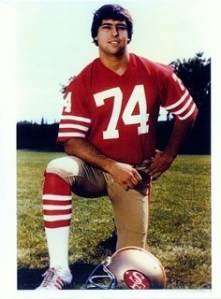
#74 NFL San Francisco 49er, George Visger @ 1981

#74 NFL San Francisco 49er, George Visger @ 1981

On offense, if you don’t score, you can’t win. To score, you have to move the ball. If the offensive lineman fires out with a long stride – like you would do when sprinting, it’s very easy for the defensive player to knock him on his butt. Holding your head up and looking 90 yards down the field at the goal line is a great way to get your cranium removed. Considering the cranium is a fairly important organ, it’s best you hang on to it. You need to keep your butt down, your face up, and your neck bowed and to take short, choppy steps.

Try it.

A long stride with your head up is a narrow stride. Any pressure from the side will knock you on your butt. To maintain the most strength, you want short, choppy steps. Fire out, and keep your butt down and your face up. Stick your face into the numbers, and, with your butt under you, drive with short (12-16 inch) strides. That’s where you get your power. Not a long, narrow, unbalanced stride with your neck craned up and your head looking downfield. Focus on the short, choppy steps.

If a football team got only 4 yards every play on offense – no more, no less, they would never lose.

Think about it.

Only 4 yards a play, and you would NEVER LOSE!

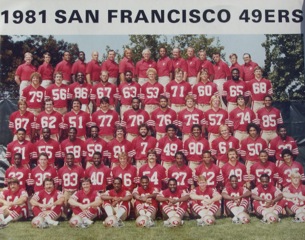
George Visger #74  4th row from bottom, 2nd from right  @ 1981

George Visger #74
4th row from bottom, 2nd from right
@ 1981

That’s a first down every 3 plays. You would score every time you had the ball. NO ONE could stop you.

Every one has a cross to bear. Some crosses are much heavier than others. I have met people on my journey, who have silently carried crosses I could never even lift. Yet they pack them – everyone.

And never complain.

If we looked downfield every day – gazing at where we want to be in life and thinking about what we have to deal with to get there, we’d never score. You need to keep that goal line in the back of your mind every day of your life – every play, but to get there, you need to focus on each step. One day at a time. One step at a time.

A single short, choppy step each day wins games.

Set a short-term goal each day, and focus on that.

In 1986, at the age of 28, I returned to school to complete my Biology degree, after an Orange Bowl, a Super Bowl, three emergency VP (ventriculoperitoneal) shunt brain surgeries, and several gran mal seizures. I needed four semesters of Chemistry (Chem 1A, Chem 1B, Organic Chem, and Bio Chem), two semesters of Physics, two semesters of Pre-Calculus, and other fun classes to complete my degree in Biological Conservation and to attain my second dream in life – to be a wildlife biologist. (My first dream was to be the greatest NFL player of all time.) At the time, I was working construction during the day, earning a Class B General Contractors license in the evenings, and bouncing at bars at night to survive. (No, all NFL players are not millionaires. I was a 6th-round pick in 1980 and signed for $35,000.)

After I returned to school in 1986, I survived five additional emergency brain surgeries during a 9-month period in ‘86-’87, while taking Organic Chem, Physics, and other classes. I was in Organic Chem three times when my shunt blew out. I had emergency brain surgery, and I dropped out of school. After the first, I came back and took the class again. Another shunt blow out and another brain surgery, and I dropped out of school again. Happened a third time. This time, I was determined not to drop out. Brain surgery on Saturday, and I left the hospital on Sunday, 23 hours later. I was sitting in Organic on Monday when I had a >50-minute gran mal seizure. I was hospitalized for a week. It seemed I had developed an infection in my shunt on that one. They sent me home with a PICC line (peripherally inserted central catheter) in my arm, with a pump taped to my bicep, and with a tube that ran directly into my heart to deliver antibiotics. I packed that around for 10 days and had to drop out of school again.

I came back the next semester, but by then I had developed dyslexia and major short-term memory issues from my surgeries and gran mal seizure meds. (I’ve been on Dilantin, Depacote, Phenobarbital, Kepra, Zonegran, and now Lamictil.) After discovering through my own investigations that each one causes short-term memory problems, I had my doctors change the meds because I didn’t like the side effects. I had to write on my notebook where I parked my truck each day, or I would spend an hour or two walking up and down each row of cars in each parking lot on each side of Sacramento State University looking for my truck.

I came back the next semester so frustrated I met with my counselor, Mr. Sterling Ebel, a man who had as much influence on my life as anyone other than my father. Mr. Ebel was a man who quietly gave me information on how best to achieve my goals and connected with me as a person and a man. He was a man who wore the same tiny tie clasp every day I knew him. It had two words:

“TRY GOD.”

“Sterling, I can’t keep doing this crap. I can’t even remember where I parked my truck, much less Organic Chemistry. I just want a degree. I don’t care what it’s in. Just find me a degree. I need to get on with my life,” I ranted one day, as I barged into his office without an appointment, ready to quit.

“You’re 12 units from a Social Science degree,” he calmly replied after studying my transcript and telling his receptionist to hold his next appointment.

“OK, I’m a Social Science major,” I said.

That semester I took 6 units towards my Social Science degree, and passed both classes. The next semester, just 6 units shy of a BA in Social Science, I decided I’d give Organic Chem one more shot. I’d never quit on anything in my life, and words of my father, Big Jack Visger, the greatest man I’ve ever known, rang in my ears:

“Shoot your best shot.”

If I didn’t make it through Organic on this one, God didn’t mean for me to be a biologist. I was shooting the last round in my chamber.

On the fourth try, I powered through Organic – a “Short, Choppy Step.”

Physics 1B – Short, Choppy Step

Pre-Calculus – Short, Choppy Step

Bio Chem – Short, Choppy Step

In 1990, at the ripe old age of 32, with 172 units completed, gran mal seizures, and eight VP shunt brain surgeries under my belt, I earned a Bachelor of Science degree in Biological Conservation. Graduating made playing in the NFL look like child’s play.Visger, George

Another Short, Choppy Step.

And I continue to take short, choppy steps each day.


Thank you, George.

Disclaimer:
Any views and opinions of the Guest Blogger are purely his/her own.


SPEAK OUT! . . . You Are Invited! Launch “Another Fork in the Road” on Brain Injury Radio Network: Donna Tells Her Story Aug. 4, 2014

Come one! Come ALL!putthis_on_calendar_clip_art

What:        Launch “Another Fork in the Road” on Brain Injury Radio Network: “Thursday, the 13th – an unlucky day!”

Why:         Donna tells about the onset of David’s Traumatic Brain Injury and their life together after TBI.

Where:     Brain Injury Radio Network

When:       Monday, August 4, 2014

Time:         5:00p PDT (6:00p MDT, 7:00p CDT, and 8:00p EDT) 90 minute show

How:         Click: Brain Injury Radio Network.


Call In
:    424-243-9540

Call In:     855-473-3711 toll free in USA

Call In:    202-559-7907 free outside US

or SKYPE

If you miss the show, but would like to still hear the interview, you can access the archive on On Demand listening (Archived show) will be available after the show

(Clip Art compliments of Bing.)

Brain Injury Resources . . . Facts and Myths About the Brain

Facts and Myths About the Brain

Brain th-2


This short video tells us what’s known to be true about the brain and clears up some common misconceptions.


(Clip Art compliments of Bing.)

SPEAK OUT! Letters . . . . . . . to Rachel

colored-envelopes-hi


Dear Rachel,

Your last post breaks my heart. I can hear so clearly your confusion, your frustration, and your sadness. I won’t lie to you and tell you that it will get completely better. As Penelope said, every TBI is different. It depends on how much damage the brain incurred and where the injury took place. My husband is 9 1/2 years out. I still remember vividly when I brought him home. He was in an infantile state and didn’t know much of what was going on around him. I thought I would lose my mind. I was feeding him, dressing him, moving him from bed to wheelchair to chair to wheelchair, etc. Fortunately, he is my best friend. We met when I was 16. AND I was committed to him. Do I now have the same man I married? NO! I have a different version of him. I longed for many years to have the old version of David back, but, alas, he’s gone, and a newer version took his place. I do miss the other David at times, but I love this “new” guy too. If the old one came back, I would be in a dilemma.

David has made many gains throughout the 9+ years. He’s worked hard to get where he is now. Is it great? Is it perfect? Is it pre-TBI? NO! NO! NO! But it is a life we can live with. It’s not what I had hoped for. It’s not what I want, but it IS! You are still so early in the process. And it’s a very hard and trying process. Diane said, “You can’t look back, and you can’t look forward.” I agree. It’s best to live in the moment. I said in a post on my blog, ” . . . there is an ‘us’ after TBI, though it’s a different ‘us.’ ”

[I write a lot about my experiences with TBI on my blog. You can read some stories there. You might start with “TBI Tales: Energizer-Ostrich. It’s how I deal with David’s and my new life.]

I don’t think or dwell on the horror of TBI and how it changed everything. I know what you mean when you said, “Husbands and wives happily sharing life’s moments.” I think that is a common feeling among us wives of TBI survivors. I know I often feel it, but then I resign myself to it and am grateful that David is still with me. I can’t promise you it will get better, but for us . . . we’ve learned to live and enjoy the “new normal” because it’s what we’ve got.

[If you want to read more about David’s and my story and how we have made a new life after TBI, you can read the stories on my blog under “TBI TALES” or “Prisoner Without Bars: Conquering Traumatic Brain Injury” (my book in search of a publisher). You can also listen to my new radio show, which will launch on Monday, August 4th, at 5:00 pm PDT (6:00 pm MDT, 7:00 pm CDT, and 8:00 pm EDT) on the Brain Injury Radio Network. It’s called “Another Fork in the Road.”]

Rachel, I didn’t mean for my response to be this long, but I hope you can gain some solace from it and maybe more understanding. The road you and your husband, Ryan, are on is not an easy one, but it can be traversed. If you want to talk, you can private-message me. I’m glad you are in this group. There are so many caring people who can offer help.

Sincerely,

Donna O’Donnell Figurski

(Clip Art compliments of Bing.)

SPEAK OUT! . . . . . . . . . . . . . . . . . . . . #1 Itty-Bitty GIANT Steps

Itty-Bitty GIant Steps for Blog

SPEAK OUT! #1 Itty-Bitty GIANT Steps

SPEAK OUT! Itty-Bitty Giant Steps will provide a venue for brain-injury survivors and caregivers to shout out their accomplishments of the week.

If you have an Itty-Bitty Giant Step and you would like to share it, just send me an email at donnaodonnellfigurski@gmail.com. It need only be a sentence. I’ll gather the accomplishments and post them with your name on my blog approximately once a week. (If you do not want your last name to be posted, please tell me in your email.)

I hope we have millions of Itty-Bitty Giant Steps.


Here are this week’s Itty-Bitty Giant Steps.

My Itty-Bitty Giant Step is that I started my blog finally and I’m going back to school to become a speech pathologist. Go me! It feels good to accomplish things I never would’ve done before.

Cheri Richardson Hicks

On May 3, I graduated from Florida State University with a Bachelor of Science in Nursing – with a 3.64 GPA and 16 years post TBI. It took many “Itty-Bitty Giant Steps” and a lot of patience to get to this point. Now I will have plenty of “patients” to go with it. LOL. Thank you for gathering this, Donna!

Erin Lea Beville

My dream is to walk a 5K race (3.1 miles) in an hour. I reached 1.6 miles in 35 minutes on a treadmill (while holding on to the handrails, of course!).

David Figurski

I was able to stand on my right foot (my “impaired” side) while holding my left foot off the ground and not hold onto anything for 33 seconds.  My therapist’s time goal for me was 30 seconds.

Jodi Jizmejian

Congratulations to all contributors!

(Clip Art compliments of Bing.)

diemodi jewelry

uniquely hand-crafted jewelry by donna

Welcome to Harmony Kent Online

The home of all things books

Pete Springer

Passionate Teacher and Future Children's Author

HOPE TBI

Helping Other People Excel - To Be Independent

For the Love of Books, Old and New

Katie Fischer, Writer and Reader of Stories

Charlie Bown

Children's Author

Jessica Hinrichs

“We write to taste life twice, in the moment and in retrospect.” ― Anais Nin

VIVIAN KIRKFIELD - Writer for Children

Picture Books Help Kids Soar

Mindy’s Writing Wonderland

For authors, parents, teachers & everyone who loves children’s books.

Kaitlyn Leann Sanchez

Literary Agent

Surviving Traumatic Brain Injury

TBI - Survivors, Caregivers, Family, and Friends

The Care Factor

Loving someone with a Traumatic Brain Injury

Brain Injury Support Group of Duluth-Extension

Brain Injury Information and SUPPORT

Brain Aneurysm Global Insight

Brain Aneurysm, cerebral hemorrhaging, hemorrhage stroke