Survivors SPEAK OUT! Jordan Emerson
Survivors SPEAK OUT! Jordan Emerson
presented by
Donna O’Donnell Figurski

Jordan Emerson – Brain Injury Survivor – Race Car Driver
1. What is your name? (last name optional)
Jordan Emerson
2. Where do you live? (city and/or state and/or country) Email (optional)
Windham, Maine, USA
3. On what date did you have your brain injury? At what age?
I had my brain injury at 13 years young.
4. How did your brain injury occur?dan Emerson
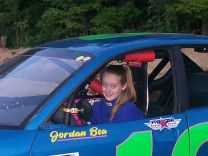
Jordan Emerson – Brain Injury Survivor – Race Car Driver
I was driving a fully-safety-equipped racecar.
5. When did you (or someone) first realize you had a problem?
When I was unconscious
6. What kind of emergency treatment, if any, did you have?
I was given a trach. I had emergency procedures for a cracked left hip, brain stem, seizures, a crushed left arm, paralyzed vocal chords, and paralyzed stomach.
7. Were you in a coma? If so, how long?
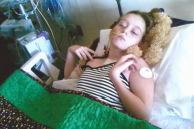
Jordan Emerson – Brain Injury Survivor
Yes. Almost 3 months
8. Did you do rehab? What kind of rehab (i.e., inpatient or outpatient and occupational and/or physical and/or speech and/or other)?
I have occupational and physical therapies as an outpatient. I was also helped by a speech-language pathologist.
How long were you in rehab?
I’m still attending OT and PT as an outpatient.
9. What problems or disabilities, if any, resulted from your brain injury (e.g., balance, perception, personality, etc.)?
I still have awful trouble going to the bathroom. Being in crowded areas makes me tired. (It’s “overstimulation,” but instead of overstimulation, it feels like a “draining of my energy.”)
10. How has your life changed? Is it better? Is it worse?
My life is neither better nor worse. It’s just different.
11. What do you miss the most from your pre-brain-injury life?
I miss being able to run around outside with my dogs.
 12. What do you enjoy most in your post-brain-injury life?
I like that everybody seems to offer to help more often.
13. What do you like least about your brain injury?
I dislike that I’ll be thinking so hard about something, and then, *poof* it’s gone.
14. Has anything helped you to accept your brain injury?
Talking with other survivors has helped.
15. Has your injury affected your home life and relationships and, if so, how?
Before I developed a filter, I said things to friends, and over time, those friends disappeared.
16. Has your social life been altered or changed and, if so, how?
Yes. I have lost friends.
17. Who is your main caregiver? Do you understand what it takes to be a caregiver?
My mom is my main caregiver. I’m thankful for her every day.
18. What are your plans? What do you expect/hope to be doing ten years from now?
I plan to be driving, living in my own apartment, married, etc.
19. Are you able to provide a helpful hint that may have taken you a long time to learn, but which you wished you had known earlier? If so, please state what it is to potentially help other survivors with your specific kind of brain injury.
Hard work really does pay off.
20. What advice would you offer to other brain-injury survivors? Do you have any other comments that you would like to add?

Jordan Emerson – Brain Injury Survivor and Mom & Dad
I owe a lot of my journey to my loving parents – I couldn’t have done this without them. I ♡ them!
Please feel free to reach out to me (#Believe). I enjoy helping whenever I am able. Believe!
(Disclaimer: The views or opinions in this post are solely that of the interviewee.)
If you would like to be a part of the SPEAK OUT! project, please go to TBI SPEAK OUT! Survivors Interview Questionnaire for a copy of the questions and the release form.
(Clip Art compliments of Bing.)
As I say after each post: Please leave a comment by clicking the blue words “Leave a Comment” below this post.
Feel free to follow my blog. Click on “Follow” on the upper right sidebar.
If you like my blog, share it with your friends. It’s easy! Click the “Share” buttons below.
If you don’t like my blog, “Share” it with your enemies. I don’t care!
Feel free to “Like” my post.
 SPEAK OUT! Itty-Bitty Giant Steps will provide a venue for brain-injury survivors and caregivers to shout out their accomplishments of the week.

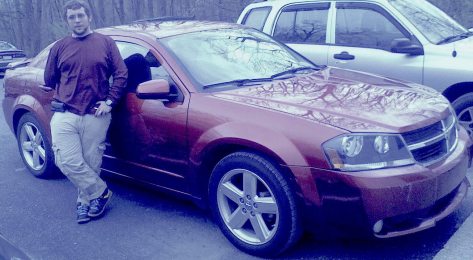
 Three years ago, our lives were turned upside down when my then 21-year-old son had his accident. It has been a long road with many hurdles to overcome, but I am so proud of him. He is my hero and my greatest blessing. And, proof to never give up. We were told that he would probably not make it that night. We were also informed that, if he did, he would not have any quality of life. But, he proved everyone wrong! Many prayers were prayed and many tears were shed, and my son is still with us – and doing very well. The first and second photos are of my son after the accident; the third is him wearing a helmet in recovery; and the fourth photo is of him with his car. (Yes, my son is driving, and his seizures are under control.)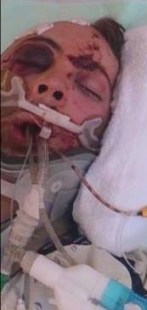




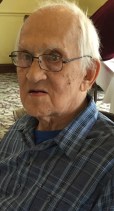
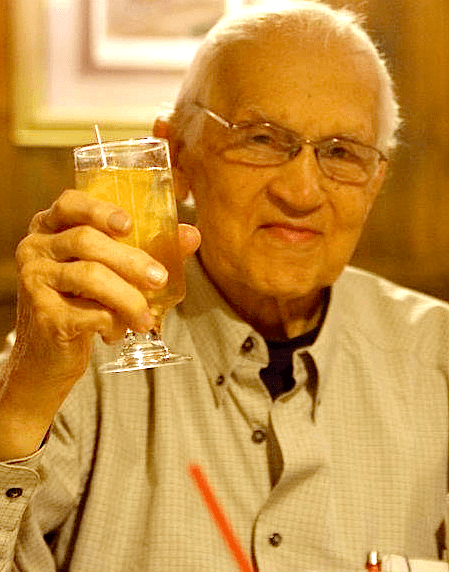
 Twelve years! Twelve years ago today, I came as close as a breath to losing my husband and best friend, David. While exercising (a thing he did every day to stay in shape), David did thirteen chin-ups, one more than he had done every other day. That was the proverbial “straw that broke the camel’s back,” or in David’s case, the “chin-up that caused his subarachnoid hemorrhage.” That day, as I rode with him in the ambulance to the hospital, I never realized what lay ahead for us. I never dreamed that this blip would be life-altering. I thought we’d be home by the end of the day, carrying on with life as usual. I was wrong!



 a problem, there is probably a group for folks to join. Groups for supporting brain-injury survivors and their caregivers, family members, and friends are cropping up everywhere. This is relatively new, since little was known about the seriousness of brain injury until rather recently. When the troops began to come home from the Iraq war with serious brain injuries, people started to notice. Then when the deaths and illnesses of so many former NFL players came to light – starting with Dr. Omalu’s finding of chronic traumatic encephalopathy (CTE) in the brain of Pittsburgh Steeler Mike Webster during an autopsy in 2002 – more people took notice.
 There are virtual groups for caregivers. (One is just for spouses or partners of survivors.) There are groups for both survivors and caregivers together. There are groups for traumatic brain injury survivors; for acquired brain injury survivors; or for survivors with ataxia, multiple sclerosis, or stroke. Some of the benefits of support-groups are that folks are more apt to understand what you are going through. Because they share similar issues, they are able to offer emotional support, suggest advice, or provide tips that worked for them. There is a veritable smorgasbord of ideas out there in cyberworld. If you are looking for an online group to hold your hand, hear you vent, or answer your questions, I promise you will find it.
 If you are not yet convinced that support-groups can be helpful for you, here are a few more reasons. They empower you. They put you in the driver’s seat to take control of what is happening in your life by helping you to find answers. You immediately become a member of a like-minded group of people who accept you, understand you, and is not judgmental. So, if you feel a support-group would be beneficial to you, by all means find one. They can be wonderful!
 the Brain Injury Association of America (BIAUSA.org) and locate your local chapter for your state to find a support-group near you. But, if you prefer the comfort of your home (as I do) and you have nimble fingers, open up your computer and find a Facebook group. There are more than thirty to join. I know … because I am a member of at least thirty. I only wish that I had known about the social media support-groups when David had his brain injury over eleven years ago. With a support-group, you are never alone.


 Raising Awareness of Traumatic Brain Injury - one view at a time. Thanks for visiting my blog
 Surviving Traumatic Brain Injury
Recent Comments