TBI – Survivors, Caregivers, Family, and Friends

Posts tagged ‘David Figurski’

SPEAK OUT! . . . . . . . . . . . . . . . . . . . . #1 Itty-Bitty GIANT Steps

Itty-Bitty GIant Steps for Blog

SPEAK OUT! #1 Itty-Bitty GIANT Steps

SPEAK OUT! Itty-Bitty Giant Steps will provide a venue for brain-injury survivors and caregivers to shout out their accomplishments of the week.

If you have an Itty-Bitty Giant Step and you would like to share it, just send me an email at donnaodonnellfigurski@gmail.com. It need only be a sentence. I’ll gather the accomplishments and post them with your name on my blog approximately once a week. (If you do not want your last name to be posted, please tell me in your email.)

I hope we have millions of Itty-Bitty Giant Steps.


Here are this week’s Itty-Bitty Giant Steps.

My Itty-Bitty Giant Step is that I started my blog finally and I’m going back to school to become a speech pathologist. Go me! It feels good to accomplish things I never would’ve done before.

Cheri Richardson Hicks

On May 3, I graduated from Florida State University with a Bachelor of Science in Nursing – with a 3.64 GPA and 16 years post TBI. It took many “Itty-Bitty Giant Steps” and a lot of patience to get to this point. Now I will have plenty of “patients” to go with it. LOL. Thank you for gathering this, Donna!

Erin Lea Beville

My dream is to walk a 5K race (3.1 miles) in an hour. I reached 1.6 miles in 35 minutes on a treadmill (while holding on to the handrails, of course!).

David Figurski

I was able to stand on my right foot (my “impaired” side) while holding my left foot off the ground and not hold onto anything for 33 seconds.  My therapist’s time goal for me was 30 seconds.

Jodi Jizmejian

Congratulations to all contributors!

(Clip Art compliments of Bing.)

So, Whaddya Think? . . . . . . . Contact Sports Are Not Safe for Children

So . . . what do you think? Is there something you are passionate about in this TBI world? Do you want to be heard? Your opinion matters! You can SPEAK OUT! on “So Whaddya Think?”

Simply send me your opinion, and I will format it for publication. Posts may be short, but please send no more than 1,000 words. Send to donnaodonnellfigurski@gmail.com

I hope to HEAR from you soon.

So Whaddya Think Brain th-4

Contact Sports Are Not Safe for Children

by

David Figurski

presented by

Donna O’Donnell Figurski

In 4-6 weeks, American football players will be getting ready for the 2014-2015 season. Millions of people enjoy playing the sport – from the pros in the NFL to college and high school athletes to young children in Pop Warner leagues. Millions more enjoy watching the sport and participating in pools and fantasy leagues. There is no question that football is a major part of US culture.

I admit I enjoy watching the game, but do players and spectators really know the risk involved? As a TBI survivor and someone who has learned first-hand how a brain injury can dramatically change a person and affect his or her life, as well as significantly change the lives of loved ones, I have become acutely aware of the dark side of contact sports. This revelation has been reinforced by the interviews Donna has published on this blog.

Many of the news items posted here have to do with the risk of brain injury in contact sports. Donna and I also posted an opinion about the danger of some sports to children. In fact, one of the TBI survivor interviews was by a young girl whose brain was injured during a volleyball match. On Thursday, Donna and I watched the PBS Frontline report (available online) called “League of Denial” about the NFL and its policy on concussions. The next interview will be from a former defensive lineman of the San Francisco 49ers, who had to quit because of a brain injury. A recent documentary, “Gladiators: The Uncertain Future of American Football” (trailer here), depicts the brutality of football. On the other hand, Roger Goodell, the Commissioner of the NFL, has gotten behind the Zackary Lystedt Law, which is designed to protect young players with a concussion. The PBS and Lystedt videos show contrasting sides of the NFL. I recommend watching both.

Knowing what I know now has greatly diminished my enthusiasm for contact sports, especially football. I see a crisis growing, but awareness by the public is also increasing. It is important that we make at least players, parents, coaches, and educators fully aware of the risk to the developing brains of young people. A brain injury can affect someone’s entire life. No parent wants that for his or her child. We who know need to speak out.

As I say after each post:

Feel free to leave a comment by clicking the blue words “Leave a Comment” below this post.

Please follow my blog. Click on “Follow Me Via eMail” on the right sidebar of your screen.anim0014-1_e0-1

If you like my blog, click the “Like” button under this post.

If you REALLY like my blog, share it with your friends. It’s easy! Click the “Share” buttons below.

If you don’t like my blog, “Share” it with your enemies. That works for me too!

(Clip Art compliments of Bing.)

TBI Tales: Bittersweet is Today

(Reposted from my other blog – Donna O’Donnell Figurski’s Blog Jan. 13, 2011)

 Bittersweet! is Today!

It’s the mix of heavenly sweetness followed quickly by harsh reality. It’s pleasure mixed with pain. It’s happiness and regret. That’s bittersweet!

Bittersweet is today!

Today – six years ago on January 13, 2005, with no invitation, bittersweet moved in with David and me. He was an uninvited guest.

He ripped David’s and my lives apart. – Bitter!

We won’t let bittersweet beat us. We are building our lives up again – together. – Sweet!

David suffered a traumatic brain injury. He endured an operation that lasted about 5 to 6 hours. He wasn’t supposed to live – Bitter!

He lived! – Sweet!

David endured two more open-brain surgeries in less that two weeks and slept the sleep of coma for more than that. He wasn’t supposed to live. – Very Bitter!

After several weeks he began to respond to the world around him. He wiggled his toes and blinked his eyes. – Sweet!

For three months he was in hospitals learning to walk, learning to talk, learning to feed and dress himself again – learning to be a part of society. He desperately missed his job at Columbia University. He did not know when or if he would ever return. Bitter-very-bitter!

Columbia welcomed David back with an article about him in the newsletter of Columbia University called, In Vivo-CUMC At Large. Very Sweet!

And by conferrring upon him in 2006, at the Medical School Commencement, the Charles Bohmfalk Award for teaching in clinical years. Sweet! Sweet! Sweet!

David still has difficulty walking, talking, swallowing, and seeing. His right arm shakes erratically. He remains a prisoner of his body. Bitter-oh-so-bitter!

He wont let anything get him down. Life has become as normal as it can with all of these disabilities. He exercises to strengthen his body. He works to strengthen his mind. Improvements are being made – slowly, but they come. Sweet!

David has lived six years longer than any of his doctors expectations. Sweet! Oh-so-Sweet!

I have my best friend with me. Sweet! Sweet! Sweet!

Bittersweet move over. There is not enough room in our lives for you.

(Picture compliments of ME)

TBI Tales: Dancer Extraordinaire

(Reposted from my other blog – Donna O’Donnell Figurski’s Blog Sep. 3, 2012)

Meet Paula Nieroda 

Paula was David’s dance instructor for almost two years. She not only guided him through his dance steps, but she assessed his every movement to help him regain his balance.

Paula is much more than a dance instructor.

She is a wonderfully sensitive and compassionate young woman.

David and I took lessons with Paula once a week for nearly two years.


We learned a number of ballroom dances, including the Cha-Cha, the Tango, and the Swing – all very quick dances, which we did not do so quickly. We learned the Waltz and the Fox Trot, too. We stumbled around the dance floor amid the elegant contestants who were preparing for their next performance. They twirled and glided and dipped and swooped with feet barely touching the floor, while we firmly planted one foot and then the other in slow succession hoping that we would not topple over. We never did.

Paula taught David form – focusing on his posture. “Renew! Renew! Renew!” was her mantra – the reminder to David to stand taller.

When Paula moved to another studio, too far from us, we did not continue our lessons because we knew we could never replace her.

Paula is also a performance dancer and has competed and won many dance contests.  In the video below you will see Paula in action. In a pink fairy-princess gown, she glides over the floor with her partner, George Valasquez, who performs an amazing routine with only one leg.

Paula is truly an inspiration.

Watch this video to see what I mean. Truly AMAZING!!!!!


If you have a story to tell, please contact me at donnaodonnellfigurski@gmail.com

(Pictures compliments of ME.)

(Video compliments of YouTube.)


As I say after each post:

Please leave a comment by clicking the blue words “Leave a Comment” below this post.anim0014-1_e0-1

Please follow my blog. Click on “Follow” on the lower right corner of your screen. (It’s nice to know there are readers out there.)

If you like my blog, share it with your friends. It’s easy! Click the “Share” buttons below.

If you don’t like my blog, “Share” it with your enemies. I don’t care!

Feel free to “Like” my post.

Permission granted to “Reblog” my post.


TBI Tales: …………………………………. A Fork in the Road to Recovery

(Reposted from my other blog – Donna O’Donnell Figurski’s Blog May 14, 2010)

A Fork in the Road to Recovery

I woke up a few weeks ago with an astounding revelation. (Aren’t they all?) But, this one really was. Though trying to sell my brilliant idea to my husband, David, would take some fancy footwork.

As our family and friends know, David is still on the long road to recovery after suffering a Traumatic Brain Injury (TBI) more than five years ago at 7:06 AM on January 13th, 2005. His TBI left his body compromised. His recovery is a balancing act – literally.

Though David’s balance has improved somewhat through the years, it is still seriously impaired. Each step David takes is deliberate, well-planned, and thought out. He is consciously adjusting his balance at every footfall. His brain constantly generates new neurons and reconnects the old in an attempt to reestablish alternate pathways to help him relearn what he already learned easily and quite well when he was a mere fourteen-month-old toddler. It’s amazing how those little tykes can balance atop their plump, squatty legs. Even more amazing that they can move them from place to place – but they do. And if they can do it … well so can David – right?

David works hard every minute of every day to relearn to walk. It’s not as easy as the two-year-olds make it look. So I had an idea to make the process easier – at  least, I hope it will.

The germ of my idea was unwittingly sown in October 2009 when I first began my salsa lessons. I admit, it was a slow-growing seed, since it took six months for it to finally hit me over the head.

On a recent morning as I pondered my first days of salsa, I recounted how difficult it was for me to make my feet and my body go where my instructor guided. He made it look easy, and I wanted my mind to comply, but my feet simply would not cooperate. I tried and tried, but the only thing I was successful at was tripping and stumbling over my own feet – not to mention my dance partner’s feet. I felt like a total  klutz. I was convinced I would never be able to do the steps. I would never learn salsa – let alone become proficient at it.  As the weeks went by and my instructor introduced the right and left turn, the hammerlock, and the cross-body lead, my mind went into swirl. No, I would never learn – I was sure of it. But, as more weeks passed, I did learn. It took time and it took practice, and after six months I can do each of those steps and I’m not too bad at it. I have even moved on to the advanced class.

What I understood on that morning of my revelation was that as I concentrated so intensely on learning each step, nothing else occupied my mind. I was entirely focused. During my lessons, it seemed that my brain rewired to accommodate the strange and foreign steps I was being asked to do. Realizing this, set the light bulb flashing. I reasoned that if my mind could overcome my dance challenge, why couldn’t David’s overcome his walking challenge?

That’s when I had my astounding revelation. It made sense to me. I had to choose the perfect time to present my idea to David, though I knew no time would be good. I knew that as soon as I uttered the words, I want you to take dance lessons. David’s immediately answer would be, “NO!”

So, I started my conversation like this … David, I have a really, really good idea. (I thought two reallys might be more convincing.) I need you to listen to my whole idea before you say anything. I don’t want you to make up your mind before I finish.” He looked skeptical. Well anyone would with that opening, but he nodded and I went on. “David, I want you to take dance lessons.” His immediate reply was “NO!” No surprise there.

I presented my ideas. He listened. One by one I ticked off all of the reasons that I thought dance lessons would be beneficial to him. He listened. I explained how I thought that the process of intense concentration might help him to overcome his balance issues as it had helped me to conquer my dance steps. He listened. I threw in the neurons and the brain-rewiring ideas. He listened. Then I told him I wanted to speak with my instructor to arrange for private dance lessons. I held my breath as I waited for his reply. He said, “Okay!”

It took a few weeks to set the lessons up, but last Monday night David had his first dance lesson with Oscar. I took the lesson with David. As we clung to each other, (He was holding on to me for dear life.) we waltzed around the room 1, 2, 3.- 1, 2, 3. Okay … so we didn’t really waltz around the room. We stayed in about a three-foot square. But at least it is a start!

When the lesson was over, I figured David would bolt. So I was really surprised when he asked to schedule the next lesson. He actually liked it. Yeah!


If you have a story to tell, please contact me at donnaodonnellfigurski@gmail.com

(Clip Art compliments of Bing.)

(Photos compliments of ME.)


As I say after each post:

Please leave a comment by clicking the blue words “Leave a Comment” below this post.

Feel free to follow my blog. Click on “Follow” on the lower right corner of your screen.anim0014-1_e0-1

If you like my blog, share it with your friends. It’s easy! Click the “Share” buttons below.

If you don’t like my blog, “Share” it with your enemies. I don’t care!

Feel free to “Like” my post.

Permission granted to “Reblog” my post.


Caregivers SPEAK OUT! . . . . . . . . . . Donna O’Donnell Figurski

Image 2

SPEAK OUT! – Donna O’Donnell Figurski

by

Donna O’Donnell Figurski


1. What is your name? (last name optional)

Donna O’Donnell Figurski

2. Where do you live? (city and/or state and/or country) Email? (optional)

Arizona, USA     donnaodonnellfigurski@gmail.com

3. What caused your survivor’s TBI?

My husband, David, was exercising before going to work. He usually did 12 chin-ups. That morning he did 13. DRAT!

4. On what date did you begin care for your TBI survivor? Are you the main caregiver? How old were you when you began care?

David had surgery for a subarachnoid hemorrhage on January 13, 2005. That was followed by another surgery for the removal of an aneurysm, and yet another surgery to remove an Arterio-Venous Malformation. Thursday the 13th was our “unlucky” day (not Friday the 13th). Thursday the 13th was the day that the title “caregiver” was bestowed upon me. I was 56 years old when I became David’s main caregiver.

5. Were you caring for anyone else at that time? (e.g., children, parents, etc.)

No. Both of our children were grown and living across the country. (But, of course, you always worry about your children no matter how old they are.)

6. Were you employed at the time of your survivor’s TBI? If so, were you able to continue working?

I was employed. I was a first-grade teacher. I called for a substitute from the ambulance and was not able to return to work for three and a half months. After David was released from the rehab hospital and settled into home life again with our support system in place, I returned to my six- and seven-year-old munchkins.

7. Did you have any help? If so, what kind and for how long?

Initially, family and friends surrounded us, but within a few short weeks they needed to return to their own lives. When, two and a half months later, David returned home from the rehabilitation hospital, I invited some friends to live with us. I am so grateful for their help. David was unable to be left alone, even for a short time. He was completely incapacitated. Makes you wonder how he was released from the hospital! I could not have returned to work without the assistance. I had the help for about a year.

8. When did your support of the survivor begin? (e.g., immediately – in hospital, when survivor returned home, etc.)

My care for David began the moment he stumbled into our bedroom with his head filling with blood, through both his hospital and his rehabilitation stays, and when he returned home two and a half months later.

Though now, nine+ years later, he is independent in many ways, I remain his caregiver for many activities. He is unable to leave our home unassisted. I am his private chauffeur and “chief cook and bottle washer.” But … he does the laundry!

9. Was your survivor in a coma? If so, what did you do at that time?

Yes. He fell into coma before he was placed into the ambulance. Though he struggled for consciousness after each of his three surgeries, he remained in coma for nearly two weeks.

While he slept the sleep of the ignorant, I read to him, played music – our old favorites (The Righteous Brothers), gave him arm and leg massages to stimulate his muscles, provided constant chatter, tried to communicate through hand squeezes (right hand squeeze = yes; left hand = no), provided the doctors with daily information since I was constantly with him, and I begged David to come back to me.

10. Did your survivor have rehab? If so, what kind of rehab? (i.e., In-patient and/or Out-patient and Occupational, Physical, Speech, and/or Other) How long was the rehab? Where were you when this was happening?

David did extensive rehab. Almost four weeks from the initial event, David was transferred to an acute facility, where he worked with physical, occupational, speech, and ADL therapists for three hours/day. I spent about fourteen hours each day cheering him on. After release from the rehabilitation hospital, he continued as an out-patient. When I returned to work, our friends took him. When David returned to his laboratory, he continued his therapy with a physical therapist for two hours/week. I wasn’t there for those sessions. He continued that therapy from 2006 until 2013, when he retired from Columbia University.

11. What problems or disabilities of your TBI survivor required your care, if any?

Imagine a newborn babe. David required constant care, even when asleep. He needed to learn to eat, dress, and care for hygiene. He couldn’t walk and had to be transported via wheelchair. He had a feeding port in his stomach, and I had to not only feed him through the port, but also play nurse and clean and dress the wound. Any ingested food was mashed or finely chopped. I applied medication to his eyes and patched one for sleeping each night, and I kept track of and doled out about fifteen medications throughout the day.

12. How has your life changed since you became a caregiver? Is it better? Is it worse?

For the first year and a half, David could never be left alone. Not only was his independence impacted, so was mine. I thought I’d lose my mind. I went to work, did errands, and was home every other minute. That was difficult. I was responsible for David’s household duties, the bills (of which I was ignorant), his many errands, and … the trash (the worst Green Smiley). Nine+ years later, life isn’t better; it’s different. It’s easier than the first five years, but it’s much more difficult than pre-TBI. Would I turn back the clock to pre-TBI time? YES! Definitely!

13. What do you miss the most from pre-TBI life?

Everything! But mostly I miss David’s being able to drive. (I hate being the primary driver.) I miss his being the man-in-charge too. Though recently he started to take over many of the business duties of running a house, which is a complete relief to me. I miss his coming home after a long day at lab and hugging me – happy to see me. I miss his running down the stairs in his running shorts and shoes and watching him from the window as he headed down the street for an eight-mile run. It’s the simple things I miss.

14. What do you enjoy most in post-TBI life?

David seems more relaxed. His position as Professor at Columbia University was very demanding of his time and energy. He gave it his all. He has become more social, and we have many dear friends who he would not have had time to know pre-TBI.

I love working together on trying to publish my book, “Prisoner Without Bars: Conquering Traumatic Brain Injury” and promoting brain injury awareness through my blog (Surviving Traumatic Brain Injury).

15. What do you like least about TBI?

I love to travel. I had hoped in retirement that we would travel the world together. It’s obvious now that that won’t happen. Air travel is challenging at best. David’s lack of balance is the biggest culprit, making it difficult for him to maneuver in the outside world. He is also unable to drive a car. Since I am not fond of driving (he was), this also curbs our over-the-land ventures far from home. Ultimately, it’s the limits that TBI puts on our lives that I dislike the most.

16. Has anything helped you to accept your survivor’s TBI?

I am just so grateful that David is still with me. I have cheered him every step of the way. David’s positive attitude, his endless work and exercise to improve his condition, and his own acceptance have been a great help to me. The internet is a wonderful source of knowledge about TBI. And books! I’ve read tons of books to understand more about TBI and how others deal with it. Below is a list of some not to miss. You can find more on my blog.

Books not to miss:

“In an Instant: A Family’s Journey of Love and Healing” by Lee and Bob Woodruff

“Gabby: A Story of Courage and Hope” by Gabrielle Giffords and Mark Kelly

“I Forgot to Remember” by Su Meck

17. Has your survivor’s injury affected your home life and relationships and, if so, how?

I told every surgeon to give him back to me. I didn’t care how. I got my wish. Though from operating room to recovery room, they made a slight switch. David looked similar to his pre-TBI self, but he had changed. Sometimes I don’t know this new David. That’s not bad – I like this new guy too. It’s just that I miss the pre-TBI David – the boy I met when I was 16 and the man I married at 20 and had children with. I feel like I am having an affair – and it’s legal!

18. Has your social life been altered or changed and, if so, how?

In the beginning, yes, my/our social life was greatly diminished. Pre-TBI David and I enjoyed Friday and Saturday date nights – dinners/movies. That became impossible when David could no longer move on his own or eat by himself. Occasionally friends visited. Eventually David regained his social skills, and, because he is more relaxed, he enjoys people more. Now we go out with friends or entertain at home, and we’ve reinstated our Friday date night.

I pursue many out-of-house activities, such as attending my writing groups, reading my work at open mics, lunching with friends, and acting and directing in the theater.

19. What are your plans? What do you expect/hope to be doing ten years from now?

I hope to continue my work of bringing awareness to TBI through this blog and of being active on internet brain injury support groups. I want to share TBI Survivor and Caregiver stories with my readers.

It’s my dream that my book, “Prisoner Without Bars: Conquering Traumatic Brain Injury,” about my husband, David, will soon be published and in the hands of those who will find knowledge, hope, inspiration, and solace in our story.

I hope that David will continue to improve, no matter how slowly, and someday be able to run the marathon that he had always dreamed of.

20. What advice would you offer other TBI survivor caregivers? Do you have any other comments that you would like to add?

Read tons of books.

Surf the internet for information.

Keep a positive attitude. I know, that one is hard. (I never let David see me cry. I was afraid it would scare him.)

Join a support group – in real life or on online site(s).

Take care of yourself. Remember the safety demonstration spiel on every flight. “If the oxygen pressure drops, place the oxygen mask over your face, then help any traveling companions who may need assistance.” You first! Take care of yourself! When your survivor had a TBI, your “oxygen pressure” dropped. PUT ON YOUR MASK!

Never give up!

david-donna-april-21,-2006

Donna & David July 2005 6 months post-TBI


(Disclaimer: The views or opinions in this post are solely that of the interviewee.)

If you would like to be a part of this project, please go to TBI Caregiver Interview Questionnaire for a copy of the questions and the release form.

(Photos compliments of ME.)
Brain Injury Resources . . . . . . . . . . TBI – More Than a Million

1660592_10203400148983396_2119524038_n


Chances are you know someone who has suffered a traumatic brain injury (TBI.) More than 1.7 million Americans each year sustain a TBI. I personally know five people who are living with some form of TBI. In fact, I’m living with one of them.

My husband, David, had his TBI in 2005. A professor friend of ours from Brigham Young University has one. So do my nephew, an actor/director friend from my local community theater, and the husband of my friend, Judy.

A TBI can occur in the blink of an eye. It is not discriminating. It cares not about color, race, or creed. It can happen to a child or an octogenarian and everyone in between. A child may fall off his bike or off her swing. A teenager may meet up with a TBI on the soccer or football field or a gymnastic mat. Car and motorcycle accidents are common causes of TBIs. An assault in a dark alley or domestic abuse in your home can result in a TBI too. One can even have a TBI while exercising (e.g., while doing chin ups in the wee hours of the morning after doing Tai Chi while listening to Deuter or some other new age CD). David did!1911631_10152299104437354_1744766119_n

Like snowflakes, no two TBIs are the same. Each survivor is different too, and each method of healing is unique to the person who is struggling to regain some of his or her former life. With a lot of hard work, patience, and persistence many survivors can enjoy a “new normal” life. While they have very different problems, each one of the five people I know is trying hard to lead a “normal” and productive life.


As I say after each post:

Feel free to leave a comment by clicking the blue words “Leave a Comment” below this post.

Please follow my blog. Click on “Follow Me Via eMail” on the right sidebar of your screen.anim0014-1_e0-1

If you like my blog, click the “Like” button under this post.

If you REALLY like my blog, share it with your friends. It’s easy! Click the “Share” buttons below.

If you don’t like my blog, “Share” it with your enemies. That works for me too!


(Clip Art compliments of Bing.)


TBI Tales: Missing Pre-TBI Life

My optimistic, forward-looking husband, who suffered a TBI over 9 years ago, was nevertheless moved by the Beatles’ song YESTERDAY. th-7 He changed a few words to make it more relevant to TBI survivors.  What’s obvious is that David, despite living productively with TBI, still misses his pre-TBI life.



“Yesterday” (for TBI Survivors)
Yesterday, all my troubles seemed so far awayth-6
Now it looks as though they’re here to stay
Oh, I REMEMBER yesterday

Suddenly, I’m not half the man I used to be
There’s a shadow hanging over me.
Oh, yesterday came suddenly

Why LIFE had to CHANGE I don’t know I COULDN’T say
I DID NOTHING wrong, now I LOST MY yesterday

Yesterday, LIFE was such an easy game to play
Now I need a place to BE AGAIN
Oh, I REMEMBER yesterday

Why LIFE had to CHANGE I don’t know I COULDN’T say
I DID NOTHING wrong, now I LOST MY yesterday

Yesterday, LIFE was such an easy game to play
Now I need a place to BE AGAIN
Oh, I REMEMBER yesterday
Mm mm mm mm mm mm mm

And now the original version of the song “Yesterday” by the Beatles.

“Yesterday”

Yesterday, all my troubles seemed so far away
Now it looks as though they’re here to stay
Oh, I believe in yesterdayth-5

Suddenly, I’m not half the man I used to be
There’s a shadow hanging over me.
Oh, yesterday came suddenly

Why she had to go I don’t know she wouldn’t say
I said something wrong, now I long for yesterday

Yesterday, love was such an easy game to play
Now I need a place to hide away
Oh, I believe in yesterday

Why she had to go I don’t know she wouldn’t say
I said something wrong, now I long for yesterday

Yesterday, love was such an easy game to play
Now I need a place to hide away
Oh, I believe in yesterday
Mm mm mm mm mm mm mm

QUESTION: What do you miss most about your TBI life?

As I say after each post:anim0014-1_e0-1

Please leave a comment by clicking the blue words “Leave a Comment” below this post.

Feel free to follow my blog. Click on “Follow” on the lower right corner of your screen.

If you like my blog, share it with your friends. It’s easy! Click the “Share” buttons below.

If you don’t like my blog, “Share” it with your enemies. I don’t care!

Feel free to “Like” my blog.

Permission granted to “Reblog” my post.

(Clip Art compliments of Bing.)


Traumatic Brain Injury – TBI – PRISONERS WITHOUT BARS

tbi-touched-life-th-5As a writer for children, I never intended to write a book for adult readers – other than those adults who read picture books to their children as the stars fill the night sky. But, circumstances changed in an instant when my husband, David, suffered a Traumatic Brain Injury in 2005. I didn’t know what a “TBI” was. I had never heard or seen those letters together before. But, they would soon become a permanent thought in my head.

As David stumbled into our bedroom, his hand covering his right eye, I knew something was drastically wrong. As his pain intensified and the paramedics transported him to the emergency room, I didn’t know how seriously our lives were about to change. The man, my lover, and my best friend, disappeared.

After three brain surgeries, a new man emerged. He looked different. He sounded different. He was severely disabled. He couldn’t speak beyond guttural sounds. He couldn’t walk, dress, brush his teeth, feed himself, or take care of personal hygiene without assistance. At first it seemed that he didn’t even know me, which nearly broke my heart.

david-running-in-hall

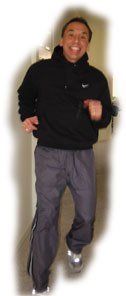
David trying out his new running outfit just three weeks before his TBI. December 2004

David’s TBI has caused us to travel many long and bumpy roads. We still do nine years post-TBI, but it is a journey we take together. I met David when I was 16 years old. I knew in an instant that he would be my life-partner – for better or for worse. We’ve had the better. We’ve had the worse. We are striving for the better once again.

Though I lost the “boy/man” I fell in love with, I have fallen in love all over again with this new version of David. Though he may look and act differently, he is still the most caring, gentle, intelligent man I know. His physical disabilities did not deter him from returning to his

Donna & David 15 months AT (After Trauma) April 2006

Donna & David 15 months AT (After Trauma)
April 2006

laboratory at Columbia University a year later to oversee his and his students’ research, to write scientific papers, to become the editor of a book of research articles from scientists from around the world, and to be awarded a grant for his research.

Our journey is not over.

I’ve written David’s story, “Prisoners Without Bars: A Caregiver’s Story,” to share our journey with you, my readers. It is a story of tears and angst, of stress and confusion. The story will make you cry. It will make you laugh. It will make you wonder in disbelief just how this man is able to accomplish so much with so little. The story chronicles David’s strength and persistence, his tenacity to build a new life, and to get better against all odds. David’s story is a story of hope and inspiration.

It is also my story. As David’s wife and best friend and as his primary caregiver, I stand on the front line advocating for him every step of the way and cheerlead his every accomplishment. It’s a story that will take you with us on our journey of TBI.

I wrote the book between my caregiving duties of David, my teaching first and third graders, and when I was not sleeping. It is currently being sent to literary agents, and I hope that it will be published soon, so you can read the inside story of how David fought and is conquering Traumatic Brain Injury one unbalanced step at a time.anim0014-1_e0-1

As I say after each post:

Please leave a comment by clicking the blue words “Leave a Comment” below this post.

Feel free to follow my blog. Click on “Follow” on the lower right corner of your screen.

If you like my blog, share it with your friends. It’s easy! Click the “Share” buttons below.

If you don’t like my blog, “Share” it with your enemies. I don’t care!

Feel free to “Like” my post.

Permission granted to “Reblog” my post.

(Clip Art compliments of Bing.)

(Photos compliments of ME.)

diemodi jewelry

uniquely hand-crafted jewelry by donna

Welcome to Harmony Kent Online

The home of all things books

Pete Springer

Passionate Teacher and Future Children's Author

HOPE TBI

Helping Other People Excel - To Be Independent

For the Love of Books, Old and New

Katie Fischer, Writer and Reader of Stories

Charlie Bown

Children's Author

Jessica Hinrichs

“We write to taste life twice, in the moment and in retrospect.” ― Anais Nin

VIVIAN KIRKFIELD - Writer for Children

Picture Books Help Kids Soar

Mindy’s Writing Wonderland

For authors, parents, teachers & everyone who loves children’s books.

Kaitlyn Leann Sanchez

Literary Agent

Surviving Traumatic Brain Injury

TBI - Survivors, Caregivers, Family, and Friends

The Care Factor

Loving someone with a Traumatic Brain Injury

Brain Injury Support Group of Duluth-Extension

Brain Injury Information and SUPPORT

Brain Aneurysm Global Insight

Brain Aneurysm, cerebral hemorrhaging, hemorrhage stroke