TBI – Survivors, Caregivers, Family, and Friends

Posts tagged ‘TBI Survivor’

Brain Injury Resources . . . . . . Music May Optimize the Brain

Music May Optimize the Brain

I found this interesting, short (4 min 45 sec) video on the blog “Beyond Injury,” which is authored by Scott, who was diagnosed with brain cancer. I thought the video should be reposted here for you. It shows how listening to music Brain th-2or – better yet – playing it stimulates several parts of the brain simultaneously, unlike other activities. The video says that musicians’ brains have developed a higher level of functioning, including – but not limited to – problem solving, perceiving emotional cues, expanding fine-motor skills, and enhancing memory. Maybe the stimulation from music will enhance recovery from TBI. But, be aware that there is no hard evidence showing a link between music and recovery from TBI. Neuroscientists do know, however, that music benefits a healthy brain. It is reasonable to expect that an activity that enhances many brain functions should at least be beneficial to TBI survivors with deficits in any of those functions.

(Clip Art compliments of Bing.)

Comments are welcome.

TBI Tales: Michael Coss Awakes After 6 Months in Coma

Meet Michael Coss

presented by

Donna O’Donnell Figurski


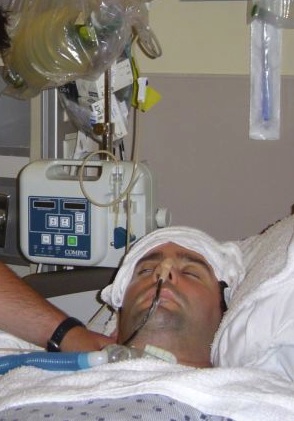
Michael Coss 2006

Michael Coss 2006

Michael Coss is the author of The Courage to Come Back: Triumph over TBI – A Story of Hope (2011) and the inspiration behind the creation of the Michael Coss Brain Injury Foundation. The foundation was created to raise money for children in need of financial support to access brain injury treatment. The proceeds from the sale of Michael’s book go directly to help the kids. The book is a moving account of Michael’s journey facing the challenges of traumatic brain injury.

Michael is also the winner of the 2011 Courage to Come Back Award for Physical Rehabilitation (Coastal Health). Michael will tell you that his life was changed forever, and it’s been changed for the good. First though, he will usually tell you that he is the very proud father of twins, Nathan and Danielle, who are now eight years old.

On May 18th, 2006, Michael was driving to Kelowna, British Columbia, Canada, with his former spouse and seven-month-old twins to attend a work function and stay with friends. Catastrophe struck while on the Coquilhalla highway — Michael lost control of the van, and it rolled at least one and a half times.

Miraculously, Michael’s former wife, Ann, and daughter, Danielle, escaped with only minor injuries, but Nathan and Michael were not as fortunate. Nathan spent several weeks at BC Children’s Hospital with head injuries. When the medical services arrived at the scene of the accident, Michael was unresponsive, even though the airbags had deployed and Michael had been restrained by his seatbelt. The Glasgow coma scale (CGS) rating at the scene was 8 out of a possible 15, which indicated a comatose state.

Michael was transported by air to Royal Inlands Hospital in Kamloops, where he was assessed by Neurosurgery. Bilateral ventriculoperitoneal shunts were inserted to relieve the pressure on Michael’s brain from the accumulation of fluid. Later he was transferred to Royal Columbian Hospital to be closer to his family. He remained comatose.

Michael’s injuries were nearly fatal, and despite comprehensive treatment at two hospitals, Michael remained in a coma for six and a half months. Doctors told his family that his chances of recovery were remote. His wife was devastated because she faced the possibility of raising their two babies without a father. Recommendations were made to Michael’s family to look for a long-term-care facility to look after him for the rest of his life.

But they did not know Michael Coss and his family. Michael’s family had researched hyperbaric oxygen therapy (HBOT), the medical use of oxygen at a level higher than atmospheric pressure. The treatments are commonly used in Asia and Europe and are available in Canada. But the treatments are not approved by Health Canada, and, therefore, they are not covered in Canada by medical insurance. The more the family learned, the more they came to believe that these treatments might work for Michael, though the treatments were prohibitively expensive and came with no guarantee.

His friends and co-workers saw a chance to mobilize and make a difference in Michael’s life. Within a few weeks, funds were raised by donations from friends, family, and his former work-colleagues at Molson Coors Canada.

Michael was transferred daily from Royal Columbian Hospital to the Richmond Hyperbaric Health Centre via ambulance. His mother, who accompanied him, would dampen a sponge with water to make him swallow and equalize the pressure within his ears. HBOT worked quickly, and on Christmas Eve of 2006, after half a year in a coma, Michael awoke and uttered his first words.

Only three months out of his coma, Michael learned about Rick Hansen’s Wheels in Motion events to raise funds for research and to improve the quality of life for people with spinal cord injuries. Michael was inspired by Rick Hansen and wanted to be a part of the event. In the midst of his rehabilitation, Michael canvassed his network, and once again they rallied in support. Friends, family members, Molson Coors co-workers, and other corporations raised over $22,000. His team (Team Cosco) not only won the award for the top fundraiser in Canada for Wheels in Motion 2007, but they also set a fundraising record for the entire six-year history of the program.

Through a long, intensive, and grueling rehabilitation, Michael relearned how to talk and eat. He is now relearning how to walk.Coss, Michael Survivor Family Photo Magazine COver

Today Michael serves as an inspiration, a motivational speaker, and a catalyst for traumatic brain injury survivors everywhere. He currently resides in a group-home not too far from his family and visits with them several times a week. His long-term goal is to be an able and active participant in his family’s life. Michael is not yet ready to walk to the park hand-in-hand with his children, but at least he is in training for it.


If you have a story to tell, please contact me at donnaodonnellfigurski@gmail.com

(Pictures compliments of Michael.)

(Clip Art compliments of Bing.)


As I say after each post:

Please leave a comment by clicking the blue words “Leave a Comment” below this post.anim0014-1_e0-1

Please follow my blog. Click on “Follow” on the lower right corner of your screen. (It’s nice to know there are readers out there.)

If you like my blog, share it with your friends. It’s easy! Click the “Share” buttons below.

If you don’t like my blog, “Share” it with your enemies. I don’t care!

Feel free to “Like” my post.


Survivors SPEAK OUT! Melinda Murphy

SPEAK OUT! – Melinda Murphy

by

Donna O’Donnell Figurski


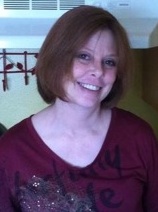
Melinda Murphy with TBI

Melinda Murphy with TBI

1. What is your name? (last name optional)

Melinda Murphy

2. Where do you live? (city and/or state and/or country) Email (optional)

Middletown, Ohio, USA

3. When did you have your TBI? At what age?

February 9, 2011 I was 40 years old.

4. How did your TBI occur?

I fell down a flight of steps into a basement.

5. When did you (or someone) first realize you had a problem?

Immediately, although the TBI was not diagnosed for quite some time.

6. What kind of emergency treatment, if any, did you have?

None

7. Were you in a coma? If so, how long?

No

8. Did you do rehab? What kind of rehab (i.e., In-patient or Out-patient and Occupational, Physical, Speech, Other)?

I have had all of the above, and I am still in therapy. I have had some fantastic therapists over the years, and I just have to say that they are the key in so many ways. I don’t know where I would be without them.

How long were you in rehab?

They did in-home rehab and therapy with me for about 5 months, if memory serves me. I do not remember most of those first months, though, so I could be lying to ya :).

9. What problems or disabilities, if any, resulted from your TBI?

I have horrible balance. I live with headaches constantly. My vision and hearing have both been affected to the point that I can no longer go out in public on my own because of the amount of stuff coming in, so to speak. I miss my church and independence. I have short-term memory loss. I lost organizational skills and basic life functions, like just being able to make simple decisions. I lost a lot of other skills, like math and English. I have trouble speaking; I lose words before they hit my mouth. Many times my brain gets over-tired and just quits working at all. I can’t explain it. I can’t drive. I could go on, but…LOL.

10. How has your life changed? Is it better? Is it worse?

Both – honestly! No one being truthful would tell you there is nothing that he or she wouldn’t give back. It’s hard, and it stinks a big chunk of the time. Learning to live again and differently is the hardest thing I have ever had to do, and I didn’t live the easiest life, so…. Learning how strong I am, though, and learning to receive (which is not something I was used to and I think not many of us are used to) is a tremendous thing. Learning of people and the spirit and nature of them – that is a very rich gift I have been given through this. Learning to be okay with not being okay – that is again a huge thing that has bettered my life. So, I think that – as sad as it is at times and as hard as it is (and it is) – it is also a blessing.

11. What do you miss the most from your pre-TBI life?

Almost everything – I miss being able to drive; I miss my independence; I miss hot meals because most days I cannot cook for fear I will forget to turn off the oven; I miss my job and clients; I miss my social life; I miss being able to keep my house clean (balance issues keep me from up and down and forward and back motions); I MISS MY CHURCH!

12. What do you enjoy most in your post-TBI life?

I enjoy the quiet. Everything is quiet in my world now, out of necessity. It’s very nice. Quiet is better than you think it is – I had forgotten how nice. I think most of us have. I like things that I have learned from having a TBI and the people whom I have met because of it. I like the growth that I see in me because of my TBI.

13. What do you like least about your TBI?

Almost everything

Melinda Murphy - after fall

Melinda Murphy – after fall

14. Has anything helped you to accept your TBI?

Time, only time. People can tell you what they want, and they can try and say anything, but until your brain is ready, well hang it up. It’s been three and a half years, and I have just accepted it this year. When you are ready, it will happen. I will say this about acceptance. People say that once you accept it, you will be fine and everything will be easier. In the end, that is correct and true, but let me tell you, acceptance itself is hard. It is the toughest thing in the world to acknowledge that you – the person you are now – are broken and that that is okay. Getting there and getting through it takes time and patience from yourself and your caregiver.

15. Has your injury affected your home life and relationships and, if so, how?

Yes. I touched on my home life earlier – it is difficult to live with a TBI. Memory, balance, and sensory issues affect me far more than people could know, and my home very often suffers. I often feel like I am a burden on my family and on those relationships. When you are dependent, the structure of the relationship is changed.

16. Has your social life been altered or changed and, if so, how?

Yes. All of my relationships changed – I am dependent now. That is a hard place to be. It stands in the way of traditional friendships. (At least, it feels that way on this end.) When you need, people tend to view you differently. We all have those friends, don’t we? I had them before my accident and still do, but those friends were different from all my other friends and from my social circle. I can’t complain now because I used to do it. I was no more aware of doing it then than are so many who are unaware of my situation now. I can say that I am blessed beyond measure to have a handful that do not fit into that mold and are there for me. God is good all the time because without them I would be in a home.

17. Who is your main caregiver? Do you understand what it takes to be a caregiver?

I am. I live alone and do the very best I can. I had to move in with my family just after the accident because of seizures and not being able to even stand up or sit down on my own. I was 100%-dependent then, but I moved back on my own as soon as I was able.

18. What are your future plans? What do you expect/hope to be doing ten years from now?

I would love to be fully functional. By that, I mean holding a job (any job) – just feeling productive and serving – and doing things more independently. (I have a servant’s heart and desire nothing more than to be helping others in any way the good Lord leads.)

19. Are you able to provide a helpful hint that may have taken you a long time to learn, but which you wished you had known earlier? If so, please state what it is to potentially help other TBI survivors with your specific kind of TBI.
You’re okay just the way you are.

It took me forever and a day to accept that, and, frankly, I am still getting there. I know those words probably mean no more than anyone else’s, but I pray they touch someone. I always had a perfect picture of what healthy looked like in my mind, and I was working so hard to get there until one day, I realized that I was already there. I don’t need to walk up those steps upright like my neighbor. If I get up all the steps with my tail in the air and bear-crawling like a two-year-old, but I make it to the top, well by Jove, I can climb a flight of stairs – can’t I? It matters not the way you get there, only that you do. The fact that you do is what makes you as healthy and whole as that beefcake next to ya. Find a way.

20. What advice would you offer to other TBI survivors? Do you have any other comments that you would like to add?
My faith has held me so strong from day 1 of this. Without it, I’m not sure I would have survived. My God is greater than my broken brain and all the problems and mess that come with it – make no mistake.

Murphy, Melinda

Melinda Murphy

Advice? I am finding that there are tools everywhere for me. Some work and some don’t, but never, ever stop looking. I still find therapies and little things that can greatly improve things in my world all the time. If there is even the slightest bit of hope that something can bring a touch of independence or relief, then you need to jump with both feet. Stop thinking, all you caregivers. Just try, try, try. You never know what will work. The more you get out there into the world of TBI, the more you find. Never stop looking; never stop trying.


Thank you, Melinda, for taking part in this interview. I hope that your experience will offer some hope, comfort, and inspiration to my readers.

(Disclaimer: The views or opinions in this post are solely that of the interviewee.)

(Photos compliments of Melinda.)

If you would like to be a part of the SPEAK OUT! project, please go to TBI Survivor Interview Questionnaire for a copy of the questions and the release form.

SPEAK OUT! Guest Blogger: Broken Brain – Brilliant Mind Change . . . for the Better

SPEAK OUT! Guest Blogger:  Broken Brain – Brilliant Mind

Change . . . for the Better


Boy Blogger thWhen it comes to TBI recovery, it’s easy to feel like things are never going to change. After I fell down a flight of stairs and hit my head in 2004, my personality changed dramatically. Before my fall, I used to be very levelheaded and thorough. I was competent to an extreme. Being a Type A overachiever was a big part of my personal identity, and any time I fell short in the know-how department, I worked my butt off to make up for it. I was very funny, once upon a time, and I was fun to work with. People sought me out and asked specifically to have me assigned to high-profile, high-stakes projects at work. I could pick up new skills with little or no problem, and I was always up for a challenge.

After my fall, I basically fell apart. I lost the ability to read things and understand them. I hardly could sleep. I was always on edge, and my hot temper flared at an instant’s notice. The worst was I lost my sense of humor. I no longer thought anything was funny. Plus, I could not learn new skills . . . at all. I could never figure out for myself where to begin new tasks, and, when others told me where to begin, I could not stick with things long enough to complete them. But I could not see that something was “up” with me. It was always someone or something else’s fault.

And I thought that nothing would ever change. So did my spouse. Both of us figured the old me was gone for good.

But it hasn’t turned out that way at all.

I somehow managed to find a neuropsychologist who is a strong believer in neuroplasticity — the idea that people’s brains change and that we can get better after TBI. My “neuropsych” is convinced that the brain can rewire itself, and so am I. In fact, I have been a believer in neuroplasticity for 30 years. Back in the early 1980s, I came across a scientific report that showed the brains of rats that had been exposed to a rich learning environment versus those that had not received any stimulation. The brains of the stimulated rats were chock-full of additional connections (their wiring). The proof was in the picture, and it was undeniable. If that happened to the brains of rats, surely it happened with humans as well!

In the last 5 years, since I started my TBI rehab, I have seen so many changes for the better. I realize now that my fall in 2004 was really the most recent of a series of mild traumatic brain injuries, which started when I was a kid. I’ve had at least 9 mild TBIs since I was about 7 years old, and there could have been more that I just can’t remember. So, I’m not just recovering from a fall in 2004. I’m recovering from a lifetime of concussions — some of them worse than others, which finally culminated in my nearly catastrophic traumatic brain injury ten years ago.

To say that I’m a different person now would be an understatement. There have been many ups and downs, and some days I still wonder who the heck I am. But in the end, things are so much better now than they were just five short years ago. TBI recovery takes years and years — and even when we reach a level of decent functioning in the outside world, our inside world can still feel like utter chaos.

My life can “feel” very chaotic, when it’s actually very calm and orderly. That’s one of the weird and frustrating things about my injury — it makes many things seem far worse than they are, and I tend to react to that impression, rather than stepping back and taking a logical look at things. It’s hard to trust my brain, when it’s constantly sending me signals that something’s wrong while everything is actually pretty awesome.

But to be honest, it’s tough to believe everything is okay when you have constant issues that never seem to go away. I get overwhelmed by back and neck pain, loud ringing in my ears, sensitivities to light and noise, and feeling like I’m always playing catch-up. My memory comes and goes; I’m tired a lot and have trouble sleeping; and my energy level is unpredictable. Some days I just need to disappear into my own world — going for long walks in the woods or walks on the country roads around my home, spending time surfing the Web, working in the yard or my workshop, or just sleeping all afternoon on the weekends.

After years of trying to fix the problems, I’ve found that a better strategy is to concentrate on creating new and better experiences that eclipse the bad ones and to get my mind off my troubles. Yes, I’m in pain. Yes, I forget things. Yes, I often feel like I’m in damage-control-mode. But when I focus my attention on the good parts of my life, the troubles fade away and become part of the scenery, instead of the defining factors of my life.

My present recovery strategy is to enjoy myself as much as humanly possible. I go out of my way to slow down and really enjoy the life around me. I want to give my brain as much good to react to, as bad. I’m an expert in identifying problems that I can fix, and it gives me a lot of pleasure to fix them. At the same time, there’s more to life than constant problems. Being able to stop and enjoy an amazing day…just breathe deeply and soak it all in…really taste the food I’m eating…feel myself getting stronger when I work out in the mornings before work…and feel my body soaking up the water I drink after my workout is done. All those things are good for my spirit AND my brain. I figure the more good things I notice and dwell on, the more “wiring” for good I’m building in my brain.

Traumatic brain injury comes with a host of predicaments and issues that you’d never expect to come up in a regular life. If I’m going to have to deal with all of that, I might as well get to enjoy myself too. There’s a ton of stuff I cannot control in my life — but my attitude and my outlook are something I can control. So, I focus my energy there.

Granted, it doesn’t always work. It takes a lot of energy, and some days I just can’t manage the whole “positive” thing. So, I cut myself a break, make myself a nice steak dinner, watch a man-against-nature television show, and call it a day.

There’s always tomorrow.Broken Brain Brilliant Mind Gravatar dc1f49ad8493ea68c0c1c5e9b24d2e69


Thank you, Broken Brain – Brilliant Mind.

Disclaimer:
Any views and opinions of the Guest Blogger are purely his/her own.


You can read more about Broken Brain – Brilliant Mind on his blog.

(Clip Art compliments of Bing.)

SPEAK OUT! . . . . . . . . . . . . . . . . . . . . #2 Itty-Bitty GIANT Steps

SPEAK OUT! #2 Itty-Bitty GIANT Steps

Itty-Bitty GIant Steps for Blog

SPEAK OUT! Itty-Bitty Giant Steps will provide a venue for brain-injury survivors and caregivers to shout out their accomplishments of the week.

If you have an Itty-Bitty Giant Step and you would like to share it, just send an email to me at donnaodonnellfigurski@gmail.com. If you are on Facebook, you can simply send a Private Message to me. It need only be a sentence or two. I’ll gather the accomplishments and post them with your name on my blog approximately once a week. (If you do not want your last name to be posted, please tell me in your email or Private Message.)

I hope we have millions of Itty-Bitty Giant Steps.


Here are this week’s Itty-Bitty Giant Steps.

Cheri Richardson Hicks . . . I managed to make a six-hour drive to go to my 20-year reunion for high school. It felt so good to reconnect with old friends. I walked a lot, but I kept up. It was a lot of fun. By the way, Donna, I really love taking part in your website. It’s fun to do.

Andi Ramsay . . . Not Itty-Bitty, but this week I rode over 100 miles for my local Headway (a brain injury charity).

David Figurski . . . I traveled cross-country and back. I flew from Phoenix, Arizona, to Boston, Massachusetts, to enjoy several days with the parents of my son’s new wife in her parents’ rented vacation cottage. My son, his wife, and her two sisters and their families were also there. Both Donna and I had a delightful time.

Congratulations to all contributors!

(Clip Art compliments of Bing.)


Brain Injury Resources . . . Unleashed Talents

Can TBI Unleash a Talent That We Didn’t Know We Have?


Brain th-2TBI survivors are usually defined by others in negative terms. Survivors are often seen as people who are no longer able to do something they once did easily or as people who are physically disabled. It has become strikingly evident from the interviews on this blog (Survivors SPEAK OUT!) that TBI survivors, once they have accepted the new normal of their lives, often show immense courage and determination. They have aspirations and exhibit motivation that is intensified or that wasn’t even known to exist. Here are two videos that show a positive outcome from TBI.

The first video is long (1 hr, 5 min), but it is mesmerizing. In it, neurologist Dr. Darold Treffert discusses (with videos) the “savant syndrome.” It is thought that some abnormality in the brain unleashes a skill that normal people find to be phenomenal. At 29 min 20 sec into the video, Dr. Treffert discusses “The Acquired Savant” – a person who has become a savant after a brain injury. Although becoming a savant after a brain injury can happen, it’s rare. But, any model of the brain has to be able to explain the savant syndrome. Dr. Treffert suggests that the brain comes “fully loaded with software” and that the normal functional brain eventually suppresses much of its intrinsic “software” to reduce stimulation. This means that we all may have suppressed talents.

The second video is much shorter (15 min) and is relevant to all TBI survivors. Ann Zuccardy redefines what it means to be smart. A person may define himself or herself by a certain talent or ability. Does one’s life then become unfulfilling when that skill is lost as the result of a brain injury? Ann Zuccardy, who was affected by a brain injury, tells us that the loss of a dominant skill allows a person to nurture and/or develop other skills that may have been ignored. These other skills can be as useful as or even more impressive than the dominant one was.

(Clip Art compliments of Bing.)


SPEAK OUT! Guest Blogger . . . . . . George Visger (former NFL SF 49er)

SPEAK OUT! Guest Blogger George Visger (former NFL SF 49er)

Short, Choppy Steps


Boy Blogger thAnyone who has ever spent time on the gridiron will know what those words mean. But their meaning holds truth far beyond the playing field and can be applied to everything we do in life.

In football, the object of the game is to win. But to win, you must score. To score, you need to punch the ball across the goal line.

But what if the goal line is 99 yards away?

Short, choppy steps will get you there – not long strides and an occasional 50-yard run.

In football, everything starts with a good stance. You need balance. Just like in life. You need to get yourself into position to succeed before you can succeed. A bad stance, and you’re beat before the ball’s snapped. When playing defense, if you have too much weight on your right foot, you’ll never be able step with that foot, and the offensive linemen will easily be able to cut you off if the play is going that way. If you have too much weight forward, like you have during a passing situation, you can never react quickly enough if they call a run to the inside.

A good stance is a balanced stance. Try it.

No, I mean try it. Everyone who can, stand up.

Stand up tall – feet, shoulder-width apart, and toes, even. Move your dominant foot back about 10-12 inches so your right toes (if right-handed) are even with the instep of your left foot. Now push your chest out and your butt back. Slowly squat down until your elbows touch your knees. Once your elbows make contact, lean forward a bit and place your hand on the ground with your thumb directly under your nose.

That’s a balanced stance. You can easily move in any direction from that position.
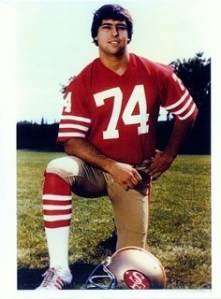
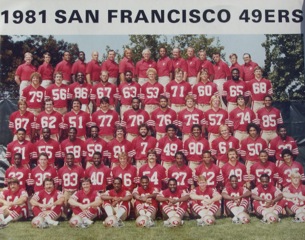
#74 NFL San Francisco 49er, George Visger @ 1981

#74 NFL San Francisco 49er, George Visger @ 1981

On offense, if you don’t score, you can’t win. To score, you have to move the ball. If the offensive lineman fires out with a long stride – like you would do when sprinting, it’s very easy for the defensive player to knock him on his butt. Holding your head up and looking 90 yards down the field at the goal line is a great way to get your cranium removed. Considering the cranium is a fairly important organ, it’s best you hang on to it. You need to keep your butt down, your face up, and your neck bowed and to take short, choppy steps.

Try it.

A long stride with your head up is a narrow stride. Any pressure from the side will knock you on your butt. To maintain the most strength, you want short, choppy steps. Fire out, and keep your butt down and your face up. Stick your face into the numbers, and, with your butt under you, drive with short (12-16 inch) strides. That’s where you get your power. Not a long, narrow, unbalanced stride with your neck craned up and your head looking downfield. Focus on the short, choppy steps.

If a football team got only 4 yards every play on offense – no more, no less, they would never lose.

Think about it.

Only 4 yards a play, and you would NEVER LOSE!

George Visger #74  4th row from bottom, 2nd from right  @ 1981

George Visger #74
4th row from bottom, 2nd from right
@ 1981

That’s a first down every 3 plays. You would score every time you had the ball. NO ONE could stop you.

Every one has a cross to bear. Some crosses are much heavier than others. I have met people on my journey, who have silently carried crosses I could never even lift. Yet they pack them – everyone.

And never complain.

If we looked downfield every day – gazing at where we want to be in life and thinking about what we have to deal with to get there, we’d never score. You need to keep that goal line in the back of your mind every day of your life – every play, but to get there, you need to focus on each step. One day at a time. One step at a time.

A single short, choppy step each day wins games.

Set a short-term goal each day, and focus on that.

In 1986, at the age of 28, I returned to school to complete my Biology degree, after an Orange Bowl, a Super Bowl, three emergency VP (ventriculoperitoneal) shunt brain surgeries, and several gran mal seizures. I needed four semesters of Chemistry (Chem 1A, Chem 1B, Organic Chem, and Bio Chem), two semesters of Physics, two semesters of Pre-Calculus, and other fun classes to complete my degree in Biological Conservation and to attain my second dream in life – to be a wildlife biologist. (My first dream was to be the greatest NFL player of all time.) At the time, I was working construction during the day, earning a Class B General Contractors license in the evenings, and bouncing at bars at night to survive. (No, all NFL players are not millionaires. I was a 6th-round pick in 1980 and signed for $35,000.)

After I returned to school in 1986, I survived five additional emergency brain surgeries during a 9-month period in ‘86-’87, while taking Organic Chem, Physics, and other classes. I was in Organic Chem three times when my shunt blew out. I had emergency brain surgery, and I dropped out of school. After the first, I came back and took the class again. Another shunt blow out and another brain surgery, and I dropped out of school again. Happened a third time. This time, I was determined not to drop out. Brain surgery on Saturday, and I left the hospital on Sunday, 23 hours later. I was sitting in Organic on Monday when I had a >50-minute gran mal seizure. I was hospitalized for a week. It seemed I had developed an infection in my shunt on that one. They sent me home with a PICC line (peripherally inserted central catheter) in my arm, with a pump taped to my bicep, and with a tube that ran directly into my heart to deliver antibiotics. I packed that around for 10 days and had to drop out of school again.

I came back the next semester, but by then I had developed dyslexia and major short-term memory issues from my surgeries and gran mal seizure meds. (I’ve been on Dilantin, Depacote, Phenobarbital, Kepra, Zonegran, and now Lamictil.) After discovering through my own investigations that each one causes short-term memory problems, I had my doctors change the meds because I didn’t like the side effects. I had to write on my notebook where I parked my truck each day, or I would spend an hour or two walking up and down each row of cars in each parking lot on each side of Sacramento State University looking for my truck.

I came back the next semester so frustrated I met with my counselor, Mr. Sterling Ebel, a man who had as much influence on my life as anyone other than my father. Mr. Ebel was a man who quietly gave me information on how best to achieve my goals and connected with me as a person and a man. He was a man who wore the same tiny tie clasp every day I knew him. It had two words:

“TRY GOD.”

“Sterling, I can’t keep doing this crap. I can’t even remember where I parked my truck, much less Organic Chemistry. I just want a degree. I don’t care what it’s in. Just find me a degree. I need to get on with my life,” I ranted one day, as I barged into his office without an appointment, ready to quit.

“You’re 12 units from a Social Science degree,” he calmly replied after studying my transcript and telling his receptionist to hold his next appointment.

“OK, I’m a Social Science major,” I said.

That semester I took 6 units towards my Social Science degree, and passed both classes. The next semester, just 6 units shy of a BA in Social Science, I decided I’d give Organic Chem one more shot. I’d never quit on anything in my life, and words of my father, Big Jack Visger, the greatest man I’ve ever known, rang in my ears:

“Shoot your best shot.”

If I didn’t make it through Organic on this one, God didn’t mean for me to be a biologist. I was shooting the last round in my chamber.

On the fourth try, I powered through Organic – a “Short, Choppy Step.”

Physics 1B – Short, Choppy Step

Pre-Calculus – Short, Choppy Step

Bio Chem – Short, Choppy Step

In 1990, at the ripe old age of 32, with 172 units completed, gran mal seizures, and eight VP shunt brain surgeries under my belt, I earned a Bachelor of Science degree in Biological Conservation. Graduating made playing in the NFL look like child’s play.Visger, George

Another Short, Choppy Step.

And I continue to take short, choppy steps each day.


Thank you, George.

Disclaimer:
Any views and opinions of the Guest Blogger are purely his/her own.


SPEAK OUT! . . . You Are Invited! Interview with Stephanie Carbone July 27, 2014


                           Come one! Come ALL!putthis_on_calendar_clip_art


What:        Interview with Stephanie Carbone

Why:         Her husband, Sean, is accused of a crime. Is he “unjustly condemned?”

Where:     Brain Injury Radio Network

When:       July 27, 2014

Time:         5:00p PDT (6:00p MDT, 7:00p CDT, and 8:00p EDT) 90 minute show

(Clip Art compliments of Bing.)

Brain Injury Resources . . . . . . . Compensating for a Disability – Guitarist Billy McLaughlin

Compensating for a Disability – Guitarist Billy McLaughlin


th-1

Right hand dominant, Billy McLaughlin, plays the guitar left-handed.

TBI survivors often have a life-long disability. The temptation, and sometimes the advice, is to submit to the disability, often causing one to stop an activity that he or she loves. This video tells the story of Billy McLaughlin’s early life. His passion for the guitar led him to develop a unique sound that made him one of best up-and-coming guitarists in the world. Then he got a neuromuscular disease (focal dystonia – see this video for details) that affected his right hand and his ability to play the guitar. This video shows that he didn’t give up. He accomplished a seemingly impossible task – he learned to play the guitar equally well with his left hand. This uplifting story shows the power of the human spirit and will affect anyone who is trying to deal with a disability.


SPEAK OUT! . . . . . . . . . . . . . . . Itty-Bitty GIANT Steps

SPEAK OUT! Itty-Bitty GIANT Steps

by

Donna O’Donnell Figurski

 What have you accomplished this week? Itty-Bitty GIant Steps for BlogHave you met any goals – BIG or small? It can be as teeny as blinking an eye – something that most of us take for granted, never think twice about. But for someone with no motion in his or her body, this would be a monumental accomplishment.

Your “giant step” may be tying a shoe, walking a few steps, not interrupting a conversation, or remembering an appointment. Or maybe you started a new job or are heading to college. All these are accomplishments.

SPEAK OUT! Itty-Bitty Giant Steps will provide a venue for brain-injury survivors and caregivers to shout out their accomplishments of the week.

If you have an Itty-Bitty Giant Step and you would like to share it, just send me an email at donnaodonnellfigurski@gmail.com. It need only be a sentence. I’ll gather the accomplishments and post them with your name on my blog approximately once a week. (If you do not want your last name to be posted, please tell me in your email.)

I hope we have millions of Itty-Bitty Giant Steps.

(Clip Art compliments of Bing.)


diemodi jewelry

uniquely hand-crafted jewelry by donna

Welcome to Harmony Kent Online

The home of all things books

Pete Springer

Passionate Teacher and Future Children's Author

HOPE TBI

Helping Other People Excel - To Be Independent

For the Love of Books, Old and New

Katie Fischer, Writer and Reader of Stories

Charlie Bown

Children's Author

Jessica Hinrichs

“We write to taste life twice, in the moment and in retrospect.” ― Anais Nin

VIVIAN KIRKFIELD - Writer for Children

Picture Books Help Kids Soar

Mindy’s Writing Wonderland

For authors, parents, teachers & everyone who loves children’s books.

Kaitlyn Leann Sanchez

Literary Agent

Surviving Traumatic Brain Injury

TBI - Survivors, Caregivers, Family, and Friends

The Care Factor

Loving someone with a Traumatic Brain Injury

Brain Injury Support Group of Duluth-Extension

Brain Injury Information and SUPPORT

Brain Aneurysm Global Insight

Brain Aneurysm, cerebral hemorrhaging, hemorrhage stroke