TBI – Survivors, Caregivers, Family, and Friends

Posts tagged ‘TBI Caregiver’

Brain Injury Resources . . . . . . . . . . TBI Awareness, The Drew Carter Project Interviews Me!

Interview with TBI caregiver, Donna O’Donnell Figurski
as seen on TBI Awareness, The Drew Carter Project

 Drew, thank you for your interest and for taking your time to interview me for your blog. Drew writes about a lot of great topics. I hope my readers will stop by to see what he shares with his readers – as we raise awareness of TBI – one view at a time.

image-2


1. How do you find time for yourself? Does this change according to your husband’s recovery? (I think I remember you telling me he had one)

My husband’s traumatic brain injury happened more than nine years ago. He wasn’t expected to survive any of his three brain surgeries (for a cerebellar hemorrhage, removal of an aneurysm, and removal of an arterio-venous malformation), but he did! When David returned home from his stays at the general hospital and the rehabilitation hospital (two and a half months after his event), picture a rag doll. He was reduced to an infantile state and was completely dependent on me. He was unable to feed himself, dress himself, and take care of any of his daily activities. Fortunately, some friends and family helped me in the beginning. After taking a family leave for three and a half months to stay by David’s side in the hospitals, I returned to teaching my first graders. However, whenever I was home, I was totally responsible for David’s welfare. For at least a year, I was never able to leave him alone. David was a prisoner without bars. So was I.As the years passed, David became more adept at caring for himself, and slowly I felt confident enough to leave him alone at home for short periods of time. The intervals grew as the years marched on, and now I can comfortably leave David for long spans of time. This has freed me immensely. I am able to run errands without having David accompany me. I am able to attend my writing-group meetings, and I have joined the theater, as an actor, assistant stage manager, and director. Despite my new freedoms, David and I remain tethered together by our cell phones. I am only a phone call away.
Unfortunately, because of David’s severe loss of balance, even nine years later he cannot leave the house unassisted.

2. Do you have a sense of community, like support groups or other services?

When David was released from the rehabilitation hospital, I took him to a local brain-injury support group. Although David’s brain was severely damaged, he was not able to relate to the other folks there. He said it made him feel worse, so we stopped going.

When David was in the hospital, I met a woman whose husband had a TBI two weeks after David. I made a point of getting to know her because I thought I could help her. Though the TBI of Judy’s husband is very different from David’s TBI, Judy and I became close friends. But, since we live a distance apart, we offered support via email, phone calls, and an occasional visit.

I was not aware of any other support groups for caregivers back then. It was only in December of 2013 that I found via Facebook brain-injury support groups online. I am now an active member of several traumatic-brain-injury groups, all of which offer friendship and support and answer questions for both caregivers and survivors.

I’m so glad to have found these groups. They provide instant information and support for anyone who needs it.

3. What have you found to be the hardest part of a TBI recovery?

Wow! That’s a hard question. The lives we knew were ripped from us on that fateful morning of January 13, 2005.

I feel very much like Dorothy, when the cyclone picked her up in Kansas and dropped her on the yellow brick road. Like Dorothy, I searched for a way home to the secure and familiar. Unlike Dorothy, I’m still searching.

When something burst inside David’s head, our lives changed forever. It was a complete role reversal. In an instant, I was suddenly in charge, and I was not prepared for my new life. Before TBI, David oversaw the business of running our home – juggling the bills, doing home repairs, making decisions, and . . . taking out the trash. I liked it that way. I chauffeured the children to their soccer games, gymnastic meets, doctor’s appointments, etc. and prepared breakfasts, lunches, and dinners. I liked it that way. In the evenings when David returned from his laboratory at Columbia University and I came home from my 1st or 3rd graders, we fit in “walk-talks” through the neighborhood. We liked it that way.

After David’s TBI, I had to figure out how to run the house. The kids were grown and gone, but I had to pay the bills. (What bills? I didn’t even know what bills we had!) I had to get money from an ATM. I know it’s crazy, but I didn’t know how. David had shown me many times, but, like Scarlet O’Hara, I never paid attention. “Tomorrow, I’ll do it tomorrow.” Well tomorrow slammed me in the face on January 13th, 2005. I was stuck when David slipped into an unconscious state and the code slept with him. I didn’t know who to call for home repairs or to distinguish between junk-mail and important mail, and . . . I had to take out the trash.

Those are some of the things that were very difficult for me. Another was dealing with insurance companies. Fighting with them to pay the bills was overwhelming and extremely stressful. The phone calls and the letters seemed unending. I felt it was unfair for my insurance company not to pay the claims that they so proudly advertised they would do when they were recruiting my business. I kept my part of the bargain. I paid my hefty insurance payments for countless years on-time each month, with no reminders or urging from the insurance company. I never missed a premium payment, though I hadn’t need of their services. Yet, when it came time for them to cover David’s hospital and doctor bills, they tried to renege, not only making me jump through hoops, but also making me feel like I was shaking a tin can on the corner. It was not only downright insensitive, it bordered on criminality. I know many folks will relate to this. I am not alone.

But, the absolute worst of course, was losing the man I married. The man I met at age sixteen went to sleep in a coma, and the man who woke up is a new version of him – a wonderful guy, just the same, whom I will love to forever, but I often miss the “old” guy too.

4. What has been the easiest part of recovery?

This question, too, takes some thought. When I brought David home after his spending two and a half months in hospitals, I thought I would lose my mind. Not only was he like a rag doll and able to do nothing for himself, he was also not quite right with his thinking. He didn’t understand what was going on, and it was very difficult for him and me to live our daily lives without the hospital support. For years, I became his extra self. I did everything for him.

But after time, as he slowly regained some of his missing skills, life became a little easier. David eventually returned to his laboratory at Columbia University. His nature before his TBI was always good, but with his job, he was usually on overload and lived with a lot of stress. After his TBI, he seems more relaxed and lets many things roll by. He tries to make things easier for me, and, now that he is more able to care for himself, he encourages me to pursue my many interests. I have become involved with the theater and my writing groups. I am able to meet girlfriends for lunch dates and walk-talks, or slip out for a quick coffee with a friend.

So, I guess David’s accepting attitude, coupled with his persistence to get better and to make a better life for both of us, is what gets us through.

5. Have you found a spiritual path helpful?

Truthfully, neither of us follows a spiritual path, but our belief and love for each other is what bolsters us through each day, week, month, and year. Together, we will do this!


Brain Injury Resources . . . . . . . . . . Facts and Advice

TBI Resources: Facts and Advice

th

“When caregivers care so much that they neglect themselves, it can create a downward spiral of self-destruction known as Compassion Fatigue,” which can result in “feeling immune to the suffering of others,” “feeling hopeless,” “insomnia,” “excessive blaming,” “bottled up emotions,” “isolation,” “addiction,” “neglecting yourself,” “financial problems,” “chronic physical ailments,” “apathy,” “preoccupation…with your loved one’s health and well-being,” or “violent thoughts.”…”Unidentified compassion fatigue causes a decline in health for caregivers and diminished care for their loved ones.”

13 signs of compassion fatigue (lift)

“Currently, almost a third of strokes occur in people under the age of 65, and this figure is set to rise.”

‘My arm went numb and I had a headache – but I never dreamed it was a STROKE’: Healthy woman, 20, is left paralysed down one side (Mail Online)

“One reason behind this jump in brainpower may lie in how much of the human metabolism is devoted to the human brain — it consumes a whopping 20 percent of the body’s total energy.”

Brain Evolution Study Shows Humans Sacrificed Brawn For High Intelligence (The Huffington Post)

“Some 20-60% of people with a TBI experience depression soon after the injury or even years later.”

Why Is Depression the Number One Symptom After a Brain Injury? (brainline.org)

“Studies show that more than 50 percent of people suffer from chronic pain disorders in the years following a brain injury.”

Why Does Everything Hurt So Much After Brain Injury? (brainline.org)th-1

“Dealing with ambiguous loss (i.e., a TBI survivor who has changed) means:

  • Recognizing and accepting your own feelings; mourn whenever you feel the need;
  • Finding a safe and supportive connection to a therapist, counselor or church;
  • Getting to know the survivor as the person he or she is now;
  • Utilizing healthy coping skills of having fun and using humor whenever possible;
  • Finding hope and exploring new treatment options;
  • Accepting what you’ve lost, but refusing to give-up on recovery!”

More than One Victim: Recovering from a Loved One’s Traumatic Brain Injury (CoSozo)

“When communicating with a person who has a brain injury, it’s important to listen, listen, listen. It’s important to be positive and encouraging in your statements, to be empathetic and at times to use humor in a positive and supportive manner.”

Making a Difference #8: Communication (brainline.org)

“No one can know for certain what our potential is.”

Lost & Found: What Brain Injury Survivors Want You to Know (brainline.org)


As I say after each post:

Feel free to leave a comment by clicking the blue words “Leave a Comment” below this post.

Please follow my blog. Click on “Follow Me Via eMail” on the right sidebar of your screen.anim0014-1_e0-1

If you like my blog, click the “Like” button under this post.

If you REALLY like my blog, share it with your friends. It’s easy! Click the “Share” buttons below.

If you don’t like my blog, “Share” it with your enemies. That works for me too!


(Clip Art compliments of Bing.)


TBI Tales: Energizer-Ostrich

TidBits About Donna #49 Energizer-Ostrich

(Reposted from my other blog – Donna O’Donnell Figurski’s Blog Jan. 13, 2012)


What do you get when you cross a hyperactive rabbit with a pink-feathered bird on a beach? That would be ME – or in other words an Energizer-Ostrich.

I guess that warrants an explanation of sorts. But I will have to retrace my steps a bit – about seven years worth – to the source of what has changed me into a replica of an energizer bunny with her head in the sand.

Today, January 13th, seven years ago, David, my husband, suffered a Traumatic Brain Injury (TBI). If you have been following my blog, you already know this. If this is your first visit, you can learn the sordid details and do a cram course by reading the following posts. Or … you can just read on to get the Cliff Notes version.

Musings by Donna #39 TBI – Traumatic Brain Injury – One Size Does Not Fit All

TBI Tales: Bittersweet is Today


TBI Tales: A Fork in the Road to Recovery

This morning I woke with a start – at precisely 7:05 – the exact time, seven years ago that David and I began the journey of our new and unexpected life. Seven years ago we did not know what was in store for us. We didn’t even know if there was going to be an “us”. This morning, as I do each year on this day, I relived the moments of David’s TBI. From excruciating pain to a wild ambulance ride, to signing on the dotted line to taking a saw to my husband’s brain (I didn’t do that – the surgeon did.) to talking incessantly on the cell phone – arranging, arranging, arranging – flights, accommodations, squeezing David’s hand and promising him he would get better – when I wasn’t sure that he would, threatening that I would never forgive him if he didn’t fight to stay with me, telling the story over and over and over … of how he stumbled into our bedroom, his hand clutching his eye – then falling into a coma as the paramedics strapped an oxygen mask over his face.

After seven years I would have expected the intense memories to fade, but they remain vivid – with maybe just a few blurred edges. I remember many of the names of the nurses and caretakers. I remember the unwanted words of the doctor. I remember how family and friends converged on the hospital at all hours both day and … well into the night from all corners of the United States. I remember the day was one of intense fog both outdoors (and inside my brain). The outdoor fog caused airline flights to be delayed. The fog inside my brain insulated me from the tragic reality around me.

That same fog has dulled the pain over the years of watching David struggle to dress himself, to learn to feed himself again, to walk and talk. That fog blurs the hurt of seeing him hunched over his keyboard painstakingly tapping each key as he prepares another paper for publication or works on a book he’s editing for an international scientific journal or sends detailed instructions to his technicians in his lab about the next experiment to do. I welcomed the fog as I not-so-patiently waited for David to recover from a recent eye surgery.

I marvel at this man I call my husband. I’m proud of his accomplishments both before and after his trauma. I admire his patience, his persistence, his positive attitude as I watch him tackle life in the “hard” lane. He does it with grace, with no complaint, and with gentle optimism.

So, there is an “us” after TBI, though it’s a different “us.” We are not the same people we were before David’s trauma. I miss the before TBI “us.” Traumatic Brain Injury seriously changes the victim, but it also alters the spouse. TBI can rend marriages. It can tear families apart. Or it can make you stronger. See the New York Times article from January 9th 2012, When Injuries to the Brain Tear at Hearts.

David’s TBI tears my heart everyday, but each day, too, it gets glued back together with a kiss, with a smile, with a hug, with a laugh – but no tears. No, NO tears.

I still have not had a good cry. Life is too busy for tears. Besides, “Tears would make this too real – and it’s not … is it?” asked the Energizer-Ostrich.

(Clip Art compliments of Bing.)

Caregivers SPEAK OUT! . . . . . . . . . Kristin Olliney

 SPEAK OUT! – Kristin Olliney

by

Donna O’Donnell Figurski

Kristin Olliney with her daughter, Isabella, (age 4 1/2) on the day Isabella woke up from her coma. Kristin says, “It was the happiest and best day of my life.”


1. What is your name? (last name optional)

Kristin Olliney

2. Where do you live? (city and/or state and/or country)     Email? (optional)

Just south of Boston, Massachusetts, USA

3. What caused your survivor’s TBI?

Sudden acute encephalitis of unknown etiology

4. On what date did you begin care for your TBI survivor? Are you the main caregiver?

Our journey began on November 25, 2010 (Thanksgiving night).

How old were you when you began care?

I was 31 years old, and Isabella was 4.5 years old

5. Were you caring for anyone else at that time (e.g., children, parents, etc.)?

No, I was a single parent to Isabella.

6. Were you employed at the time of your survivor’s TBI?

No, I was laid off about 18 months before Isabella got sick.

If so, were you able to continue working?

N/A

7. Did you have any help? If so, what kind and for how long?

I was a single parent from the day Isabella was born. I have always been her sole caregiver.

8. When did your support of the survivor begin (e.g., immediately – in hospital, when survivor returned home, etc.)?

Isabella was 4.5 years old at the time, so I was already supporting her.

9. Was your survivor in a coma?

Yes, Isabella was in a drug-induced coma and then her own coma. The total time was 6 days. On the 7th day, she woke up. That was the best day of my entire life.

If so, what did you do at that time?

I never left Isabella’s side. I spent the first 73 hours without sleep because, if she was going to die (which she was supposed to), I didn’t want to miss a single second. I eventually collapsed, and I was forced to sleep. After that, I lived off coffee, and I took sporadic naps.

10. Did your survivor have rehab? If so, what kind of rehab? (i.e., In-patient and/or Out-patient and Occupational, Physical, Speech, and/or Other) How long was the rehab? Where were you when this was happening?

Yes, Isabella went to In-patient rehab [occupational therapy (OT), physical therapy (PT), and speech therapy (ST)] for 15 days post brain injury. She was there for only 13 days, due to my insurance. I was with her the entire time. Isabella is currently still receiving Out-patient rehab for OT and ST. Her PT ended last summer. Isabella also did aquatics therapy for a few months.

11. What problems or disabilities of your TBI survivor required your care, if any?

Isabella requires 24/7 care due to her extensive medical needs. She has a cognitive disorder due to her brain injury. Isabella has debilitating hallucinations (not psychotic) and anxiety, which causes multiple panic attacks every single day. She has migraines and tics. Isabella has sensory issues and Obsessive-Compulsive Disorder (OCD). She has learning difficulties. Isabella has aggression due to her inability to control or regulate her mood, emotions, and behavior. Isabella has speech difficulties, especially in word retrieval and expressing herself. Isabella also needs help with daily living skills, such as using the bathroom, getting dressed, showering, using the stairs, teeth brushing, etc. Isabella also suffers from various types of seizures and many other things that require around-the-clock care.

12. How has your life changed since you became a caregiver?

I was already Isabella’s caregiver. Prior to her brain injury, she had some medical issues, including life-threatening allergies to food, an immune deficiency (and another more serious one diagnosed post brain injury), and a few other conditions. Once Isabella got sick though, everything changed because I was parenting and caring for an entirely different child. It was like completely starting over.

Is it better? Is it worse?

It is different. It is challenging. It is amazing. It is heartbreaking. I wouldn’t want to be anywhere else. I want to be the one caring for my child. She needs me more now than ever before.

13. What do you miss the most from pre-TBI life?

I miss the Isabella that I used to have, although I love the Isabella I have now more than I ever knew was possible. I miss our carefree, social, active life. Isabella is worth it though.

14. What do you enjoy most in post-TBI life?

I have learned the value of life and how in an instant it can all change. It is both a blessing and a curse to know how fragile life really is. I appreciate the small things that most can’t value unless they have come close to losing it all. I cherish each laugh, each silly joke, the smiles, hugs, and kisses, and hearing Isabella say “Mommy,” and I notice things like the sunset (or, in our case, the sunrise too), the way flowers smell, etc.

15. What do you like least about TBI?

It’s the one of the most rewarding, yet most heartbreaking, journeys that you can go on. I hate that it has robbed Isabella of the life she was meant to have. This journey is also extremely isolating. I chose to focus on the positive and the blessing that I have, which is Isabella’s still being here.

16. Has anything helped you to accept your survivor’s TBI?

I have always been a single parent, so I had no choice but to accept it from the start. I think that was a blessing. Writing my bi-monthly blog, “Mommy of a Miracle,” for the Brain Injury Association of Massachusetts has helped me give a voice to our journey. I also started a Facebook support group, “Parents of Children with Brain Injuries,” which has helped me know that I am not alone. I knew statistically speaking that I was not the only parent with a child who has a brain injury, and yet I couldn’t find anyone.  This group has been the most amazing support for me.

17. Has your survivor’s injury affected your home life and relationships and, if so, how?

Yes, how could it not? Brain injury changes not only the survivor but also the caregiver as well. Our home life is very structured and centered completely around what helps Isabella be successful. It has changed my relationships tremendously. In the face of a life-altering event, you learn quickly who is going to be there and who isn’t. I would rather have a few people whom I know I can count on than a whole lot of people who will just disappoint.

18. Has your social life been altered or changed and, if so, how?

Yes. Isabella and I had a very active social life. We were never home. Friends and family were always a huge part of our life. Now it is not possible, due to the extensive care that she requires and her instability. I no longer have the time to invest in one-sided friendships. We are not able to attend parties, get-togethers, events, and the like. Phone conversations are no longer possible. I only get to see a friend or a family member if he or she comes by at night when Isabella is asleep in bed.

19. What are your plans?

I live day-by-day. I take each day as it comes. Looking beyond that is too difficult.

What do you expect/hope to be doing ten years from now?

I hope that Isabella is doing better and stable. I hope that we are able to enjoy more things in life. Personally, I want to have a nonprofit organization to specifically help parents of children with brain injuries. I hope to be on the floor of congress advocating for change, for funding for research, and for additional resources for brain injury survivors and their caregivers.

20. What advice would you offer other TBI survivor caregivers?

Always follow your gut-instinct. You are your survivor’s biggest advocate. Stand your ground. Your survivor is not ever going to be who he or she once was. The faster you are able to come to that realization, the better off you will be. This is a journey, not a race. Take life one day at a time.  You are not alone.

Do you have any other comments that you would like to add?

Kristin Olliney with her lovely daughter, Isabella – 8 years old. 2014

Thank you for this amazing opportunity to tell people a little bit more about our journey.


Check out my blog: In An Instant Your Life Can Change Forever: Brain Injury Association of Massachusetts Blog – Mommy of a Miracle

Check out this video for Brain Injury Awareness.


Thank you, Kristin, for taking part in this interview. I hope that your experience will offer some hope, comfort, and inspiration to my readers.

If you would like to be a part of this project, please go to TBI Caregiver Interview Questionnaire for a copy of the questions and the release form.

(Photo compliments of Kristin.)

Disclaimer: The views or opinions in this post are solely that of the interviewee.

Caregivers SPEAK OUT! Francie Boothe

SPEAK OUT! – Francie Boothe

by

Donna O’Donnell Figurski

Francie Booth

Francie Boothe


1. What is your name? (last name optional)

Francie Boothe

2. Where do you live? (city and/or state and/or country)     Email? (optional)

North Attleboro, MA, USA     francieb18@gmail.com

3. What caused your survivor’s TBI?

My 16-year-old son fell off the back of his cousin’s truck.

4. On what date did you begin care for your TBI survivor? Are you the main caregiver? How old were you when you began care?

Nov. 27, 2013

My husband and I are the main caregivers.     I was 41.

5. Were you caring for anyone else at that time? (e.g., children, parents, etc.)

My 14-year-old daughter

6. Were you employed at the time of your survivor’s TBI? If so, were you able to continue working?

Yes, I was employed. No, I could not continue.

7. Did you have any help? If so, what kind and for how long?

I had help from my family.

8. When did your support of the survivor begin? (e.g., immediately – in hospital, when survivor returned home, etc.)

Immediately

9. Was your survivor in a coma? If so, what did you do at that time?

Yes. I sat in the pediatric ICU praying with family and friends.

10. Did your survivor have rehab? If so, what kind of rehab? (i.e., In-patient and/or Out-patient and Occupational, Physical, Speech, and/or Other) How long was the rehab? Where were you when this was happening?

Boothe, Francie Son 052214

Francie Boothe’s 16 year old son.

All rehab was In-patient therapy at the Spaulding Rehab in Charlestown, MA. He had occupational, physical, and recreational therapies and speech-language pathology.

11. What problems or disabilities of your TBI survivor required your care, if any?

Washing, dressing, eating, etc.

12. How has your life changed since you became a caregiver? Is it better? Is it worse?

It’s worse, but there are good days also.

13. What do you miss the most from pre-TBI life?

Normalcy. I miss my son’s being whole and healthy.

14. What do you enjoy most in post-TBI life?

I enjoy my son’s new outlook. His personality has changed – he’s much more personable.

15. What do you like least about TBI?

My son’s suffering and the family’s suffering

16. Has anything helped you to accept your survivor’s TBI?

Faith in God, prayer, family, and friends

17. Has your survivor’s injury affected your home life and relationships and, if so, how?

No, not really, but it does get crazy sometimes.

18. Has your social life been altered or changed and, if so, how?

Yes, I don’t have much of a social life, but I don’t care.

19. What are your plans? What do you expect/hope to be doing ten years from now?

I want my son to lead a normal life without infection or complications.

20. What advice would you offer other TBI survivor caregivers? Do you have any other comments that you would like to add?

Boothe, Francie & Son 052214

Francie Boothe and her son sharing special time.

Have faith. Be strong. Be patient. Take one day at a time. There will be good days and bad days.


Thank you, Francie, for taking part in this interview. I hope that your experience will offer some hope, comfort, and inspiration to my readers.


If you would like to be a part of this project, please go to TBI Caregiver Interview Questionnaire for a copy of the questions and the release form.

(Photo compliments of Francie.)

Disclaimer: The views or opinions in this post are solely that of the interviewee.

Caregivers SPEAK OUT! . . . . . . . . . Marleen Salo

SPEAK OUT! – Marleen Salo

by

Donna O’Donnell Figurski

Marleen Salo with her son, Marty Salo (TBI Survivor) and her husband, Al Salo.

Marleen Salo with her son, Marty Salo (TBI Survivor) and her husband, Al Salo.


1. What is your name? (last name optional)

Marleen Salo (Marty’s Mom)

2. Where do you live? (city and/or state and/or country)     Email? (optional)

Lutz, Florida, USA      marleensalogm@gmail.com

3. What caused your survivor’s TBI?

A car hit my son while he was crossing a street on his bicycle.

4. On what date did you begin care for your TBI survivor? Are you the main caregiver? How old were you when you began care?

April 1982     36 years old

5. Were you caring for anyone else at that time? (e.g., children, parents, etc.)

No

6. Were you employed at the time of your survivor’s TBI? If so, were you able to continue working?

I was employed as a Registered Nurse. I took several weeks off and then returned to work per advice from professional friends.

7. Did you have any help? If so, what kind and for how long?

My husband (Marty’s father) and I were co-caregivers. Physical therapists, school tutors, and friends assisted at intervals.

8. When did your support of the survivor begin? (e.g., immediately – in hospital, when survivor returned home, etc.)

Upon Marty’s discharge from the hospital

9. Was your survivor in a coma? If so, what did you do at that time?

He was in a coma for 7 1/2 weeks. We stayed with him for long hours at the hospital. We went home to sleep, bathe, eat, etc.

We brought him home in semi-coma. We fed him, bathed him, and helped him do exercises in bed. He was bedridden for the first few weeks at home. He then used a wheelchair. Eventually he walked with assistance; then he walked unsupported. By fall, he was able to walk into classroom at a private school, with lots of school support.

10. Did your survivor have rehab? If so, what kind of rehab? (i.e., In-patient and/or Out-patient and Occupational, Physical, Speech, and/or Other) How long was the rehab? Where were you when this was happening?

Doctors told us to place him into a nursing home. His pediatrician advised us to set up a “hospital bed” at home and have the physical therapist make home visits. There was no In-patient rehab.

11. What problems or disabilities of your TBI survivor required your care, if any?

Feeding, bathing, moving from bed to chair, exercises to legs and feet

12. How has your life changed since you became a caregiver? Is it better? Is it worse?

It’s hard to answer. I learned that it is possible to come through such trauma stronger and more aware of the precious entity that is life. I learned how many people come around in support at times of crisis.

Worse, in that I worried more about every aspect of Marty’s life. Worse, when I saw him struggle in daily activities and when he had to prove himself over and over in every grade level of school. Heartaches, when he could not achieve a goal.

13. What do you miss the most from pre-TBI life?

I miss the freedom from guilt that I could prevent such pain. I miss Marty’s carefree independence with other kids his age.

14. What do you enjoy most in post-TBI life?

I like that all of us place more value in day-to-day experiences. We also feel a closeness for having survived as a family.

15. What do you like least about TBI?

Marty’s physical deficits – driving, etc.

16. Has anything helped you to accept your survivor’s TBI?

Internet TBI support sources

Friends’ acceptance

17. Has your survivor’s injury affected your home life and relationships and, if so, how?

We have been a cohesive family. Some marriages dissolve with such stress, but our lives came together.

18. Has your social life been altered or changed and, if so, how?

Vacations were put on hold for a few years. Now our social life is good.

19. What are your plans? What do you expect/hope to be doing ten years from now?

I hope to spend summers in the mountains and winters in Florida. I want to continue to be in a close relationship with Marty and his wife, Fran.

20. What advice would you offer other TBI survivor caregivers? Do you have any other comments that you would like to add?

Don’t give up.

Appreciate the small increments of change.

Marty & Fran Salo

Marty Salo (TBI Survivor) with his wife, Fran

Find external support, such as on the Internet or from other families.

Know there is something in you that does not exist until you pass through pain and suffering.  It is then you understand.


Thank you, Marleen, for taking part in this interview. I hope that your experience will offer some hope, comfort, and inspiration to my readers.

(Disclaimer: The views or opinions in this post are solely that of the interviewee.)


If you would like to be a part of the SPEAK OUT! project, please go to TBI Caregiver Interview Questionnaire for a copy of the questions and the release form.

Caregivers SPEAK OUT! Diane Caldwell

SPEAK OUT! – Diane Caldwell

by

Donna O’Donnell Figurski

1. What is your name? (last name optional)Diane Caldwell

Diane Caldwell

2. Where do you live? (city and/or state and/or country)     Email? (optional)

Columbus, Ohio, USA     ladydi147@yahoo.com

3. What caused your survivor’s TBI?

Car accident – Sept. 24, 2010

4. On what date did you begin care for your TBI survivor? Are you the main caregiver? How old were you when you began care?

I started caring for my daughter after she was sent home from Dodd Hall, OSU, an In-patient rehabilitation facility, in December 2010. I was 53 years old. My daughter was 28.

5. Were you caring for anyone else at that time? (e.g., children, parents, etc.)

Yes. I was caring for my grandson – my daughter’s son.

6. Were you employed at the time of your survivor’s TBI? If so, were you able to continue working?

Yes. I was employed and somehow managed to keep my job, mainly because I have had the same employer for a 20-plus years. My daughter still required 24×7 care, but I was able to work from home for about 6 months until she could be left alone at home. She was bed-ridden and wheelchair-bound during that time.

7. Did you have any help? If so, what kind and for how long?

No. Occasionally her brother would stay with her while I went to the store, but her behavior was a little scary to him (i.e., she would be talking coherently one minute, and the next she wouldn’t know who he was).

8. When did your support of the survivor begin? (e.g., immediately – in hospital, when survivor returned home, etc.)

Immediately. She was life-flighted from the accident scene and was on life support in critical condition for several days. I went to the hospital daily.

9. Was your survivor in a coma? If so, what did you do at that time?

Yes. I went to the hospital every day, but at that time, the doctors thought she had a slim chance of making it. I still cared for my grandson. I prayed.

10. Did your survivor have rehab? If so, what kind of rehab? (i.e., In-patient and/or Out-patient and Occupational, Physical, Speech, and/or Other) How long was the rehab? Where were you when this was happening?

Yes. She had In-patient rehab (occupational, physical, and speech therapy), and then she had Out-patient rehab when she was sent home. Her rehab totaled about 5 months. I usually went with her to her appointments, as she required special transportation (due to the wheelchair) and was often left waiting for a return ride home. She was afraid to be left alone.

11. What problems or disabilities of your TBI survivor required your care, if any?

Short-term memory problems, emotional swings and instability, suicidal actions, personal safety issues

12. How has your life changed since you became a caregiver? Is it better? Is it worse?

My life is just different now. Some things are better, some things worse.  My life changed dramatically, as I was living alone previously. We walked through some dark days together, so it was very rough at first. My daughter’s personality changed, and her IQ dropped into the mildly retarded range. My daughter knew she was not who she used to be, and she didn’t embrace who she was after the accident for about 18 months. Today, my life is better. My relationship with my daughter has reached a depth most people never get to experience. I learned a lot about myself too, and I became a much more spiritual person. I believe in miracles!

13. What do you miss the most from pre-TBI life?

Time to myself, freedom to travel

14. What do you enjoy most in post-TBI life?

Sleeping!

15. What do you like least about TBI?

How it impacts relationships. For a while, I felt like I lost my daughter, even though she was alive. Everyone works through it differently.

16. Has anything helped you to accept your survivor’s TBI?

Yes. I got connected with OSU TBI Network.

17. Has your survivor’s injury affected your home life and relationships and, if so, how?

Yes. My daughter and grandson live with me and rely on me as a result of the TBI. It’s like being a single mom again.

18. Has your social life been altered or changed and, if so, how?

Yes. I am unable to attend functions where I will be away overnight. I don’t like leaving my daughter alone since she started having seizures.

19. What are your plans? What do you expect/hope to be doing ten years from now?

I guess I don’t really think about that too much. I would like to be retired by then and do some fun things with my daughter and grandson.

20. What advice would you offer other TBI survivor caregivers? Do you have any other comments that you would like to add?

Don’t isolate yourself! Learn as much as you can about TBI. Reach out for help. (I didn’t do that enough.) Be patient, loving, and caring. Take it one day at a time.DIane C. daughter


Thank you, Diane, for taking part in this interview. I hope that your experience will offer some hope, comfort, and inspiration to my readers.


If you would like to be a part of this project, please go to TBI Caregiver Interview Questionnaire for a copy of the questions and the release form.

(Photo compliments of Diane.)

Disclaimer: The views or opinions in this post are solely that of the interviewee.

Caregivers SPEAK OUT! Trish Herzog

SPEAK OUT! – Trish Herzog

by

Donna O’Donnell Figurski

Herzog Trish 042314  photo


1. What is your name? (last name optional)

Trish Herzog

2. Where do you live? (city and/or state and/or country)     Email? (optional)

Platte City, Missouri, USA         herzogtrish@gmail.com

3. What caused your survivor’s TBI?

An auto-racing accident

4. On what date did you begin care for your TBI survivor? Are you the main caregiver? How old were you when you began care?

June 6, 1998     I was the main caregiver.     I was 33.

5. Were you caring for anyone else at that time? (e.g., children, parents, etc.)

No

6. Were you employed at the time of your survivor’s TBI? If so, were you able to continue working?

No. I was a housewife.

7. Did you have any help? If so, what kind and for how long?

Yes – in-home caregivers for 11 years, until my husband passed away in 2009 as a result of complications from his TBI.

8. When did your support of the survivor begin? (e.g., immediately – in hospital, when survivor returned home, etc.)

Immediately – in the hospital

9. Was your survivor in a coma? If so, what did you do at that time?

Yes – for 6 days. I cried, prayed, journaled, and read books and pamphlets about TBI to educate myself about the condition as much as possible.

10. Did your survivor have rehab? If so, what kind of rehab? (i.e., In-patient and/or Out-patient and Occupational, Physical, Speech, and/or Other) How long was the rehab

In-patient for 3 months

Out-patient for over a year and off and on, as needed in the years

Where were you when this was happening?

I was with my husband during most therapies, except for speech. They suggested against my being there, as I was too much of a distraction for him. He didn’t filter things as well after he suffered the TBI.

11. What problems or disabilities of your TBI survivor required your care, if any?

My husband was full-care. He was paralyzed from the waist down and remained in a wheelchair for the remaining 11 years of his life. He suffered memory issues and speech dysphasia issues initially. His motor skills were also affected. He had significant spasticity in his legs. He had a shunt put in due to hydrocephalus. He suffered a few strokes after his TBI over the years. We spent quite a bit of time in and out of the hospital for various infections and health issues

12. How has your life changed since you became a caregiver? Is it better? Is it worse?

My husband died in 2009. I cared for him and managed his care in our home from 1998-2009. It was exhausting at times, but I wouldn’t have had him anywhere else. After he passed, it was quite an adjustment period for me. Losing him and losing the chaos of daily life, with therapists and caregivers in your home, was quite the change

13. What do you miss the most from pre-TBI life?

I missed our intimacy. We were still able to cuddle and be affectionate, but I became the stronger role in our relationship after he was injured. I missed my protector, my confidante, etc. We still had that together, but the dynamic was somewhat changed. He was still my best friend.

14. What do you enjoy most in post-TBI life?

I can’t explain how, because my husband was my best friend and we were so close, but, in the years after he was injured, we became even closer at deeper levels. We were in this together, and we fought the battles of day-to-day TBI life together.

15. What do you like least about TBI?

It took away the husband I loved and married and left me with a different one. I loved him just as much, but in some ways very differently.

16. Has anything helped you to accept your survivor’s TBI?

We saw humor in so many things on a day-to-day basis. You have to find the humor in the basic things. Our general positive outlook on life and love for each other helped us survive and thrive in the shadow of TBI.

17. Has your survivor’s injury affected your home life and relationships and, if so, how?

It changed our dynamic completely. I took on more of a motherly role with my husband. My parents, seeing everything I was dealing with and managing, developed a greater respect and appreciation for me as an adult and not just as their little girl. I was making life-and-death decisions and handling rather scary things.

18. Has your social life been altered or changed and, if so, how?

Yes. It was isolating, to a certain extent. Life moves on for others after the initial traumatic occurrence, but you are still dealing with the day-to-day of your new TBI life. The real friends and family will hang around. You find out who your diehard friends are.

19. What are your plans? What do you expect/hope to be doing ten years from now?

I am doing it now. As I said, my husband died in 2009. I have been rediscovering who I am for over four years now. It’s still a process. I was a caregiver for so many years. It was who I was, and when he passed away, my entire purpose and reason for existence went away too. I had to figure out what I wanted to do with my life and re-invent myself…solo. It’s an ongoing process.

20. What advice would you offer other TBI survivor caregivers? Do you have any other comments that you would like to add?

You have to take care of yourself. If you are going to be in it for the long haul, respite is a must! In the years of dealing with a loved one with a TBI, there were ups and downs, sadness, laughter, eureka moments, and exhaustive moments. It was all worthwhile, every minute of it. I am a far better person today because of the hand my husband and I were dealt back in 1998. I have a much greater appreciation for many things we often take for granted – life, love, health, all of them. I miss my husband, and I wish I still had him with me…TBI or no TBI.


Thank you, Trish, for taking part in this interview. I hope that your experience will offer some hope, comfort, and inspiration to my readers.


If you would like to be a part of this project, please go to TBI Caregiver Interview Questionnaire for a copy of the questions and the release form.

(Photo compliments of Trish.)

Disclaimer: The views or opinions in this post are solely that of the interviewee.

Caregivers SPEAK OUT! Shirl

SPEAK OUT! – Shirl

by

Donna O’Donnell Figurski

Shirl 35571_137366786279300_5704951_n


1.    What is your name? (last name optional)


Shirl


2.    Where do you live? (city and/or state and/or country) Email? (optional)


Seville, OH, USA       mstrow7@gmail.com

3.    What caused your survivor’s TBI?


Car accident – July 24, 2010

4.  On what date did you begin care for your TBI survivor? Are you the main caregiver? How old were you when you began care?         

I began Sept. 2010.
Yes. I am the main caregiver.
I began care at age 48.

5.    Were you caring for anyone else at that time? (e.g., children, parents, etc.)

No

6.   Were you employed at the time of your survivor’s TBI? If so, were you able to continue working?

Somewhat. I just had a paper route. No, I was not able to continue.

7.   Did you have any help? If so, what kind and for how long?

No

8.   When did your support of the survivor begin? (e.g., immediately – in hospital, when survivor returned home, etc.)

Immediately

9.   Was your survivor in a coma? If so, what did you do at that time?

He wasn’t in a coma, but he didn’t respond for 15 days. I visited every day, played music, and talked to him.

10.   Did your survivor have rehab? If so, what kind of rehab? (i.e., In-patient and/or Out-patient and Occupational, Physical, Speech, and/or Other)

Yes. He had 4 weeks of In-patient rehab. He had Out-patient rehab for physical therapy and speech therapy.

How long was the rehab?

Several weeks.

Where were you when this was happening?

I was at home. I visited him and then brought him to out-patient rehab.

11.   What problems or disabilities of your TBI survivor required your care, if any?

Short-term memory loss

12.     How has your life changed since you became a caregiver? Is it better? Is it worse?

I guess it’s both. It has been the hardest thing I’ve gone through, yet it has taught me a lot.

13.     What do you miss the most from pre-TBI life?

Fun times with my husband

14.     What do you enjoy most in post-TBI life?

Time to relax a little

15.     What do you like least about TBI?

What it does to the family. Personalities changed – anger, pain

16.     Has anything helped you to accept your survivor’s TBI?

Finding support groups on Facebook
Seeing there are others in the same place as us

17.     Has your survivor’s injury affected your home life and relationships and, if so, how?

Yes. There were trust issues for a while – misunderstandings. Our children didn’t understand why their dad acted the way he did.

18.    Has your social life been altered or changed and, if so, how?

Somewhat. I don’t do much with friends.

19.     What are your plans? What do you expect/hope to be doing ten years from now?

Not sure. Would like to travel with my husband, but probably won’t have the money since have to work all the time and there isn’t enough.

20.     What advice would you offer other TBI survivor caregivers? Do you have any other comments that you would like to add?

Go to a neuropsychologist for counseling if needed. Or, go to someone for counseling. Find support groups. Read as much as you can to learn about TBI. Try to understand your survivor and be compassionate.


Thank you, Shirl, for taking part in this interview. I hope that your experience will offer some hope, comfort, and inspiration to my readers.


If you would like to be a part of this project, please go to TBI Caregiver Interview Questionnaire for a copy of the questions and the release form.

(Photo compliments of Shirl.)

Disclaimer: The views or opinions in this post are solely that of the interviewee.


Caregivers SPEAK OUT! . . . . . . . . . . Donna O’Donnell Figurski

Image 2

SPEAK OUT! – Donna O’Donnell Figurski

by

Donna O’Donnell Figurski


1. What is your name? (last name optional)

Donna O’Donnell Figurski

2. Where do you live? (city and/or state and/or country) Email? (optional)

Arizona, USA     donnaodonnellfigurski@gmail.com

3. What caused your survivor’s TBI?

My husband, David, was exercising before going to work. He usually did 12 chin-ups. That morning he did 13. DRAT!

4. On what date did you begin care for your TBI survivor? Are you the main caregiver? How old were you when you began care?

David had surgery for a subarachnoid hemorrhage on January 13, 2005. That was followed by another surgery for the removal of an aneurysm, and yet another surgery to remove an Arterio-Venous Malformation. Thursday the 13th was our “unlucky” day (not Friday the 13th). Thursday the 13th was the day that the title “caregiver” was bestowed upon me. I was 56 years old when I became David’s main caregiver.

5. Were you caring for anyone else at that time? (e.g., children, parents, etc.)

No. Both of our children were grown and living across the country. (But, of course, you always worry about your children no matter how old they are.)

6. Were you employed at the time of your survivor’s TBI? If so, were you able to continue working?

I was employed. I was a first-grade teacher. I called for a substitute from the ambulance and was not able to return to work for three and a half months. After David was released from the rehab hospital and settled into home life again with our support system in place, I returned to my six- and seven-year-old munchkins.

7. Did you have any help? If so, what kind and for how long?

Initially, family and friends surrounded us, but within a few short weeks they needed to return to their own lives. When, two and a half months later, David returned home from the rehabilitation hospital, I invited some friends to live with us. I am so grateful for their help. David was unable to be left alone, even for a short time. He was completely incapacitated. Makes you wonder how he was released from the hospital! I could not have returned to work without the assistance. I had the help for about a year.

8. When did your support of the survivor begin? (e.g., immediately – in hospital, when survivor returned home, etc.)

My care for David began the moment he stumbled into our bedroom with his head filling with blood, through both his hospital and his rehabilitation stays, and when he returned home two and a half months later.

Though now, nine+ years later, he is independent in many ways, I remain his caregiver for many activities. He is unable to leave our home unassisted. I am his private chauffeur and “chief cook and bottle washer.” But … he does the laundry!

9. Was your survivor in a coma? If so, what did you do at that time?

Yes. He fell into coma before he was placed into the ambulance. Though he struggled for consciousness after each of his three surgeries, he remained in coma for nearly two weeks.

While he slept the sleep of the ignorant, I read to him, played music – our old favorites (The Righteous Brothers), gave him arm and leg massages to stimulate his muscles, provided constant chatter, tried to communicate through hand squeezes (right hand squeeze = yes; left hand = no), provided the doctors with daily information since I was constantly with him, and I begged David to come back to me.

10. Did your survivor have rehab? If so, what kind of rehab? (i.e., In-patient and/or Out-patient and Occupational, Physical, Speech, and/or Other) How long was the rehab? Where were you when this was happening?

David did extensive rehab. Almost four weeks from the initial event, David was transferred to an acute facility, where he worked with physical, occupational, speech, and ADL therapists for three hours/day. I spent about fourteen hours each day cheering him on. After release from the rehabilitation hospital, he continued as an out-patient. When I returned to work, our friends took him. When David returned to his laboratory, he continued his therapy with a physical therapist for two hours/week. I wasn’t there for those sessions. He continued that therapy from 2006 until 2013, when he retired from Columbia University.

11. What problems or disabilities of your TBI survivor required your care, if any?

Imagine a newborn babe. David required constant care, even when asleep. He needed to learn to eat, dress, and care for hygiene. He couldn’t walk and had to be transported via wheelchair. He had a feeding port in his stomach, and I had to not only feed him through the port, but also play nurse and clean and dress the wound. Any ingested food was mashed or finely chopped. I applied medication to his eyes and patched one for sleeping each night, and I kept track of and doled out about fifteen medications throughout the day.

12. How has your life changed since you became a caregiver? Is it better? Is it worse?

For the first year and a half, David could never be left alone. Not only was his independence impacted, so was mine. I thought I’d lose my mind. I went to work, did errands, and was home every other minute. That was difficult. I was responsible for David’s household duties, the bills (of which I was ignorant), his many errands, and … the trash (the worst Green Smiley). Nine+ years later, life isn’t better; it’s different. It’s easier than the first five years, but it’s much more difficult than pre-TBI. Would I turn back the clock to pre-TBI time? YES! Definitely!

13. What do you miss the most from pre-TBI life?

Everything! But mostly I miss David’s being able to drive. (I hate being the primary driver.) I miss his being the man-in-charge too. Though recently he started to take over many of the business duties of running a house, which is a complete relief to me. I miss his coming home after a long day at lab and hugging me – happy to see me. I miss his running down the stairs in his running shorts and shoes and watching him from the window as he headed down the street for an eight-mile run. It’s the simple things I miss.

14. What do you enjoy most in post-TBI life?

David seems more relaxed. His position as Professor at Columbia University was very demanding of his time and energy. He gave it his all. He has become more social, and we have many dear friends who he would not have had time to know pre-TBI.

I love working together on trying to publish my book, “Prisoner Without Bars: Conquering Traumatic Brain Injury” and promoting brain injury awareness through my blog (Surviving Traumatic Brain Injury).

15. What do you like least about TBI?

I love to travel. I had hoped in retirement that we would travel the world together. It’s obvious now that that won’t happen. Air travel is challenging at best. David’s lack of balance is the biggest culprit, making it difficult for him to maneuver in the outside world. He is also unable to drive a car. Since I am not fond of driving (he was), this also curbs our over-the-land ventures far from home. Ultimately, it’s the limits that TBI puts on our lives that I dislike the most.

16. Has anything helped you to accept your survivor’s TBI?

I am just so grateful that David is still with me. I have cheered him every step of the way. David’s positive attitude, his endless work and exercise to improve his condition, and his own acceptance have been a great help to me. The internet is a wonderful source of knowledge about TBI. And books! I’ve read tons of books to understand more about TBI and how others deal with it. Below is a list of some not to miss. You can find more on my blog.

Books not to miss:

“In an Instant: A Family’s Journey of Love and Healing” by Lee and Bob Woodruff

“Gabby: A Story of Courage and Hope” by Gabrielle Giffords and Mark Kelly

“I Forgot to Remember” by Su Meck

17. Has your survivor’s injury affected your home life and relationships and, if so, how?

I told every surgeon to give him back to me. I didn’t care how. I got my wish. Though from operating room to recovery room, they made a slight switch. David looked similar to his pre-TBI self, but he had changed. Sometimes I don’t know this new David. That’s not bad – I like this new guy too. It’s just that I miss the pre-TBI David – the boy I met when I was 16 and the man I married at 20 and had children with. I feel like I am having an affair – and it’s legal!

18. Has your social life been altered or changed and, if so, how?

In the beginning, yes, my/our social life was greatly diminished. Pre-TBI David and I enjoyed Friday and Saturday date nights – dinners/movies. That became impossible when David could no longer move on his own or eat by himself. Occasionally friends visited. Eventually David regained his social skills, and, because he is more relaxed, he enjoys people more. Now we go out with friends or entertain at home, and we’ve reinstated our Friday date night.

I pursue many out-of-house activities, such as attending my writing groups, reading my work at open mics, lunching with friends, and acting and directing in the theater.

19. What are your plans? What do you expect/hope to be doing ten years from now?

I hope to continue my work of bringing awareness to TBI through this blog and of being active on internet brain injury support groups. I want to share TBI Survivor and Caregiver stories with my readers.

It’s my dream that my book, “Prisoner Without Bars: Conquering Traumatic Brain Injury,” about my husband, David, will soon be published and in the hands of those who will find knowledge, hope, inspiration, and solace in our story.

I hope that David will continue to improve, no matter how slowly, and someday be able to run the marathon that he had always dreamed of.

20. What advice would you offer other TBI survivor caregivers? Do you have any other comments that you would like to add?

Read tons of books.

Surf the internet for information.

Keep a positive attitude. I know, that one is hard. (I never let David see me cry. I was afraid it would scare him.)

Join a support group – in real life or on online site(s).

Take care of yourself. Remember the safety demonstration spiel on every flight. “If the oxygen pressure drops, place the oxygen mask over your face, then help any traveling companions who may need assistance.” You first! Take care of yourself! When your survivor had a TBI, your “oxygen pressure” dropped. PUT ON YOUR MASK!

Never give up!

david-donna-april-21,-2006

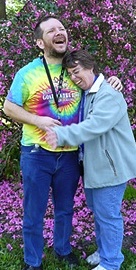
Donna & David July 2005 6 months post-TBI


(Disclaimer: The views or opinions in this post are solely that of the interviewee.)

If you would like to be a part of this project, please go to TBI Caregiver Interview Questionnaire for a copy of the questions and the release form.

(Photos compliments of ME.)

diemodi jewelry

uniquely hand-crafted jewelry by donna

Welcome to Harmony Kent Online

The home of all things books

Pete Springer

Passionate Teacher and Future Children's Author

HOPE TBI

Helping Other People Excel - To Be Independent

For the Love of Books, Old and New

Katie Fischer, Writer and Reader of Stories

Charlie Bown

Children's Author

Jessica Hinrichs

“We write to taste life twice, in the moment and in retrospect.” ― Anais Nin

VIVIAN KIRKFIELD - Writer for Children

Picture Books Help Kids Soar

Mindy’s Writing Wonderland

For authors, parents, teachers & everyone who loves children’s books.

Kaitlyn Leann Sanchez

Literary Agent

Surviving Traumatic Brain Injury

TBI - Survivors, Caregivers, Family, and Friends

The Care Factor

Loving someone with a Traumatic Brain Injury

Brain Injury Support Group of Duluth-Extension

Brain Injury Information and SUPPORT

Brain Aneurysm Global Insight

Brain Aneurysm, cerebral hemorrhaging, hemorrhage stroke