TBI – Survivors, Caregivers, Family, and Friends

Posts tagged ‘Donna O’Donnell Figurski’

SPEAK OUT! NewsBit . . . . . . . . . . . Military and Traumatic Brain Injury

The Military and Traumatic Brain Injury


Newsboy thIt has been said that traumatic brain injury is the signature wound of troops returning from the wars in Iraq and Afghanistan. Mild TBIs (mTBIs), many of which are concussions, constitute the majority of TBIs. Often an mTBI is invisible. Even the injured soldier may not be aware that he/she has an mTBI. Treatment, if it is obtained at all, is sometimes sought weeks or months later. mTBIs are common, but they can have serious consequences. The Military has increased its awareness of TBI. For example, they are supporting research to develop a hand-held eye-tracking device that will enable a troop with an mTBI to be diagnosed quickly in the field. It will help soldiers get immediate treatment, and it will prevent those troops from being sent back into the field. Here are two powerful videos (parts 1 and 2) of returning soldiers with a TBI and their families discussing their new lives. I have also provided a link to the Department of Defense’s material on TBI. (Videos Part 1 and Part 2) (DoD page)


SPEAK OUT! NewsBit . . . . . . . . . . The Silent Epidemic

Newsboy th


The Silent Epidemic


Here’s a months-old YouTube video released originally to increase awareness of TBI. The event advertised has passed, but this short (5 min 33 sec) video is still moving. It’s worth watching. (Video)


Survivors SPEAK OUT! Tabbie

 SPEAK OUT! – Tabbie

by

Donna O’Donnell Figurski

Tabbie Survivor MRI Photo 050215

Tabbie on her way into the MRI


1. What is your name? (last name optional)

Tabitha! But my friends and family call me Tabbie!

2. Where do you live? (city and/or state and/or country) Email (optional)

In the U.S!

3. When did you have your TBI? At what age?

I got my TBI back in September 2012, and I was 14 years old!

4. How did your TBI occur?

My TBI occurred during the warm-ups at an away volleyball game. A girl from the opposing team purposely served a ball at my face to get me out of the game.

5. When did you (or someone) first realize you had a problem?

My mom realized the next day, but she couldn’t take me to the doctor because it was a Saturday.

6. What kind of emergency treatment, if any, did you have?
(e.g., surgery,

tracheotomy, G-peg)

I didn’t get any. The first doctor I saw said it wouldn’t be possible for me to get a concussion from a volleyball.

7. Were you in a coma? If so, how long?

I don’t think so, but I don’t remember anything after I got hit until the next day.

8. Did you do rehab? What kind of rehab (i.e., In-patient or Out-patient and Occupational, Physical, Speech, Other)?
How long were you in rehab?

I saw a psychologist, but that’s it for any type of rehab!

9. What problems or disabilities, if any, resulted from your TBI?
(e.g., balance, perception, personality, etc.)

Balance, dizziness, lightheadedness, constant severe headache/migraines, poor concentration and focus, noise/light sensitivity, tiredness, memory

10. How has your life changed? Is it better? Is it worse?

It’s been a bit of both! It’s been mostly better right now, because I can do a bit more than I could since I got hit.

11. What do you miss the most from your pre-TBI life?

My way of exercising and learning/education

12. What do you enjoy most in your post-TBI life?

The people I’ve gotten to meet, the people I’ve gotten to help, and the fact they’ve allowed me into their life/journey!

13. What do you like least about your TBI?

The amount of extreme pain I’m always in

14. Has anything helped you to accept your TBI?

Yes! Prayer, acceptance of having a TBI, and forgiving the person who had caused all of this for me!

15. Has your injury affected your home life and relationships and, if so, how?

Yes. It’s hard to relay how I’m feeling to family, and I’m constantly tired.

16. Has your social life been altered or changed and, if so, how?

It has in weird ways! My friends became distant when I was homebound, but I’ve also gained tons of support through social media.

17. Who is your main caregiver?

My parents

Do you understand what it takes to be a caregiver?

I think I do for the most part, but all I can say is “God bless them” because I know it’s hard on then too.

18. What are your future plans? What do you expect/hope to be doing ten years from now?

I just want to be able to reach out and inspire as many people as I can in awareness and happiness! I’m not sure what I’ll be doing in ten years honestly, but I know it’ll be something great!

19. What advice would you offer to other TBI survivors

Not to lose hope and to know that you’re not alone in this. It’s a bumpy journey, but what you’ll get from it and the people you’ll meet are worth it!

Tabbie

Tabbie – doing what she loves – playing volleyball

20. Do you have any other comments that you would like to add?

If you ever need someone to talk to, you can follow my twitter account: @brainyblondegal (https://twitter.com/brainyblondegal). I’m always here to help!


Thank you, Tabbie, for taking part in this interview. I hope that your experience will offer some hope, comfort, and inspiration to my readers.

(Disclaimer: The views or opinions in this post are solely that of the interviewee.)

(Photo compliments of Tabbie.)

If you would like to be a part of the SPEAK OUT! project, please go to TBI Survivor Interview Questionnaire for a copy of the questions and the release form.

SPEAK OUT! NewsBit . . . . . . . . . . Men Take Longer to Recover From Concussions Than Women

Men Take Longer to Recover From Concussions Than Women


Newsboy thConcussions are common mild TBIs. With time, the brain often heals. A recent study showed that recovery from concussion was substantially shorter (average=26 days) in women than in men (average=67 days), regardless of the severity of the symptoms. Concussions affect the white matter of the brain. The neurologists used a special MRI scan to “see” the white matter. They found that men had more abnormalities in their white matter. The recovery time increased with the number of abnormalities. Why women have fewer abnormalities is not known. (Full story)


SPEAK OUT! NewsBit . . . . . . . . . . . . Football – Is It Dangerous to Your Brain?

Football May Affect the Brain


Newsboy thThe Journal of the American Medical Association has recently published a study of the brains of 25 University of Tulsa (TU) football players without a known concussion, 25 TU players known to have at least one concussion, and 25 college students who are non-players. The study showed that there was a correlation of years of playing football with differences in behavior and brain anatomy. The researchers found that football players had slower reaction times, and the reaction time was directly related to the length of time an individual played football. The researchers also found that the hippocampus in football players was smaller than it was in non-players. The hippocampus is a part of the brain whose volume is related to memory and emotion. Even players who did not have a concussion had a hippocampus that was smaller than it was in non-players, but there was a greater decrease in volume in those players who had had a concussion. This study does not prove that playing football causes a reduction of hippocampus volume, but it is suggestive. The researchers want to know what causes the smaller hippocampus. David Polanski, head athletic trainer at TU and a co-author on the study, said. “This research brings us one step closer to understanding the connection between contact sports and brain injury.” (Full story 1 and Full story 2)


SPEAK OUT! NewsBits ……………….. To Play or NOT to Play

Possibility of Brain Injury Causing Kids to Shun Some Sports


Newsboy th

Congresswoman Jan Schakowsky says that there are 300,000 sports-related TBIs annually in the US. Because many of our youth and their parents understand how much is at stake, even from mild concussions, some young players have walked away from a sport they love, rather than risk a life-altering injury. (Full story)


Caregivers SPEAK OUT! Francie Boothe

SPEAK OUT! – Francie Boothe

by

Donna O’Donnell Figurski

Francie Booth

Francie Boothe


1. What is your name? (last name optional)

Francie Boothe

2. Where do you live? (city and/or state and/or country)     Email? (optional)

North Attleboro, MA, USA     francieb18@gmail.com

3. What caused your survivor’s TBI?

My 16-year-old son fell off the back of his cousin’s truck.

4. On what date did you begin care for your TBI survivor? Are you the main caregiver? How old were you when you began care?

Nov. 27, 2013

My husband and I are the main caregivers.     I was 41.

5. Were you caring for anyone else at that time? (e.g., children, parents, etc.)

My 14-year-old daughter

6. Were you employed at the time of your survivor’s TBI? If so, were you able to continue working?

Yes, I was employed. No, I could not continue.

7. Did you have any help? If so, what kind and for how long?

I had help from my family.

8. When did your support of the survivor begin? (e.g., immediately – in hospital, when survivor returned home, etc.)

Immediately

9. Was your survivor in a coma? If so, what did you do at that time?

Yes. I sat in the pediatric ICU praying with family and friends.

10. Did your survivor have rehab? If so, what kind of rehab? (i.e., In-patient and/or Out-patient and Occupational, Physical, Speech, and/or Other) How long was the rehab? Where were you when this was happening?

Boothe, Francie Son 052214

Francie Boothe’s 16 year old son.

All rehab was In-patient therapy at the Spaulding Rehab in Charlestown, MA. He had occupational, physical, and recreational therapies and speech-language pathology.

11. What problems or disabilities of your TBI survivor required your care, if any?

Washing, dressing, eating, etc.

12. How has your life changed since you became a caregiver? Is it better? Is it worse?

It’s worse, but there are good days also.

13. What do you miss the most from pre-TBI life?

Normalcy. I miss my son’s being whole and healthy.

14. What do you enjoy most in post-TBI life?

I enjoy my son’s new outlook. His personality has changed – he’s much more personable.

15. What do you like least about TBI?

My son’s suffering and the family’s suffering

16. Has anything helped you to accept your survivor’s TBI?

Faith in God, prayer, family, and friends

17. Has your survivor’s injury affected your home life and relationships and, if so, how?

No, not really, but it does get crazy sometimes.

18. Has your social life been altered or changed and, if so, how?

Yes, I don’t have much of a social life, but I don’t care.

19. What are your plans? What do you expect/hope to be doing ten years from now?

I want my son to lead a normal life without infection or complications.

20. What advice would you offer other TBI survivor caregivers? Do you have any other comments that you would like to add?

Boothe, Francie & Son 052214

Francie Boothe and her son sharing special time.

Have faith. Be strong. Be patient. Take one day at a time. There will be good days and bad days.


Thank you, Francie, for taking part in this interview. I hope that your experience will offer some hope, comfort, and inspiration to my readers.


If you would like to be a part of this project, please go to TBI Caregiver Interview Questionnaire for a copy of the questions and the release form.

(Photo compliments of Francie.)

Disclaimer: The views or opinions in this post are solely that of the interviewee.

TBI Tales: Bittersweet is Today

(Reposted from my other blog – Donna O’Donnell Figurski’s Blog Jan. 13, 2011)

 Bittersweet! is Today!

It’s the mix of heavenly sweetness followed quickly by harsh reality. It’s pleasure mixed with pain. It’s happiness and regret. That’s bittersweet!

Bittersweet is today!

Today – six years ago on January 13, 2005, with no invitation, bittersweet moved in with David and me. He was an uninvited guest.

He ripped David’s and my lives apart. – Bitter!

We won’t let bittersweet beat us. We are building our lives up again – together. – Sweet!

David suffered a traumatic brain injury. He endured an operation that lasted about 5 to 6 hours. He wasn’t supposed to live – Bitter!

He lived! – Sweet!

David endured two more open-brain surgeries in less that two weeks and slept the sleep of coma for more than that. He wasn’t supposed to live. – Very Bitter!

After several weeks he began to respond to the world around him. He wiggled his toes and blinked his eyes. – Sweet!

For three months he was in hospitals learning to walk, learning to talk, learning to feed and dress himself again – learning to be a part of society. He desperately missed his job at Columbia University. He did not know when or if he would ever return. Bitter-very-bitter!

Columbia welcomed David back with an article about him in the newsletter of Columbia University called, In Vivo-CUMC At Large. Very Sweet!

And by conferrring upon him in 2006, at the Medical School Commencement, the Charles Bohmfalk Award for teaching in clinical years. Sweet! Sweet! Sweet!

David still has difficulty walking, talking, swallowing, and seeing. His right arm shakes erratically. He remains a prisoner of his body. Bitter-oh-so-bitter!

He wont let anything get him down. Life has become as normal as it can with all of these disabilities. He exercises to strengthen his body. He works to strengthen his mind. Improvements are being made – slowly, but they come. Sweet!

David has lived six years longer than any of his doctors expectations. Sweet! Oh-so-Sweet!

I have my best friend with me. Sweet! Sweet! Sweet!

Bittersweet move over. There is not enough room in our lives for you.

(Picture compliments of ME)

Survivors SPEAK OUT! . . . . . . . . . . . Carmen Kumm

SPEAK OUT! – Carmen Kumm

by

Donna O’Donnell Figurski
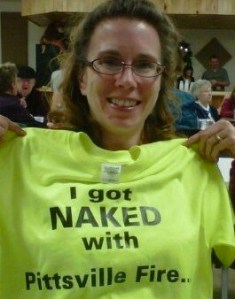
Kumm, Carmen 050514

Carmen with a T-shirt from the firefighters who helped to save her life

1. What is your name? (last name optional)

Carmen Kumm

2. Where do you live? (city and/or state and/or country) Email (optional)

Pittsville, WI, USA    cjkumm87@gmail.com

3. When did you have your TBI? At what age?

July 19, 2010     Age 41

4. How did your TBI occur?

I was T-boned in a car accident.

5. When did you (or someone) first realize you had a problem?

When I was in the hospital

6. What kind of emergency treatment, if any, did you have?
(e.g., surgery,

tracheotomy, G-peg)

I was airlifted to Marshfield hospital. I was treated for broken bones, but I’m not sure about surgery. I had a tracheotomy, and I was in a drug-induced coma.

7. Were you in a coma? If so, how long?

I was unable to respond or know who I was for about 2 ½ months.

8. Did you do rehab? What kind of rehab (i.e., In-patient or Out-patient and Occupational, Physical, Speech, Other)?
How long were you in rehab?

I did In-patient and Out-patient therapy. I had occupational, physical, and speech therapies. I think it was about 8 months after my accident.

9. What problems or disabilities, if any, resulted from your TBI?
(e.g., balance, perception, personality, etc.)

Memory, personality, temperament

10. How has your life changed? Is it better? Is it worse?

I worked so hard to be a high-school Spanish teacher again. That’s what I believe got me to how well I’m doing now. On May 2, 2013, I hit a student (sophomore boy) because he was “egging” me on, and he knew it. Then he reported me to the administration. Rather than let them fire me, I resigned after 25 years – 2 ½ years post-accident. I was so very angry afterwards. I believe up until about 6 months ago I was still angry, but now I love my life. There are days when I struggle, but, if I choose to take care of myself first, I get better.

11. What do you miss the most from your pre-TBI life?

My ability to do more than one thing at a time

12. What do you enjoy most in your post-TBI life?

I enjoy my family much more.

13. What do you like least about your TBI?

Fatigue

14. Has anything helped you to accept your TBI?

Honestly, God has done so much in my life as of late, or maybe I’m listening now.

15. Has your injury affected your home life and relationships and, if so, how?

My youngest daughter was 10 when my accident happened, and I wasn’t a very nice person for a long time. Our relationship struggled, but as of late it has improved. My eldest daughter had taken much of the responsibility for my three other kids, so I had to make sure she was reminded that she no longer needed to be the mom. That has greatly improved as of late – I don’t think I’ve had to tell her that in about 3 months. My youngest son was only 4 at the time, and we struggled too. I was so mean for a couple of years that he didn’t trust me, but that is returning too.

16. Has your social life been altered or changed and, if so, how?

No, I still have all the friends I had before and maybe more.

17. Who is your main caregiver? Do you understand what it takes to be a caregiver?

My husband is my main caregiver. My parents even moved for about 4 months to be closer to me.

18. What are your future plans? What do you expect/hope to be doing ten years from now?

I am working part-time at a local post office. In 10 years I will be 55. I’m not sure what my plans are. I hope to have an almost empty nest.

19. What advice would you offer to other TBI survivors

Accept that you now have a new life to start and rejoice in it. Plan your days and plan for disaster and what you will do if it doesn’t go as planned. Have a back-up plan. Always assume it won’t go well so that you will know what to do if it doesn’t work.

20. Do you have any other comments that you would like to add?

Depression is something that I didn’t allow myself to acknowledge. Now I know it’s an issue for me, so I’m constantly working to keep it at bay. I try not to worry about things that I don’t have control over. I can’t waste my energy on that. It’s a commodity that needs to be saved. I know when I’m struggling too much that I need to stop and put myself first, and others will follow suit. For example, I’m too tired tonight, and my morning will be hard, so I’m taking care of myself tonight and my son is making his lunch for tomorrow.


Thank you, Carmen, for taking part in this interview. I hope that your experience will offer some hope, comfort, and inspiration to my readers.

(Disclaimer: The views or opinions in this post are solely that of the interviewee.)


If you would like to be a part of the SPEAK OUT! project, please go to TBI Survivor Interview Questionnaire for a copy of the questions and the release form.

 

SPEAK OUT! NewsBits . . . . . . . . . . . Stem Cells, MS, and TBI – Strange Bedfellows

Stem Cells, MS, and TBI – Strange Bedfellows

Newsboy th

Multiple sclerosis (MS) is thought to cause weakness and paralysis by an immune reaction that attacks myelin, which forms a protective sheath around nerves. A surprising result was found after implanting human neural stem cells into the brains of mice with an MS-like disease. As expected, the human cells were rejected and disappeared within a week. But, the treated MS mice could now walk and continued to do so. Scientists believe that the human stem cells released a protein that signaled the mouse neurons to repair their myelin sheaths. This is great news for people with MS. But, what other signals were released? Might a released signal help damaged neurons of TBI survivors? The excitement over a signal means that you don’t have to implant cells. Once the signal is understood, it should be possible to design a therapeutic drug that does the same thing. (Full story and video)

diemodi jewelry

uniquely hand-crafted jewelry by donna

Welcome to Harmony Kent Online

The home of all things books

Pete Springer

Passionate Teacher and Future Children's Author

HOPE TBI

Helping Other People Excel - To Be Independent

For the Love of Books, Old and New

Katie Fischer, Writer and Reader of Stories

Charlie Bown

Children's Author

Jessica Hinrichs

“We write to taste life twice, in the moment and in retrospect.” ― Anais Nin

VIVIAN KIRKFIELD - Writer for Children

Picture Books Help Kids Soar

Mindy’s Writing Wonderland

For authors, parents, teachers & everyone who loves children’s books.

Kaitlyn Leann Sanchez

Literary Agent

Surviving Traumatic Brain Injury

TBI - Survivors, Caregivers, Family, and Friends

The Care Factor

Loving someone with a Traumatic Brain Injury

Brain Injury Support Group of Duluth-Extension

Brain Injury Information and SUPPORT

Brain Aneurysm Global Insight

Brain Aneurysm, cerebral hemorrhaging, hemorrhage stroke